
The Modern Nèi Jīng
The Huáng Dì Nèi Jīng is the foundational text of Chinese medicine, written over 2,000 years ago as a dialogue between the Yellow Emperor and his physician Qí Bó.
This project reimagines all 81 chapters of the Sù Wèn for a 2026 audience — addressing modern diets, screen habits, chronic stress, and environmental toxins — while preserving the original classical passages as footnotes for scholarly reference.
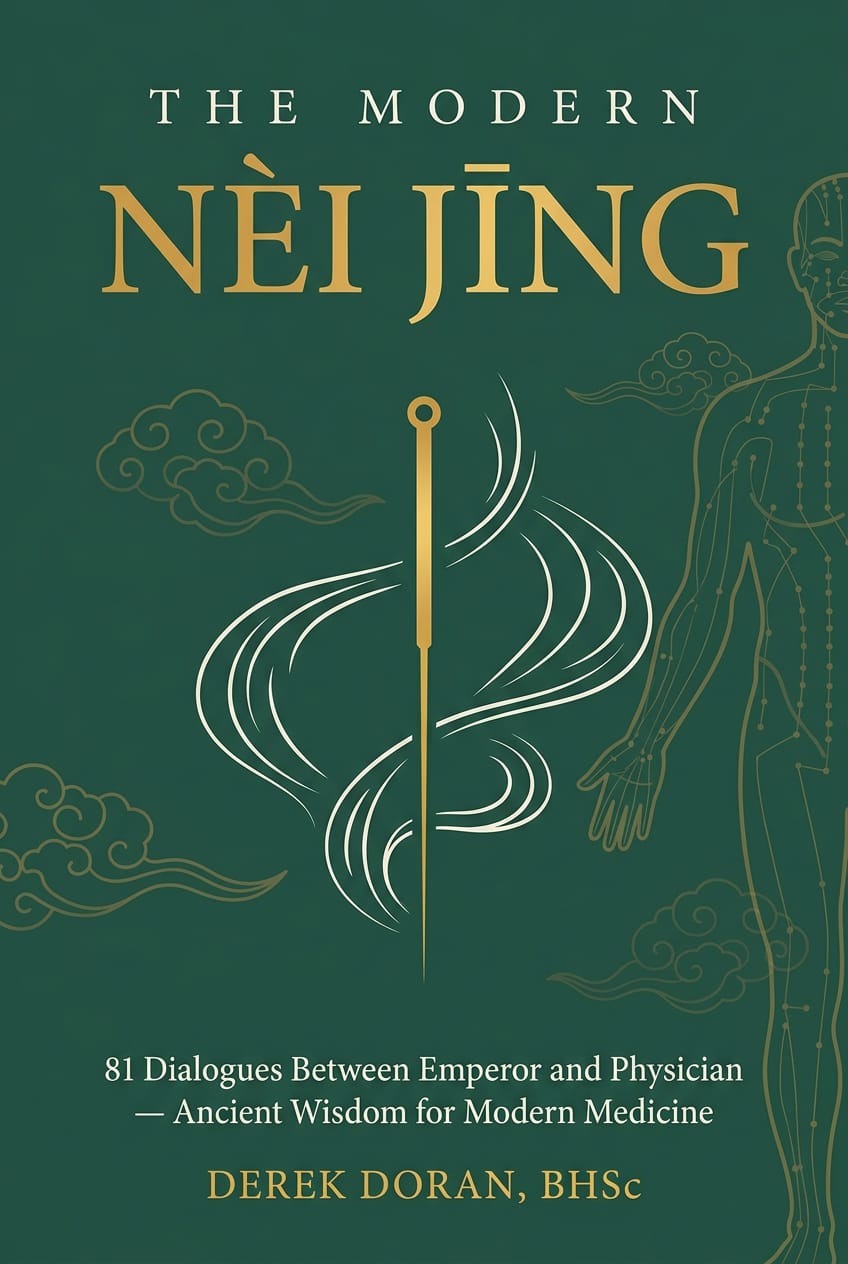
Digital Ebook — Available Now
The Modern Nèi Jīng — The Book
All 81 chapters of the Sù Wèn reimagined as a beautifully typeset digital volume. One purchase includes both formats — ancient wisdom meets modern medicine.
Includes PDF (best for print & desktop) + EPUB (Kindle, Apple Books, eReaders)
Published Chapters
上古天真論 · Shàng Gǔ Tiān Zhēn Lùn
Why Our Ancestors Lived to 100 (And We Burn Out at 35)
The Yellow Emperor asks why ancient people lived long, vibrant lives while modern people age prematurely. Qí Bó explains that the ancients lived in harmony with nature's rhythms — and what that means in an age of blue-light screens, ultra-processed food, and chronic stress.
四气调神大论 · Sì Qì Tiáo Shén Dà Lùn
Your Body Has Four Modes — And You're Stuck on One
This chapter reveals that health depends on living in rhythm with the seasons. Spring is for expansion, summer for expression, autumn for letting go, winter for conservation. Modern life forces us into perpetual summer mode — always producing, always 'on' — and we pay the price.
生气通天论 · Shēng Qì Tōng Tiān Lùn
You Are Not Separate From Your Environment
This chapter explores how human vitality (Yang Qi) mirrors the sun's energy. When your protective Qi is compromised — by poor sleep, chronic stress, or toxic exposures — pathogens enter freely. A guide to understanding your body's defence system in the modern world.
金匱真言論 · Jīn Guì Zhēn Yán Lùn
Your Five Organ Systems Are Running Your Metabolism — Here's How
The Yellow Emperor asks Qí Bó to reveal the 'golden casket' secrets of the five Zàng organs. The conversation maps ancient organ theory onto modern metabolic health — insulin resistance, fatty liver, thyroid dysfunction, and the gut-brain axis — showing that the classical five-organ framework anticipated problems Western medicine is only now connecting.
阴阳应象大论 · Yīn Yáng Yìng Xiàng Dà Lùn
Hormonal Balance Is Just Yin and Yang — Your Body Already Knows
Chapter 5 is one of the most important in the entire Nèi Jīng. The Yellow Emperor and Qí Bó explore how Yin and Yang govern every physiological process — from hormonal rhythms and circadian biology to the interplay of structure and function, rest and activity, cooling and warming. Modern endocrinology, chronobiology, and autonomic nervous system science are all prefigured here.
陰陽離合論 · Yīn Yáng Lí Hé Lùn
When Your Immune System Turns Against You — Autoimmunity Is Yin-Yang Divorce
The Yellow Emperor asks what happens when Yin and Yang, normally inseparable, begin to separate. Qí Bó explains how the Three Yin and Three Yang channels represent gradients of immune response — and how autoimmune disease occurs when the body's defensive Yang loses the ability to distinguish self from other, attacking its own Yin structures.
陰陽別論 · Yīn Yáng Bié Lùn
Your Body Is Always Talking — A Diagnostic Framework for Reading Its Signals
The Yellow Emperor asks how a physician can know what is happening inside the body without opening it up. Qí Bó reveals the classical diagnostic framework: reading the pulse, the complexion, the voice, the emotions, and the quality of sleep and digestion as a unified signal — and how this maps to modern biomarkers and functional medicine testing.
灵兰秘典论 · Líng Lán Mì Diǎn Lùn
Your Body Is a Government: The Twelve Officials and Why Burnout Is a Leadership Crisis
The Sù Wèn's most famous metaphor: the organs as government officials, each with a specific role. When the Heart-Emperor loses clarity, the entire administration collapses. A masterclass in systems thinking applied to human health — and why treating symptoms in isolation always fails.
六节脏象论 · Liù Jié Zàng Xiàng Lùn
Reading the Body's Weather Report: How Organs Manifest on the Surface
How do internal organ states reveal themselves externally? Chapter 9 explains the concept of Zàng Xiàng — the idea that each organ has visible, audible, and palpable surface manifestations. Your patient's skin, hair, nails, voice, and body odour are not cosmetic details — they are diagnostic data.
五脏生成 · Wǔ Zàng Shēng Chéng
You Are What You Absorb: How the Organs Build (and Rebuild) Each Other
The five Zang organs don't just coexist — they generate, nourish, and restrain each other in a continuous cycle. Chapter 10 explores how the body constructs and maintains itself, why deficiency in one organ inevitably affects another, and what 'the five colours appearing on the face' reveals about prognosis.
五臟別論 · Wǔ Zàng Bié Lùn
Your Organs: A Deep Dive into Storage & Transformation
This chapter explores the fundamental differences between Zang (solid, storing) and Fu (hollow, transforming) organs, introducing the concept of 'extraordinary Fu'. It bridges ancient wisdom with modern trends like gut health and functional anatomy, explaining each organ's unique role in maintaining vitality.
異法方宜論 · Yì Fǎ Fāng Yí Lùn
The Geo-Bio-Social Blueprint: Personalizing Wellness in a Globalized World
This chapter explores how diverse geographical, climatic, and societal factors in 2026 shape health and disease. Qí Bó guides Huáng Dì through the modern manifestation of regional specificities, advocating for a deeply personalized approach to health that integrates ancient wisdom with contemporary scientific understanding.
移精變氣論 · Yí Jīng Biàn Qì Lùn
Digital Distress, Ancient Wisdom: Reclaiming Our Inner Harmony
This chapter explores how modern complexities, from digital overload to environmental stressors, have complicated disease patterns compared to ancient times. It emphasizes the profound impact of a patient's mental state and the physician's diagnostic prowess, particularly through pulse and observation, in navigating these intricate health challenges and guiding individuals back to spiritual and physical equilibrium.
湯液醪醴論 · Tāng Yè Láo Lǐ Lùn
Alchemy of Adaptation: When the Body's Waters Run Dry (or Overflow)
Huáng Dì questions the ancient reliance on simple remedies given today's complex ailments. Qí Bó explains how modern stressors disrupt the body's fluid metabolism, leading to deeper pathologies previously held at bay. They discuss the critical role of the Zàng in regulating internal waters amidst a world of chronic stress and biohacking fads.
玉版論要 · Yù Bǎn Lùn Yào
Digital Demeanor: Decoding Sickness in the Screen Age
In this chapter, Huáng Dì and Qí Bó explore the enduring relevance of complexion diagnostics in an era saturated with digital interfaces and environmental stressors. They bridge ancient wisdom regarding vital signs with modern understanding of how lifestyle factors impact the body's outward manifestations, especially when evaluating life or death scenarios.
診要經終論 · Zhěn Yào Jīng Zhōng Lùn
SEASONAL SYNCHRONICITY: OPTIMIZING THERAPIES IN A DATA-DRIVEN WORLD
This chapter explores the profound impact of seasonal alignment on therapeutic interventions, particularly acupuncture. It delves into the precise timing and channel selection for needling methods across seasons, contrasting these ancient principles with modern health tech and diagnostic trends, while also examining the critical signs of severe channel dysfunction.
脈要精微論 · Mài Yào Jīng Wēi Lùn
Decoding the Biofeedback: The Pulse, Wearables, and the AI Doctor Within
This chapter re-examines the ancient art of pulse diagnosis through a modern lens, exploring how contemporary health tech, from wearables to AI diagnostics, both complements and challenges the subtle, intuitive wisdom of traditional observation. It delves into the circadian rhythm's impact on diagnostic accuracy, the profound connection between dreams and organ health, and the enduring significance of facial complexion in an era saturated with digital data.
平人氣象論 · Píng Rén Qì Xiàng Lùn
The Pulse of Being Human: A Digital Age Diagnostic
In an era of hyper-connected health data, how do we discern true vitality from mere biometric readings? This chapter re-examines the foundational concept of 'Stomach Qi' as the ultimate biomarker for health, exploring how even the most advanced AI falls short without understanding this fundamental principle of dynamic balance.
玉機真臟論 · Yù Jī Zhēn Zàng Lùn
The Algorithm of Qi: Reading Your Body's Bio-Rhythms Before the Final Glitch
This chapter explores the sophisticated interpretation of physiological signals, specifically the pulse, as indicators of health and looming pathology. It bridges ancient diagnostic wisdom with modern bio-tracking technologies, emphasizing the predictive power of subtle shifts in the body's internal rhythms and the critical role of 'Stomach Qi' (digestive and adaptive vitality) in preventing collapse.
三部九候論 · Sān Bù Jiǔ Hòu Lùn
Beyond the Wearable: The Body's Own AI-Engine
In an era saturated with digital health metrics, Huáng Dì challenges Qí Bó to explain how the ancient art of pulse diagnosis can still offer profound insights, surpassing even the most advanced AI. This chapter explores the body's inherent wisdom and its nuanced 'data points' that reveal health far beyond what external gadgets can capture.
經別論 · Jīng Bié Lùn
The Body's Hidden Networks: Redundant Systems and Stored Trauma
Huáng Dì and Qí Bó discuss the Jīng Bié (divergent meridians) as the body's hidden, redundant communication networks. They explore how these deeper pathways, distinct from the primary channels, act as critical backups, store emotional and physical trauma within fascial tissues, and play a pivotal role in resilience—much like an advanced, self-healing cloud infrastructure.
藏氣法時論 · Zàng Qì Fǎ Shí Lùn
The Rhythms of Zang: Seasonal Sync in the Biohacker’s Age
Huáng Dì questions how ancient principles of seasonal living apply in a world obsessed with year-round availability and climate control. Qí Bó explains the enduring wisdom of Zàng Qi seasonal dominance and how internal rhythms still respond, even when external cues are muted, emphasizing mindful living and dietary choices over artificial consistency.
宣明五氣論 · Xuān Míng Wǔ Qì Lùn
The Digital Diet of Organ-Qi: Likes, Dislikes, and the Algorithmic Body
Huáng Dì and Qí Bó explore how our modern lifestyles – from screen time to dietary fads – interact with the ancient concept of the five organ-qi preferences and aversions, revealing the subtle ways our digital habits impact our internal balance.
血氣形志論 · Xuè Qì Xíng Zhì Lùn
The Digital Self and the Embodied Soul: Decoding Form, Flow, and Feeling
Huáng Dì questions the obsessive pursuit of perfect digital avatars and idealized physiques, leading Qí Bó to explain how the ancient principles of Xuè (Blood), Qì (Qi), Xíng (Form), and Zhì (Spirit) illuminate modern phenomena like body dysmorphia, fitness culture's extremes, and the intricate connection between our posture and our mental state.
寶命全形論 · Bǎo Mìng Quán Xíng Lùn
The Digital Dao of the Needle: A Surgeon's Sacred Touch
Huáng Dì and Qí Bó explore the profound responsibility of the healer, comparing ancient needling arts to modern surgery. They discuss the sacred trust involved, the five essential prerequisites for effective intervention, and the holistic vision of preserving the 'whole form' in an era of specialized medicine.
八正神明論 · Bā Zhèng Shén Míng Lùn
The Chronos Codex: Aligning the Therapeutics of the Cosmos
Huáng Dì questions Qí Bó on the subtle art of chronotherapy, exploring how celestial rhythms—from lunar cycles to solstices—profoundly influence the efficacy of medical interventions. They discuss bridging ancient 'cosmic timing' with modern circadian science and why the 'right' treatment at the 'wrong' time might fail.
離合真邪論 · Lí Hé Zhēn Xié Lùn
Friendly Fire: The Identity Crisis Within
This chapter reinterprets the classical struggle between righteous (Zhen) and pathogenic (Xie) qi as the modern phenomenon of autoimmune disease. It explores how the body's defense system can lose its way due to post-viral triggers like long COVID, microbiome disruption, and molecular mimicry, leading to a state of internal civil war where the body attacks itself.
通評虛實論 · Tōng Píng Xū Shí Lùn
The Burnout-Inflammation Paradox: Beyond Supplements
Huáng Dì questions Qí Bó about modern health fads and the indiscriminate use of supplements. Qí Bó explains the core principles of Deficiency (Xū) and Excess (Shí) in the context of contemporary ailments like burnout and chronic inflammation, warning against the dangers of misapplication and the pursuit of quick fixes when the body fundamentally needs balance, not just more 'stuff.'
太陰陽明論 · Tài Yīn Yáng Míng Lùn
The Digester & The Deliverer: Your Gut's Power Duo
Huáng Dì and Qí Bó delve into the quintessential partnership of the Spleen (Tài Yīn) and Stomach (Yáng Míng), reframing ancient TCM insights into the language of modern gut health, metabolic function, and the pervasive impact of diet and lifestyle. They explore how this foundational duo drives everything from nutrient assimilation to energy production, offering a potent counterpoint to contemporary concerns like leaky gut and metabolic syndrome.
陽明脈解論 · Yáng Míng Mài Jiě Lùn
The Furnace Within: Navigating the Yang Ming's Abundance and Its Fevers
This chapter explores the formidable nature of the Yang Ming channel, often seen as the 'furnace' of the body. We delve into how its abundant Qi and Blood manifest as both vital energy and potent heat, leading to discussions on fever, inflammation, and the gut-brain axis. The dialogue bridges ancient wisdom on 'burning through pathogens' with modern perspectives on anti-inflammatory treatments, cytokine storms, and contemporary 'fever phobia'.
熱論 · Rè Lùn
Let It Burn? Navigating 'Fever Phobia' in the Age of Ibuprofen
Emperor Huáng Dì, alarmed by his wearable's temperature spike, questions the modern impulse to immediately suppress fevers. Qí Bó explains the role of fever as a righteous battle between the body's protective Qi and external pathogens, distinguishing between beneficial fevers and dangerous hyperthermia.
刺熱論 · Cì Rè Lùn
Beyond Antibiotics: Needling Your Way to Immune Resilience
As headlines scream about antibiotic-resistant superbugs, Huáng Dì wonders about alternative defenses. Qí Bó reveals the ancient art of using acupuncture not just for pain, but to strategically guide the immune response, vent pathogenic heat, and fortify the body's internal terrain.
評熱病論 · Píng Rè Bìng Lùn
The Ghost in the Machine: Decoding Long COVID and Post-Infectious Syndromes
Huáng Dì is baffled by subjects who test negative for a virus but remain plagued by symptoms like brain fog and fatigue. Qí Bó explains the concept of 'lingering pathogenic factor' (餘邪), an ancient diagnosis that perfectly describes the modern phenomenon of post-viral syndromes.
逆調論 · Nì Tiáo Lùn
When 'Help' Hurts: Navigating Polypharmacy and Treatment Side Effects
Huáng Dì reviews patient charts filled with dozens of medications, each prescribed to fix the side effects of another. Qí Bó uses the concept of 'counterflow' (逆) to explain iatrogenic harm and how treatments that oppose the body's natural state can create more disease than they cure.
瘧論 · Nüè Lùn
Not Just Malaria: Decoding Autoimmune Flares and Chronic Fatigue Cycles
Huáng Dì observes patients whose illnesses come and go with a frustrating rhythm, like autoimmune flares or ME/CFS crashes. Qí Bó explains that the ancient understanding of malaria, a disease of recurring chills and fever, provides a perfect model for any cyclical illness where a pathogen hides and re-emerges.
刺瘧論 · Cì Nüè Lùn
Timing Is Everything: Acupuncture, Chronobiology, and Breaking the Cycle
Intrigued by the cyclical nature of chronic illness, Huáng Dì asks how to intervene effectively. Qí Bó explains the critical importance of timing in acupuncture, describing how needling just before a predicted flare-up can intercept the pathogen and break the cycle of recurring symptoms.
氣厥論 · Qì Jué Lùn
When Your System Crashes: Understanding Panic Attacks, Fainting, and Dysautonomia
Huáng Dì is concerned about sudden episodes of fainting, dizziness, and overwhelming anxiety. Qí Bó explains these as 'Qì Reversal' (氣厥), where energy flows chaotically, providing a framework for modern diagnoses like panic attacks, vasovagal syncope, and POTS.
咳論 · Ké Lùn
The Lingering Cough: More Than Just Lungs... Let's Talk Gut, Nerves, and Stress
Huáng Dì is annoyed by a persistent, tickling cough his physicians can't solve. Qí Bó reveals that not all coughs originate in the Lungs, explaining how they can be linked to the Liver (stress), Spleen (gut), and Kidneys (exhaustion), offering a framework for the modern mystery of chronic refractory cough.
舉痛論 · Jǔ Tòng Lùn
Unlocking the Pain Code: Beyond Opioids to Flow, Temperature, and Emotion
Facing an empire plagued by chronic pain and the dangers of opioid dependency, Huáng Dì seeks a more sustainable solution. Qí Bó explains that all pain is rooted in a lack of free flow ("Bù Tōng Zé Tòng"), decoding how different qualities of pain reveal their cause—be it cold, heat, stagnation, or even strong emotion.
腹中論 · Fù Zhōng Lùn
The Bloating Epidemic: Your Gut as an Ecosystem, Not a Machine
Huáng Dì is distressed by widespread digestive complaints of bloating, gas, and unpredictable bowels. Qí Bó explains the abdomen not as parts, but as a central cauldron whose function depends on the 'digestive fire' of the Spleen and Stomach, providing a lens for modern issues like IBS, SIBO, and food sensitivities.
腰痛論 · Yāo Tòng Lùn
Modern Nèi Jīng, Chapter 41: 腰痛論 (Yāo Tòng Lùn) — Treatise on Lumbar Pain
Huangdi and Qibo revisit lumbar pain amid the desk-job epidemic: sitting marathons, sciatica, and herniated discs. They map classical patterns—kidney deficiency, cold-damp, and strain—onto modern biomechanics, neuroinflammation, and workplace ergonomics, offering practical prevention, red flags, and integrated care.
風論 · Fēng Lùn
Modern Nèi Jīng — Chapter 42: Fēng Lùn (Treatise on Wind Conditions)
Wind as the fleet messenger of disease: a metaphor for immune volatility and viral triggers. This chapter reframes classical ‘wind’ as the rapid, shifting dynamics of host–pathogen interactions, barrier breaches, and autoimmune flares—where movement, changeability, and ‘upper-first’ invasion mirror cytokine storms, neuro-immune dysregulation, and molecular mimicry. Strategy: guard the surface, quiet the wind, and settle the root—integrating antivirals, immunomodulation, and terrain-focused care.
痹論 · Bì Lùn
Modern Nèi Jīng, Chapter 43 — 痹論 (Bì Lùn): On Impediment and the Storms Within
Huangdi and Qibo revisit Bì (impediment) through the lens of autoimmune arthritis and chronic widespread pain. Wind, cold, and damp map to triggers, immune misfire, and tissue swelling; wei qi aligns with innate immunity and barriers. They parse rheumatoid arthritis, fibromyalgia, and the disbelief that shadows wandering pain, then sketch integrative care: warmth and movement, sleep and mood regulation, acupuncture and moxibustion, alongside DMARDs and biologics when needed.
痿論 · Wěi Lùn
Modern Nèi Jīng · Chapter 44: Wěi Lùn — Treatise on Atrophy in the Age of Long Fatigue
Atrophy (wěi) arises when lingering internal heat desiccates fluids and the five viscera fail to nourish their tissues: lung-skin, spleen-muscle, liver-tendon, heart-vessel, kidney-bone. Mapped to modern syndromes—Long COVID fatigue, ME/CFS, sarcopenia, post-viral weakness—this chapter links residual inflammation, autonomic drift, microcirculatory dryness, and deconditioning with classical patterns. Treatment blends clearing remnant heat, restoring fluids, and fortifying the Yangming ‘granary’ with modern pacing, protein and resistance training, and sleep-circadian repair.
厥論 · Jué Lùn
Modern Nèi Jīng, Chapter 45: 厥論 (Jué Lùn) — Treatise on Reversal Conditions
Reversal conditions (厥) appear when the body's up–down traffic loses coordination: the extremities go cold, the spirit dims, and posture betrays the brain. Classical ‘qi inversion’ maps neatly onto modern dysautonomias—POTS, vasovagal syncope, and broader autonomic dysfunction. We read baroreflexes as palace stewards of ascent and descent, relate tilt-table findings to the ancient axis of rise and fall, and pair urgent rescue (branch) with rehabilitation of the circuit (root): fluids, salt, compression, graded training, breath, and when needed, medicines that steady rate, volume, and tone.
病能論 · Bìng Néng Lùn
Modern Nèi Jīng, Chapter 46: 病能論 — Treatise on Pathogenic Qi and Zang-Fu Disease
Huangdi and Qibo revisit Bing Neng Lun to decode how invisible pathogenic qi manifests as functional syndromes—patterns of breath, voice, sensation, and mood—when structure appears normal. They bridge five-zang ‘capabilities’ to modern network physiology, discussing interoception, autonomic reactivity, central sensitization, brain–gut cross-talk, and therapeutic strategies for medically unexplained symptoms and somatic symptom disorder.
奇病論 · Qí Bìng Lùn
Chapter 47: 奇病論 — Treatise on Extraordinary Diseases
Huangdi and Qibo revisit the Su Wen’s discourse on 奇病—conditions that slip past ordinary categories—to illuminate today’s rare diseases and diagnostic odysseys. They map Ehlers-Danlos to the slackened ‘fabric’ of jingluo, mast cell activation to hidden fire and errant wind within the blood-halls, and POTS-like orthostatic symptoms to uprising qi akin to奔豚. They argue that the art is to see patterns across systems, integrating modern genomics, immunology, and autonomics with classical principles of root-branch and the governance of networks.
大奇論 · Dà Qí Lùn
Modern Nèi Jīng, Chapter 48: 大奇論 (Dà Qí Lùn) — Treatise on Great Extraordinary Discourse
In the liminal space between life and death—the modern resuscitation bay—the Treatise on Great Extraordinary Discourse reframes ‘great extraordinaries’ as the rare, dangerous thresholds where physiology unravels. Through sharp, humane dialogue, the text maps ABCs to qi, breath, and pulse; reads ominous signs without arrogance; balances heroic measures with compassionate limits; and counsels prognostic humility when outcomes are uncertain. It offers principles for critical care, emergency medicine, and end-of-life practice, grounded in the Su Wen’s warnings about the sounds, colors, and pulses that portend collapse.
脈解論 · Mài Jiě Lùn
Modern Nèi Jīng 49: 脈解論 — Treatise on Pulse Explanations in the Age of Wearables
Huangdi and Qibo revisit the art of pulse diagnosis through the lens of wearable biometrics: HRV, single‑lead ECG, and PPG-derived metrics. They map cun‑guan‑chi to modern sampling sites and time windows, relate classical pulse images to autonomic balance, and contrast arrhythmias in Apple Watch ECG with the classical ‘jie, dai, cu’ patterns. The dialogue shows how data streams can extend, not replace, the subtle clinical synthesis the classics demand.
刺要論 · Cì Yào Lùn
Modern Nèi Jīng · Chapter 50 — 刺要論 (Cì Yào Lùn): Precision at the Smallest Dose
Huangdi and Qibo revisit the Essential Treatise on Needling to frame precision medicine: wait for the right signal before acting, individualize dose by constitution and season, and stop at sufficiency. They contrast minimal effective intervention with the harms of overtreatment and polypharmacy, mapping deqi to actionable biomarkers, shallow–deep to dose–response, and timing to chronotherapy.
刺齐论 · Cì Qí Lùn
The End of 'One-Size-Fits-All': Precision Medicine, Ancient & Modern
Huáng Dì questions the idea of a universal treatment protocol, prompting Qí Bó to explain why therapy must be precisely calibrated to an individual's unique constitution, age, and condition. This chapter bridges the classical art of personalizing acupuncture with the modern science of bespoke medicine, emphasizing that true healing lies in tailored intervention, not standardized formulas.
刺禁论 · Cì Jìn Lùn
Red Flags & No-Fly Zones: The Art of Knowing When NOT to Needle
Huáng Dì expresses concern over the potential dangers of acupuncture, leading Qí Bó to detail the critical importance of contraindications. By mapping classical prohibitions onto modern anatomical danger zones and physiological states of vulnerability, this chapter underscores that a master physician's first duty is safety and risk assessment.
刺志论 · Cì Zhì Lùn
Mind Over Matter: How the Clinician's Intention Changes Patient Outcomes
Huáng Dì probes the seemingly mystical concept of a practitioner's intent, asking if it truly impacts treatment. Qí Bó provides a powerful defense of this idea, framing it within the modern context of the therapeutic alliance, the placebo effect, and the neurobiology of expectation. This chapter reveals how the physician's focused mind (Zhì) is not magic, but a potent, measurable tool in the clinical encounter.
针解 · Zhēn Jiě
Acupuncture Deconstructed: How Needles Reprogram Your Body's Software
Seeking a mechanistic explanation, Huáng Dì asks what physically occurs when a needle is inserted. Qí Bó demystifies the process, translating classical concepts like 'De Qi' into modern neurophysiological language, describing the stimulation of nerve fibers, the release of endogenous chemicals, and the powerful regulatory effect on the central nervous system.
长刺节论 · Cháng Cì Jié Lùn
Hacking Chronic Pain: Deep Needling and Myofascial Chains
Huáng Dì asks about treating stubborn, deep-seated pain that superficial methods can't touch. Qí Bó introduces the concept of 'long needling' (長刺), drawing a direct line from ancient techniques for deep blockages to modern trigger point therapy and the needling of myofascial planes to release chronic tension and resolve referred pain patterns.
皮部论 · Pí Bù Lùn
The Body's Dashboard: Decoding Health Signals from Your Skin
Huáng Dì observes a correlation between a skin anomaly and an internal complaint, prompting Qí Bó to explain the classical theory of the twelve Skin Regions (皮部). This chapter illuminates how the skin acts as a diagnostic map, linking specific surface areas to the health of internal channel systems and organs, a concept mirrored in the modern understanding of dermatomes and viscero-cutaneous reflexes.
经络论 · Jīng Luò Lùn
The Body's Information Superhighway: Are Meridians the Neural and Fascial Networks?
Huáng Dì poses the ultimate question: are channels and collaterals (Jing Luo) physically real? Qí Bó provides a nuanced answer, describing them not as single, visible structures but as functional pathways that integrate the body's systems. He draws powerful parallels to modern discoveries in fascia research, interoceptive nerve pathways, and systems biology, reframing the Jing Luo as the body's original information superhighway.
气穴论 · Qì Xué Lùn
The Body's Control Panels: What Makes an Acupoint a 'Point'?
Huáng Dì questions the specificity of acupoints, asking what makes one small spot on the body therapeutically potent while an adjacent spot is not. Qí Bó explains that 'Qi points' (Qi Xue) are not arbitrary marks but are anatomical and bioelectrical hotspots. He likens them to control nodes on a network, often located in depressions over neurovascular bundles, where a precise stimulus can create a powerful systemic effect.
气府论 · Qì Fǔ Lùn
The Body's Bioelectric Grid: Mapping the Qi Network
This chapter reimagines the classical concept of 'Qi Mansions' as nodes in the body's complex bioelectric and fascial network. It explores how these hundreds of acupuncture points act as critical communication hubs, regulating physiological processes from the cellular to the systemic level.
骨空论 · Gǔ Kōng Lùn
Deep Tissue Interface: Bone, Marrow, and Chronic Disease
This dialogue explores the 'Bone Cavities' as critical interfaces between the skeletal system, bone marrow, and surrounding tissues. It connects the classical strategy of treating deep, persistent diseases with modern concepts of osteoimmunology, stem cell biology, and the role of bone as an endocrine organ.
水热穴论 · Shuǐ Rè Xué Lùn
Thermoregulation and Fluid Dynamics: The Body's Coolant System
This chapter reinterprets the classical model of 'water' and 'heat' points through the lens of modern thermoregulation and fluid dynamics. It discusses how specific acupuncture points can influence local circulation, lymphatic drainage, and systemic inflammatory responses, effectively managing the body's internal temperature and fluid balance.
调经论 · Tiáo Jīng Lùn
The Neuro-Fascial Circuitry: Rewiring for Health
This chapter examines the art of 'Regulating the Channels' as a form of applied neuromodulation. It portrays the channels not as mystical lines but as integrated pathways of nerve bundles, blood vessels, and fascial planes, whose regulation via acupuncture can recalibrate the autonomic nervous system and address complex mind-body syndromes.
缪刺论 · Miù Cì Lùn
Contralateral Care: Cross-Body Communication and Neuroplasticity
This chapter explores 'Miu Needling' (contralateral treatment) through the lens of modern neuroscience. It explains how treating the side of the body opposite to the injury leverages the brain's cross-hemispheric communication and principles of neuroplasticity to resolve pain and dysfunction, especially in acute trauma.
四时刺逆从论 · Sì Shí Cì Nì Cóng Lùn
Chronomedicine: Aligning Treatment with Natural Cycles
This chapter updates the classical concept of seasonal needling by integrating it with modern chronobiology and climate medicine. It discusses how treatment efficacy can be maximized by aligning interventions with the body's natural circadian rhythms and adapting to the physiological shifts that occur with seasonal and environmental changes.
标本病传论 · Biāo Běn Bìng Chuán Lùn
Root vs. Branch: Prioritizing Treatment in Complex Illness
This chapter re-examines the critical diagnostic principle of Biao (Branch, or symptom) and Ben (Root, or cause). It provides a strategic framework for clinicians navigating multifactorial chronic diseases, teaching them when to manage acute symptoms (the Branch) and when to focus on the underlying systemic imbalance (the Root).
天元纪大论 · Tiān Yuán Jì Dà Lùn
One Health: Cosmic Cycles and Planetary Well-being
This grand-scale dialogue positions classical cosmology within the modern 'One Health' framework, connecting human health to planetary health. It discusses how cosmic cycles, climate change (the shifting of the Five Phases and Six Qi), and environmental factors have profound, predictable impacts on epidemiology and individual well-being.
五运行大论 · Wǔ Yùn Xíng Dà Lùn
The Planetary Operating System
This chapter reinterprets the Five Movements (Wu Xing) not just as ancient symbols, but as a dynamic framework for understanding the Earth's major systemic cycles. It presents a cosmological systems theory for ecological science, resource management, and global economics, explaining how the flow and transformation of capital, data, and natural resources follow these ancient patterns.
六微旨大论 · Liù Wēi Zhǐ Dà Lùn
Decoding Climatic Influence
Exploring the Six Qi (Liu Qi) as primary environmental and climatic effectors, this chapter connects ancient meteorological observations with modern epigenetics and environmental health. It explains how atmospheric and climatic conditions—Wind, Cold, Heat, Damp, Dryness, and Fire—act as 'subtle' but powerful signals that regulate biological expression and public health outcomes.
气交变大论 · Qì Jiāo Biàn Dà Lùn
Convergence & Catastrophe
This chapter synthesizes the Five Movements and Six Qi, presenting the Wu Yun Liu Qi theory as a powerful predictive model for large-scale health crises, including pandemics. It posits that the 'interaction of Qi'—the convergence of ecological imbalances (Movements) and extreme climatic events (Qi)—creates the precise conditions for pathogens to emerge and spread, offering a framework for planetary pandemic preparedness.
五常政大论 · Wǔ Cháng Zhèng Dà Lùn
The Principles of Planetary Governance
This chapter translates the 'Five Constants' into a modern theory of governance and public health policy. It argues that sustainable, effective leadership (Zheng) must be based on the constant, normative functions (Chang) of the Five Movements. This provides a cosmic blueprint for creating policies in agriculture, energy, and economics that are inherently resilient and aligned with natural law.
六元正纪大论 · Liù Yuán Zhèng Jì Dà Lùn
The Great Cosmic Clock
This chapter delves into the deepest cycles of time, the 'Six Origins,' which correspond to the sixty-year cycle of Chinese cosmology. It reframes this ancient chronobiology as a grand unified theory of cyclical influence, linking long-term astral and solar cycles to multi-generational trends in health, society, and even consciousness. This cosmic clock provides a basis for forecasting beyond mere seasons, into the deep rhythms that shape civilizations.
刺法论 · Cì Fǎ Lùn
Precision Intervention & Systems Tuning
This chapter reimagines 'needling' as a metaphor for all forms of precise, targeted intervention, from acupuncture and epigenetic therapies to public health policies and technological solutions. It frames intervention not as a blunt force, but as a subtle art of 'tuning' a complex system—whether a person, an ecosystem, or a society—to restore its own homeostatic, harmonious function.
本病论 · Běn Bìng Lùn
Treating the Root, Not the Branch
This chapter focuses on the crucial distinction between the 'root' (ben) and 'branch' (biao) of illness and systemic dysfunction. 'Bark' is a metaphor for the superficial symptoms, while the 'root' lies in the underlying disharmony. It champions a shift from symptomatic relief to a functional, root-cause approach in medicine, economics, and environmental policy.
至真要大论 · Zhì Zhēn Yào Dà Lùn
The Unified Theory of Health
In this final synthesizing chapter, the 'Utmost Truth' is revealed as the recognition of a single, unified pattern of health that connects the cosmos, the planet, society, and the individual. It argues that all phenomena, from the movement of galaxies to the firing of a neuron, follow the principles of Yin-Yang and the Five Movements. True health is not a state to be achieved, but a dynamic process of aligning oneself with this universal, holographic truth—the Dào.
著至教论 · Zhù Zhì Jiào Lùn
The Enduring Principles of Clinical Wisdom
Huáng Dì seeks the essence of medical mastery, which Qí Bó reveals is not in technique alone but in profound ethical commitment and holistic understanding. This chapter bridges the ancient ideal of the sage physician with the modern demand for compassionate, patient-centered care.
示从容论 · Shì Cóng Róng Lùn
Reading the Signs: The Art of Subtle Diagnosis
The dialogue explores the art of diagnosis through calm, unhurried observation, a skill Qí Bó calls 'cóng róng.' This ancient practice of presence and perception is contrasted with the rush of modern clinics and our reliance on quantitative data.
疏五过论 · Shū Wǔ Guò Lùn
Five Diagnostic Blind Spots
Huáng Dì learns of the five fundamental errors that lead physicians astray. Qí Bó's ancient warnings are re-contextualized as modern cognitive biases, such as confirmation bias and the dangers of depersonalizing the patient.
征四失论 · Zhēng Sì Shī Lùn
Four Failures of Intervention
Following diagnostic errors, Qí Bó identifies four key ways treatments can fail. This ancient caution serves as a powerful critique of rigid, one-size-fits-all protocols in an era that calls for truly personalized medicine.
阴阳类论 · Yīn Yáng Lèi Lùn
The Algorithm of Yin and Yang
The dialogue returns to the core principle of Yin and Yang, framing it as a sophisticated system for pattern recognition. Qí Bó discusses how this ancient 'algorithm' can provide the qualitative wisdom needed to guide modern big data and artificial intelligence in healthcare.
方盛衰论 · Fāng Shèng Shuāi Lùn
Navigating Ebb and Flow
Huáng Dì asks how to discern the body's state of 'shèng' (excess) and 'shuāi' (deficiency). Qí Bó explains the diagnostic signs, providing a timeless framework for understanding the dynamics of chronic illness, burnout, and aging in the modern world.
解精微论 · Jiě Jīng Wēi Lùn
The Elegant Blueprint
In the grand finale, Qí Bó synthesizes all teachings by explaining the 'Jīng Wēi'—the subtle and essential nature of the channel system. This is portrayed as the body's living, intelligent blueprint, bridging matter and energy, offering a profound vision for the future of unified, conscious medicine.