
The 12 Primary Meridians
Meridians are the channels through which Qi and blood flow. Each of the 12 primary meridians connects to a major organ system and is associated with one of the Five Elements.
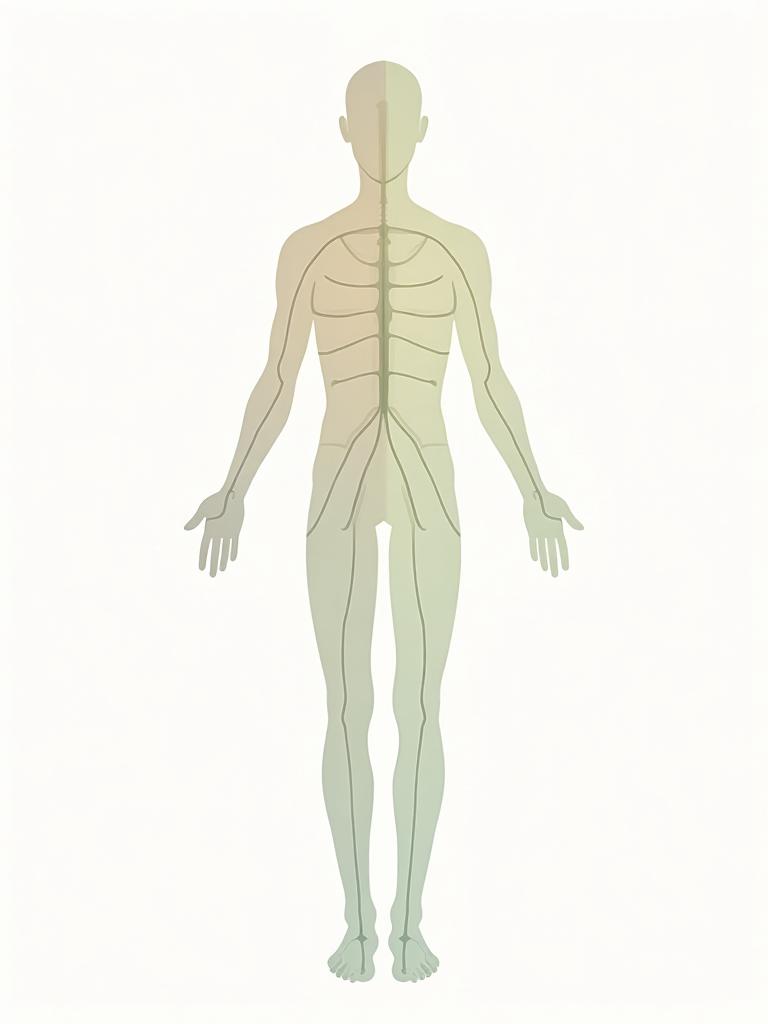
Meridian Pathways
The 12 primary meridians form a network of energy channels that connect the body's organs, tissues, and extremities. Six meridians flow through the arms (Hand meridians) and six through the legs (Foot meridians), creating a continuous circuit of Qi circulation.
Each meridian has specific acupuncture points along its pathway where Qi can be accessed and influenced through needling, pressure, or moxibustion.
How Meridians Guide Diagnosis
Meridians are the body's internal map. Think of them as rivers of Qi that connect every organ, joint, and tissue. When a river runs smoothly, you feel well. When it gets blocked, drained, or flooded, symptoms appear along its path. Listening to where symptoms show up is one of the oldest and most reliable diagnostic tools in TCM.
1. Where it hurts tells a story
Pain along the side of the head often points to the Gallbladder channel. Tightness across the shoulders frequently follows the Small Intestine path. The location is the first clue to which organ system is involved.
2. Inside and outside connect
Each meridian links a surface area of the body to an internal organ. A red, itchy skin rash isn't just skin — it can reflect Lung or Liver heat moving outward through the channel.
3. Channels come in pairs
Every Yin organ (e.g. Liver) is paired with a Yang organ (Gallbladder). Treating one often helps the other — which is why a practitioner may needle your leg to ease a headache.
Putting it together: a simple example
Say a patient has migraines behind one eye, feels irritable, and wakes around 3 AM. The location follows the Liver and Gallbladder channels, the mood points to Liver Qi stagnation, and 1–3 AM is the Liver's peak time on the TCM body clock. Three different channel signals — one consistent diagnosis. That's channel theory at work.
Symptom location suggests the channel.
Time of day patterns hint at the organ.
Emotion reveals which Element is out of balance.
Tongue & pulse confirm the underlying pattern.
Educational content — not a substitute for professional clinical assessment.
Point locations: use the WHO standard
For channel pathways and exact point locations we point you to the published reference rather than a redrawn chart. The WHO standard gives the anatomical landmark, the cun measurement and a drawn figure for all 361 classical points, plus the extra points, and it is the location standard used across the Western Pacific Region.
WHO Standard Acupuncture Point Locations — World Health Organization, 2008. Hosted by the World Health Organization (IRIS handle 10665/353407); the PDF opens on WHO's own site. Cun measurements cross-checked against Deadman, Al-Khafaji & Baker, A Manual of Acupuncture, 2nd ed.
Jump straight to a channel or point
These open the WHO standard on WHO's own site at the right page. Search a point code, a point name in pinyin or Chinese, a channel name, or a channel and point together (“Lung LU-7”, “gallbladder 34”) — or pick a channel below to start at the top of that section.
Channels
Page numbers shown are the printed folios in the standard. Deep links rely on your PDF viewer honouring page anchors — Safari, Chrome, Edge and Firefox all do; if yours opens at page 1, scroll to the printed page listed above.
Citation and licensing: WHO point standard
The WHO standard is published on IRIS under the Creative Commons Attribution-NonCommercial-ShareAlike 3.0 IGO licence. That is why we link to the original PDF instead of redrawing or embedding its figures here.
What the licence allows
- Attribution (BY) — you must credit WHO, name the work and note any changes you made.
- NonCommercial (NC) — no commercial use. Study notes, class handouts and coursework are fine; selling material built on the figures is not.
- ShareAlike (SA) — if you adapt the work, share your version under the same licence.
- IGO terms — WHO does not endorse any adaptation, and disputes are settled under WIPO rules rather than a national court.
How to attribute it
Paste this line into your reference list. If you have adapted a figure, add “adapted from” before the title and state what you changed.
World Health Organization Regional Office for the Western Pacific. WHO Standard Acupuncture Point Locations. Manila: WHO; 2008. Available from: https://iris.who.int/handle/10665/353407. Licensed under CC BY-NC-SA 3.0 IGO.
Medi-Chi links to the WHO standard (IRIS handle 10665/353407) and does not reproduce its figures. Our own point notes are written independently and cross-checked against Deadman, Al-Khafaji & Baker, A Manual of Acupuncture, 2nd ed.
Which Channel Fits?
Select where you feel symptoms and (optionally) the time they're worst. We'll rank the most likely meridians and explain why.
Lung (手太阴肺经)
MetalGoverns respiration and Qi circulation. Opens to the nose and controls skin and body hair.
11 acupuncture points
Large Intestine (手阳明大肠经)
MetalResponsible for elimination and transformation of waste. Paired with the Lung meridian.
20 acupuncture points
Stomach (足阳明胃经)
EarthControls digestion and the 'rotting and ripening' of food. Key source of post-natal Qi.
45 acupuncture points
Spleen (足太阴脾经)
EarthGoverns transformation and transportation of nutrients. Controls blood and muscles.
21 acupuncture points
Heart (手少阴心经)
FireHouses the Shen (spirit/mind). Governs blood circulation and mental activity.
9 acupuncture points
Small Intestine (手太阳小肠经)
FireSeparates the pure from the impure in digestion. Paired with the Heart meridian.
19 acupuncture points
Bladder (足太阳膀胱经)
WaterThe longest meridian with back-Shu points for all organs. Governs water metabolism.
67 acupuncture points
Kidney (足少阴肾经)
WaterStores Essence (Jing) and governs birth, growth, and reproduction. Root of Yin and Yang.
27 acupuncture points
Pericardium (手厥阴心包经)
FireProtects the Heart and governs blood vessels. Closely linked to emotional well-being.
9 acupuncture points
Triple Burner (手少阳三焦经)
FireRegulates water passages and the three body cavities. Unique to TCM with no Western equivalent.
23 acupuncture points
Gallbladder (足少阳胆经)
WoodGoverns decision-making and courage. Stores and excretes bile for digestion.
44 acupuncture points
Liver (足厥阴肝经)
WoodEnsures the smooth flow of Qi throughout the body. Stores blood and governs the tendons.
14 acupuncture points
Five Elements & Meridian Pairs
Each meridian is associated with one of the Five Elements — Wood, Fire, Earth, Metal, and Water. These elements follow cycles of generation (nurturing) and control (restraining) that explain how organ systems interact and influence each other.
Extraordinary Vessels
Beyond the 12 primary meridians, TCM recognizes eight Extraordinary Vessels (奇经八脉) that serve as reservoirs of Qi and blood. The two most clinically important are the Governing Vessel (Du Mai) and the Conception Vessel (Ren Mai), which have their own acupuncture points.
Du Mai — Governing Vessel (督脉)
ExtraordinaryRuns along the posterior midline from the coccyx over the spine and head to the upper lip. Called the 'Sea of Yang Meridians,' it governs all Yang channels, strengthens the spine, and nourishes the brain and spinal cord. Key for treating spinal disorders, mental illness, and febrile diseases.
28 acupuncture points
Ren Mai — Conception Vessel (任脉)
ExtraordinaryRuns along the anterior midline from the perineum up to the chin. Known as the 'Sea of Yin Meridians,' it regulates all Yin channels and governs the uterus and reproductive system. Essential for treating urogenital, digestive, and respiratory conditions.
24 acupuncture points
Chong Mai — Penetrating Vessel (冲脉)
ExtraordinaryKnown as the 'Sea of Blood' and 'Sea of the Twelve Meridians,' it originates in the uterus and runs alongside the Kidney channel. Governs menstruation, reproduction, and the ascending-descending of Qi and Blood in the abdomen.
Dai Mai — Belt Vessel (带脉)
ExtraordinaryThe only meridian that runs horizontally, encircling the waist like a belt. It binds and restrains all vertical meridians. Key for treating leukorrhea, lateral waist pain, and prolapse conditions.
Yin Qiao Mai — Yin Heel Vessel (阴跷脉)
ExtraordinaryOriginates at KI-6 and ascends the medial leg to the eyes. Controls the closing of the eyes and governs the Yin aspect of the lower limbs. Excess causes somnolence and hypersomnia.
Yang Qiao Mai — Yang Heel Vessel (阳跷脉)
ExtraordinaryOriginates at BL-62 and ascends the lateral leg to the eyes. Controls the opening of the eyes and governs the Yang aspect of the lower limbs. Excess causes insomnia and restlessness.
Yin Wei Mai — Yin Linking Vessel (阴维脉)
ExtraordinaryLinks all the Yin meridians together. When diseased, manifests as chest pain, anxiety, and Heart symptoms. Confluent with the Pericardium channel via PC-6 Neiguan.
Yang Wei Mai — Yang Linking Vessel (阳维脉)
ExtraordinaryLinks all the Yang meridians together. When diseased, manifests as alternating chills and fever and exterior defense weakness. Confluent with the Triple Burner channel via SJ-5 Waiguan.
The meridian organ clock
Qi circulates through the twelve channels over a full day, each holding a two-hour peak. It is why the hour a symptom appears is a genuine diagnostic clue — waking at 1–3 am points at the Liver before another question has been asked.
Common questions about the 12 meridians
What are the 12 major meridians in the body?
Lung, Large Intestine, Stomach, Spleen, Heart, Small Intestine, Bladder, Kidney, Pericardium, Triple Burner, Gallbladder and Liver. Six are Yin and six are Yang, arranged in interior-exterior pairs across the Five Elements.
What are the 12 meridians and their main purposes?
Each channel carries Qi to one organ system and governs its function — Lung governs respiration, Spleen transformation and transport, Heart the Blood and the Shén, Kidney Essence and reproduction, Liver the smooth flow of Qi, and so on down the list. The pairing means treating one channel routinely affects its partner.
Are the 12 meridians real?
There is no confirmed anatomical structure corresponding to a meridian — dissection does not reveal channels. They are best understood as a functional map built from two millennia of clinical observation, describing where symptoms cluster and which distant points relieve them. The map earns its place clinically whether or not a physical conduit is ever found.
How many meridians are there in total?
Twelve primary meridians, plus the Eight Extraordinary Vessels. Two of those eight — Du Mai and Ren Mai — carry their own points and are counted alongside the twelve, which is why the set is often described as fourteen channels.
Related references
Pulse positions · Back-Shu points · The Bladder meridian · Jeffrey Yuen's channel systems