    Annual subscribers now receive The Modern Nèi Jīng FREESubscribe AnnuallyClinical Education ToolThis platform provides educational resources for TCM practitioners and students. It does not issue medical certificates, prescriptions, or clinical diagnoses.

    Chapter index

    All 81 chapters, in the order the classic has them.

    Part 1 · The needle itself九針

    The nine needles, the transport points, the spirit that has to be present at both ends of the handle. Everything the rest of the book assumes you have already understood.

    1The nine needles and the twelve source points九針十二原 · Jiǔ Zhēn Shí Èr YuánThe opening chapter sets out nine instruments, the twelve source points, and the single instruction the whole book keeps repeating: pay attention to the qì, not to the clock.
    Free
    2The transport points as the foundation本輸 · Běn ShūThe five transport (shū) points of each channel, laid out from the fingertips inward as a stream growing into a river — the classical original of the five-phase point systems still in daily use.3Explaining the small needle小針解 · Xiǎo Zhēn JiěA line-by-line commentary on chapter one, written because even in antiquity people found the original too terse — the first known acupuncture study guide.4How pathogenic qì in the organs shows on the surface邪氣藏府病形 · Xié Qì Zàng Fǔ Bìng XíngWhere illness enters, how it travels inward, and how organ disease announces itself in the complexion, the pulse and the skin — the classic's account of referred signs.5Root and knot根結 · Gēn JiéEach channel has a root at the extremity and a knot where it terminates in the head or trunk — the classical basis for treating the head by needling the foot.6Long life, early death, the hard and the soft壽夭剛柔 · Shòu Yāo Gāng RóuWhy constitutions differ — hard and soft bodies, matched and mismatched form and qì — and what that predicts about resilience and lifespan.7The official needling methods官針 · Guān ZhēnTwenty-six named needling techniques — depths, angles, multiple-needle patterns — the closest thing the classic has to a technique manual.8Rooted in spirit本神 · Běn ShénThe five aspects of mind — shén, hún, pò, yì and zhì — each housed in an organ, and what fear, grief, worry and anger do to the body that hosts them.
    Free
    9End and beginning終始 · Zhōng ShǐHow to open and close a treatment: reading both pulses, deciding what is excess and what is deficient, and knowing when the treatment is finished.

    Part 2 · The map of the body經脈

    Channels, divergences, sinews, bone measurements and the timing of circulation. The most anatomically concrete stretch of the whole classic.

    10The twelve channels and what goes wrong on each one經脈 · Jīng MàiThe single most-used chapter in the whole classic: the twelve regular channels laid out start to finish, each with its own list of disease signs and its own treatment principle.
    Free
    11The deep divergent branches nobody needles directly經別 · Jīng BiéTwelve extra internal branches peel off the main channels at elbow and knee, dive through the chest and abdomen, and surface at the head and neck — the classic's account of how surface treatment can still reach the trunk and head.12The channels compared to the rivers of the land經水 · Jīng ShuǐThe twelve channels are mapped onto twelve real rivers of Han-dynasty China by size and character, and the chapter uses this to argue for measuring the individual patient rather than needling by a fixed rulebook.13The sinew channels — muscle, tendon and the places they knot經筋 · Jīng JīnTwelve sinew channels track the muscles and tendons alongside the main channels, describing spasm, contracture and knotting rather than organ disease — the classic's clearest overlap with modern myofascial medicine.14Bone measurements — how big is a body, exactly骨度 · Gǔ DùA full inventory of skeletal measurements — head, torso and limbs given in standardised units — providing the scaffolding for the proportional cùn measurement system still taught in every modern point-location class.15Fifty circuits — timing qì to the breath五十營 · Wǔ Shí YíngA calculation chapter arguing that qì completes exactly fifty circuits of the body in a day and night, timed against the breath and the water-clock, and reaching the eyes at the point sleep begins.16Nutritive qì and its fixed route through the twelve channels營氣 · Yíng QìThe precise sequential route nutritive (yíng) qì takes through all twelve channels and the two midline vessels, treated as the deep, nourishing counterpart to the more superficial defensive qì.17Measuring the vessels, and where the senses connect to them脈度 · Mài DùThe total length of the body's vessels is tallied, and each of the twelve channels is linked to a sense organ, giving the classical basis for treating eyes, ears, nose, mouth and tongue through channel points at a distance.18Where nutritive and guard qì meet, and the rhythm of day and night營衛生會 · Yíng Wèi Shēng HuìNutritive qì running the deep vessels and guard qì patrolling the surface are described as two distinct circuits that nonetheless meet, tying waking, digestion and sleep to a day-night cycle centred on the meeting of yin and yang at midnight and midday.

    Part 3 · Disease and where to meet it

    Seasonal qì, the five evils, fever, cold, madness, collapse and blockage — the classic's working case load.

    19Matching treatment to the season四時氣 · Sì Shí QìNeedling strategy changes with the season because qì sits at a different depth in spring, summer, autumn and winter, and the chapter gives point selections for a run of common complaints on top of that seasonal frame.20Five patterns of invading pathogen五邪 · Wǔ XiéA short chapter mapping five patterns of pathogenic qì lodging in lung, liver, spleen, kidney and heart to characteristic symptoms and a short list of points for each.21Cold and heat disorders寒熱病 · Hán Rè BìngA grab-bag chapter on conditions presenting as cold or heat in particular body regions — including facial paralysis, deafness, throat swelling and bone-deep aching — each with points and a note on prognosis.22Seizure and severe mental disturbance癲狂 · Diān KuángThe classic's account of what it calls diān (collapse with convulsion, closer to epilepsy) and kuáng (mania, agitated psychosis), with warning signs, staged progression and point protocols — read here as historical psychiatry, not as current management.23Febrile disease, day by day熱病 · Rè BìngA structured account of febrile illness tracked through successive days, with point protocols for each stage and a list of death signs the classic considered untreatable.24Collapse and counterflow厥病 · Jué BìngJué describes a family of presentations where qì is said to run the wrong way and pool, producing sudden headache, chest pain, cold limbs or fainting, each variant given its own points.25Deciding what to treat first病本 · Bìng BěnA short but pointed chapter on treatment order: when root and branch conflict, which to address first, and the general rule that urgent problems get treated before underlying ones regardless of theory.26Miscellaneous complaints雜病 · Zá BìngA genuinely miscellaneous chapter — hiccup, sciatica-type leg pain, throat obstruction, toothache, earache and more — each given a brief, practical point prescription with little theoretical framing.27Wandering pain that won't settle周痹 · Zhōu BìA short chapter distinguishing bì pain that stays fixed in one place from a 'wandering' form that moves from joint to joint or spreads through the body, with a discussion of why it fails to resolve.

    Part 4 · Food, fluids and the body's economy腸胃

    Gut measurements, what happens when eating stops, the seas of the body, swelling and the separation of the fluids.

    28The small involuntary things: yawns, hiccups, sneezes and tears口問 · Kǒu WènHuángdì asks Qí Bó about the little reflexive noises the body makes without being asked — yawning, hiccupping, sighing, sneezing, tearing up, ringing ears — and gets a channel-based account of each.
    Free
    29What gets handed down: how to actually talk to a patient師傳 · Shī ChuánA chapter on the teacher-to-student transmission of clinical judgement that turns into practical advice on reading a patient's build and habits, and — more usefully — on how to get someone to actually change what they do.30Sorting out the different things we call qì決氣 · Jué QìHuángdì complains that qì, blood, fluid, humour and essence are all lumped together under one word, and Qí Bó gives each a separate definition and a distinct failure state.31Measuring the gut腸胃 · Cháng WèiA remarkably specific set of measurements for the length, width and capacity of the mouth, oesophagus, stomach and intestines — early anatomical dissection, not metaphor.32What happens to a healthy person who stops eating平人絕穀 · Píng Rén Jué GǔBuilding directly on the previous chapter's measurements, this one calculates how much food and fluid the stomach and intestines hold and predicts, almost to the day, how long a healthy person survives without food.33The four seas of the body海論 · Hǎi LùnThe body is described as having four seas — of marrow, of blood, of qì and of food — each with a named access point, and disease as either the sea overflowing or running dry.34When qì goes to the wrong place五亂 · Wǔ LuànFive patterns of qì becoming disordered and turning up where it shouldn't — in the chest, the stomach, the head, the limbs or the whole body — each with a matched treatment.35Distension: bloating, swelling and where it comes from脹論 · Zhàng LùnA survey of distension — of the chest, abdomen, and each of the organs — attributed to qì and cold lodging where they shouldn't, with treatment aimed at draining the excess rather than purging the person.36Urinary blockage and where the body's fluids actually go五癃津液別 · Wǔ Lóng Jīn Yè BiéAn account of the five patterns of urinary difficulty (lóng) and a broader theory of how the body sorts fluid into sweat, tears, saliva, urine and joint fluid depending on temperature, emotion and effort.

    Part 5 · Reading the surface外揣

    Faces, complexions, blood vessels in the skin, dreams and the daily tide of symptoms — diagnosis by what is visible.

    37The five features that report on the five organs五閱五使 · Wǔ Yuè Wǔ ShǐFive regions of the face and five sense organs are described as gauges the organs use to signal outward, so a practitioner who knows where to look can read internal states from the surface.38Adjusting the needle to the body in front of you逆順肥瘦 · Nì Shùn Féi ShòuA practical chapter on tailoring depth, force and dose to body type — the heavy-set, the lean, the robust, the frail, children and the elderly all need a different needle, not the same needle applied harder or softer.39On the small blue-black vessels under the skin血絡論 · Xuè Luò LùnA short, focused chapter on the visible surface blood vessels (blood-network vessels) and what happens, and can go wrong, when they are pricked and bled.40Clear qì and turbid qì moving on different routes陰陽清濁 · Yīn Yáng Qīng ZhuóQi is sorted into a clear, light fraction that rises and a turbid, heavier fraction that sinks, each following its own channel pathway rather than mixing indiscriminately.41The limbs and months tied to sun and moon陰陽繫日月 · Yīn Yáng Xì Rì YuèThe twelve months and the limbs' twelve channels are mapped onto a yÄ«n-yáng and sun-moon scheme, giving the classic's most explicitly calendrical and astronomical framework for timing treatment.42How disease moves from one organ to the next病傳 · Bìng ChuánA description of the typical sequence by which disease spreads from one organ system to another, and the window of time within which treatment can still interrupt that sequence before it becomes fatal.43What excess and invading influences do to your dreams淫邪發夢 · Yín Xié Fā MèngA catalogue linking specific dream content to specific internal imbalances — flying dreams to excess yáng, sinking dreams to excess yÄ«n, and organ-specific dream themes for each of the five organs.
    Free
    44Why symptoms follow the shape of the day順氣一日分為四時 · Shùn Qì Yī Rì Fēn Wéi Sì ShíA single day is treated as a miniature year — morning as spring, midday as summer, evening as autumn, night as winter — and disease is observed to typically ease in the morning, hold steady by day, worsen toward evening and peak at night.45Reasoning inward from what you can see outside外揣 · Wài ChuǎiA short closing chapter on method: the inside of the body cannot be directly observed, so the practitioner must learn to reason accurately from external signs to internal states, the way a skilled craftsman judges a bell's soundness by its ring.

    Part 6 · Constitution and lifespan天年

    Why the same exposure makes one person ill and not another: organ shape, courage, pain tolerance and the arc of a life.

    46Five ways the same cause produces different diseases五變 · Wǔ BiànWhy one wind, one cold snap or one bad meal produces five different diseases in five different people, depending on the tissue and organ that was already the weak point.47The organs as they actually come, shape by shape本藏 · Běn ZàngA long catalogue of organ shape and size as a source of individual constitution — small and large, high and low, thick and thin organs, each with a predicted pattern of resilience and vulnerability.48Teachings you don't hand out lightly禁服 · Jìn FúA student swears an oath before being taught pulse diagnosis and the balancing of yīn and yáng — the classic's own statement that some clinical knowledge is dangerous in careless hands.49Reading colour in the face五色 · Wǔ SèA detailed facial map linking regions of the face to organs and body parts, and colour changes in those regions to specific patterns of disease and prognosis.50On why some people startle and others don't論勇 · Lùn YǒngWhy some people stay steady under provocation and others flare or panic, framed through organ constitution rather than moral character.51The back-shu points, one per organ背腧 · Bèi ShūThe named locations of the five zàng organs' back-transport points along the bladder channel, along with the classic's own instruction on depth and moxa rather than deep needling.52The guard that patrols outside the channels衛氣 · Wèi QìGuard qì (wèi qì) described as a fast-moving, non-channel-bound defensive layer with its own head-and-trunk command points, distinct from the slower nourishing qì running the twelve channels.53Why the same wound hurts different people differently論痛 · Lùn TòngAn explanation of individual variation in pain tolerance and tolerance of needling itself, tied to tissue thickness, skin colour and constitution rather than character.54The decades of a life天年 · Tiān NiánA decade-by-decade sketch of the ageing body from the tenth year to the hundredth, and what determines a long, functional life versus an early decline.
    Free

    Part 7 · Flavour, guard qì and restraint五味

    Diet as medicine, the defensive layer, the five prohibitions and the jade tablets — the chapters about knowing when not to needle.

    55Going with it or against it逆順 · Nì ShùnA short, blunt list of states in which a practitioner should not needle at all — the classic's first real chapter on restraint rather than technique.56The five flavours and what they do五味 · Wǔ WèiThe classical root of Chinese dietetics: five flavours matched to five organ systems, plus practical detail on which grains, meats and vegetables belong where.
    Free
    57Water swelling, and how to tell it from the rest水脹 · Shuǐ ZhàngA differential-diagnosis chapter distinguishing water swelling, wind swelling, abdominal masses and pregnancy from one another by their physical signs.58The thief wind, or why illness returns without warning賊風 · Zéi FēngOn disease that seems to appear out of nowhere with no obvious current exposure — the classic's model of latent susceptibility from old injury and old evils.59When the defensive layer runs off course衛氣失常 · Wèi Qì Shī ChángOn guard qì losing its proper circuit and pooling in the chest, abdomen or limbs, plus a body-typing system by build — thin, fat, and in between.60The jade tablets: what must not be needled玉版 · Yù BǎnA severe chapter on the treatment of abscesses and internal collapse, warning that some conditions are already past the point where needling helps and may make things worse.61The five prohibitions五禁 · Wǔ JìnFive day-and-organ combinations, five conditions and five body regions the classic says should not be needled together — an old system of built-in caution.62The points that pulse動輸 · Dòng ShūWhy certain points on the stomach, kidney and lung channels show a palpable pulse while others on the same channels do not — an early observation of arterial anatomy.63The five flavours, in more detail五味論 · Wǔ Wèi LùnA companion discussion to chapter 56 explaining what happens physiologically, in the classic's own terms, when each flavour is eaten to excess.

    Part 8 · Human types and the long illnesses陰陽二十五人

    The twenty-five constitutional types, how chronic disease actually begins, sleep, speech and the visiting evils.

    64The twenty-five constitutional types陰陽二十五人 · Yīn Yáng Èr Shí Wǔ RénA typology that sorts people into five phase-groups of five, by build, complexion, temperament and how they age, as a rough guide to susceptibility and treatment style.65The five notes and the five flavours五音五味 · Wǔ Yīn Wǔ WèiExtends the constitutional typology with musical notes and taste preferences matched to each type, and links flavour excess back to organ damage.66How every illness actually begins百病始生 · Bǎi Bìng Shǐ ShēngThe classic's clearest staged model of disease onset — external evils and internal strain acting together, moving from skin to channel to bowel to the accumulated lump — and why chronic disease so rarely has one cause.
    Free
    67Why the same needle does different things to different people行針 · Xíng ZhēnExplains why patients with matched conditions respond so differently to identical needling — differences in constitution, qì responsiveness and temperament — and what a slow or absent response actually means.68Obstruction above the diaphragm上膈 · Shàng GéA short chapter on food and drink being unable to pass, blocked at or above the diaphragm — with a modern non-negotiable: new or progressive difficulty swallowing is a red flag, not a needling case.69Grief, rage and the loss of voice憂恚無言 · Yōu Huì Wú YánOn sudden loss of voice from strong emotion or throat obstruction, and the anatomy of the throat structures the classic identifies as responsible for speech.70Chronic cold-and-heat and the lumps in the neck寒熱 · Hán RèOn the condition of alternating cold and heat with chains of hard lumps in the neck and armpit — historically scrofula — its classical staging, and the modern non-negotiable to investigate persistent lymphadenopathy.71The visiting evil and the sleepless night邪客 · Xié KèA long chapter on how a visiting evil disturbs the circulation of defensive qì at night and prevents it settling inward, producing insomnia — plus detailed vessel anatomy and needling of the heart-protector channel.72Reaching heaven — the five temperaments通天 · Tōng TiānA second, temperament-based typology sorting people by how much yīn or yáng dominates their character, from the domineering excess-yáng type to the balanced type the chapter clearly holds up as the ideal.

    Part 9 · Skill, timing and the surgical end官能

    What makes a competent practitioner, the movement of guard qì through the day, the eight winds, confusion, and the chapter on abscesses that ends the book.
    73Who should be doing this job官能 · Guān NéngThe classic's chapter on competence: which practitioner suits which task, and what has to be true of someone before you let them near a patient.
    Free
    74Reading illness from the skin of the forearm論疾診尺 · Lùn Jí Zhěn ChǐDiagnosis by palpating the forearm — temperature, texture, moisture and slackness of the skin between wrist and elbow.75Needling the joints, and telling true qì from evil刺節真邪 · Cì Jié Zhēn XiéA long technical chapter on five specialised needling methods and on distinguishing the body's own qì from the pathogenic kind.76The daily circuit of the defensive layer衛氣行 · Wèi Qì XíngGuard qì is described running fifty circuits a day — outside by day, inside by night — with treatment timed to where it has got to.77Nine palaces and eight winds九宮八風 · Jiǔ Gōng Bā FēngA calendrical scheme placing the ruler in one of nine positions through the year and naming eight winds, each said to bring its own kind of harm.78The nine needles, revisited九針論 · Jiǔ Zhēn LùnA return to the instruments of chapter one, now with each needle's shape, length and intended job set out in detail.79The year's dew, and why epidemics come歲露論 · Suì Lù LùnSeasonal irregularity, wind and the moon are offered as an explanation for why illness sometimes arrives in whole communities at once.80Dizziness, blurred vision and the great confusion大惑論 · Dà Huò LùnWhy the world sometimes spins, doubles or dims — and why the classic connects the eyes to the spirit rather than to the eye alone.81Abscesses, and where the book stops癰疽 · Yōng JūThe final chapter turns to deep infection — how it forms, how it is named, and how far a practitioner of that era could go.
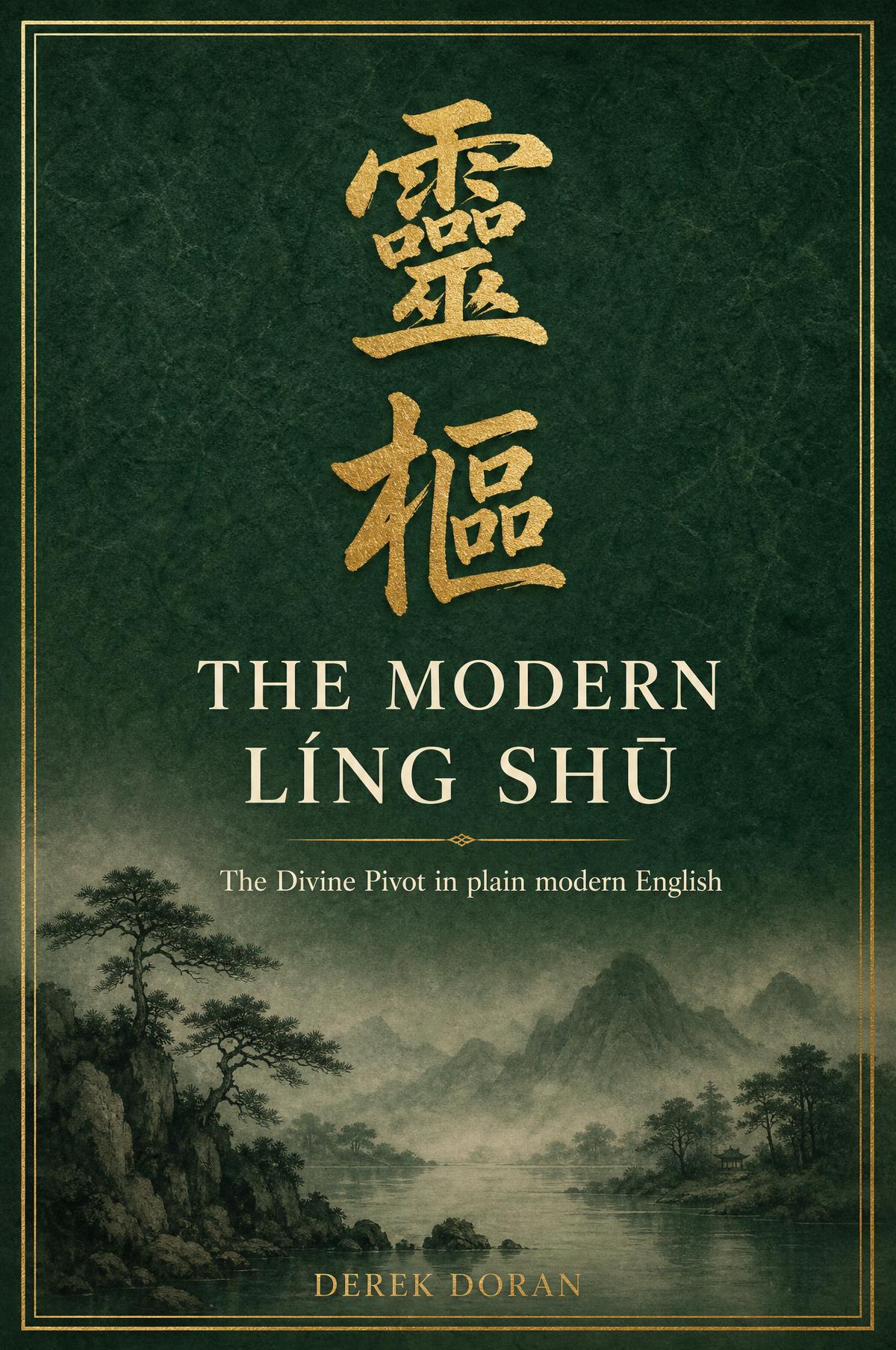
    Front cover of The Modern Líng Shū — jade and gold cover with the characters 靈樞

    Medi-Chi · medichi.online

    The Modern Líng Shū — chapter index

    © 2026 Medi-Chi. The Modern Líng Shū. All rights reserved.
    Medi-Chi