
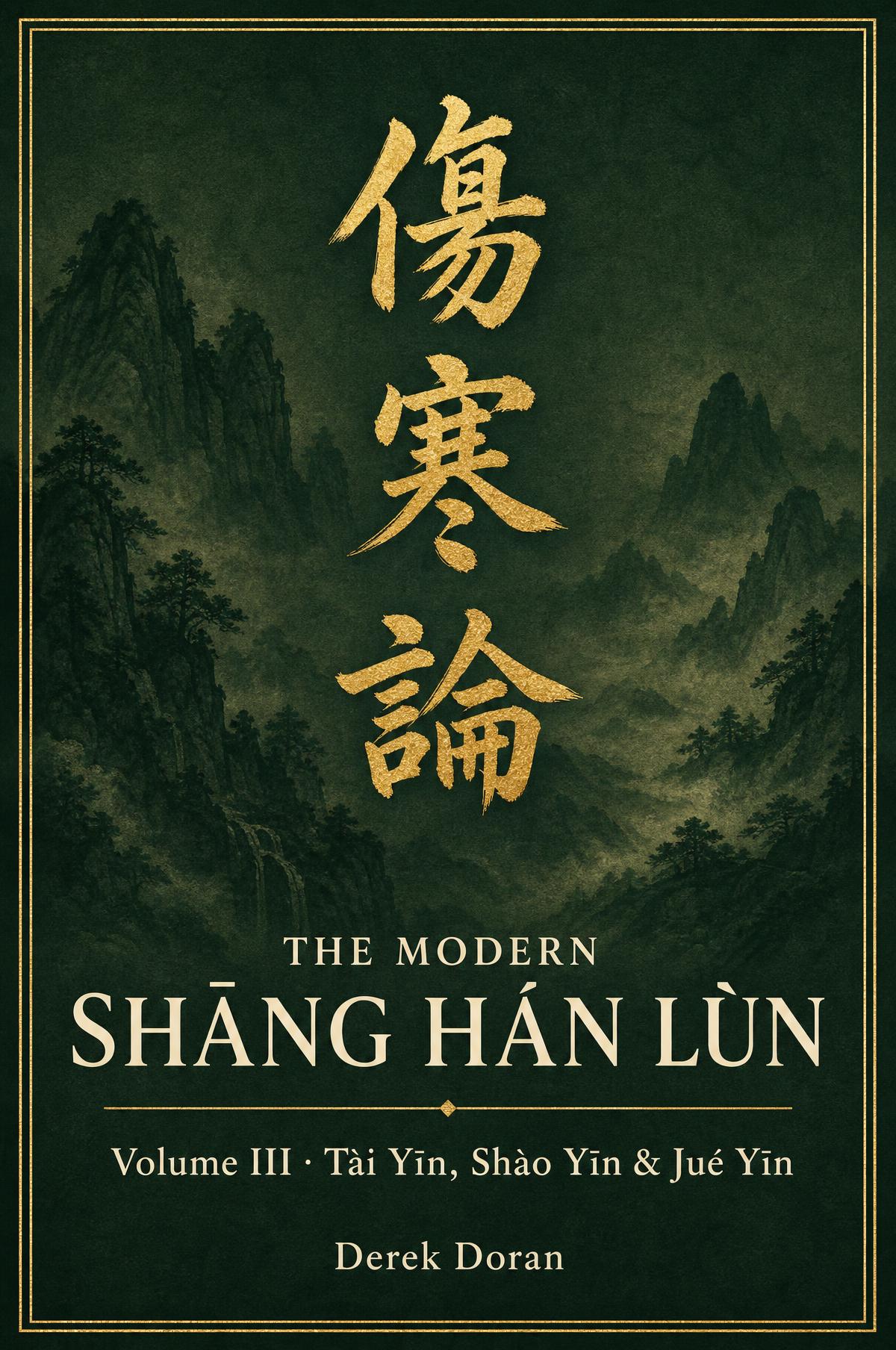
The Modern Shāng Hán Lùn — Volume III
Tài Yīn, Shào Yīn & Jué Yīn, clauses 273–398
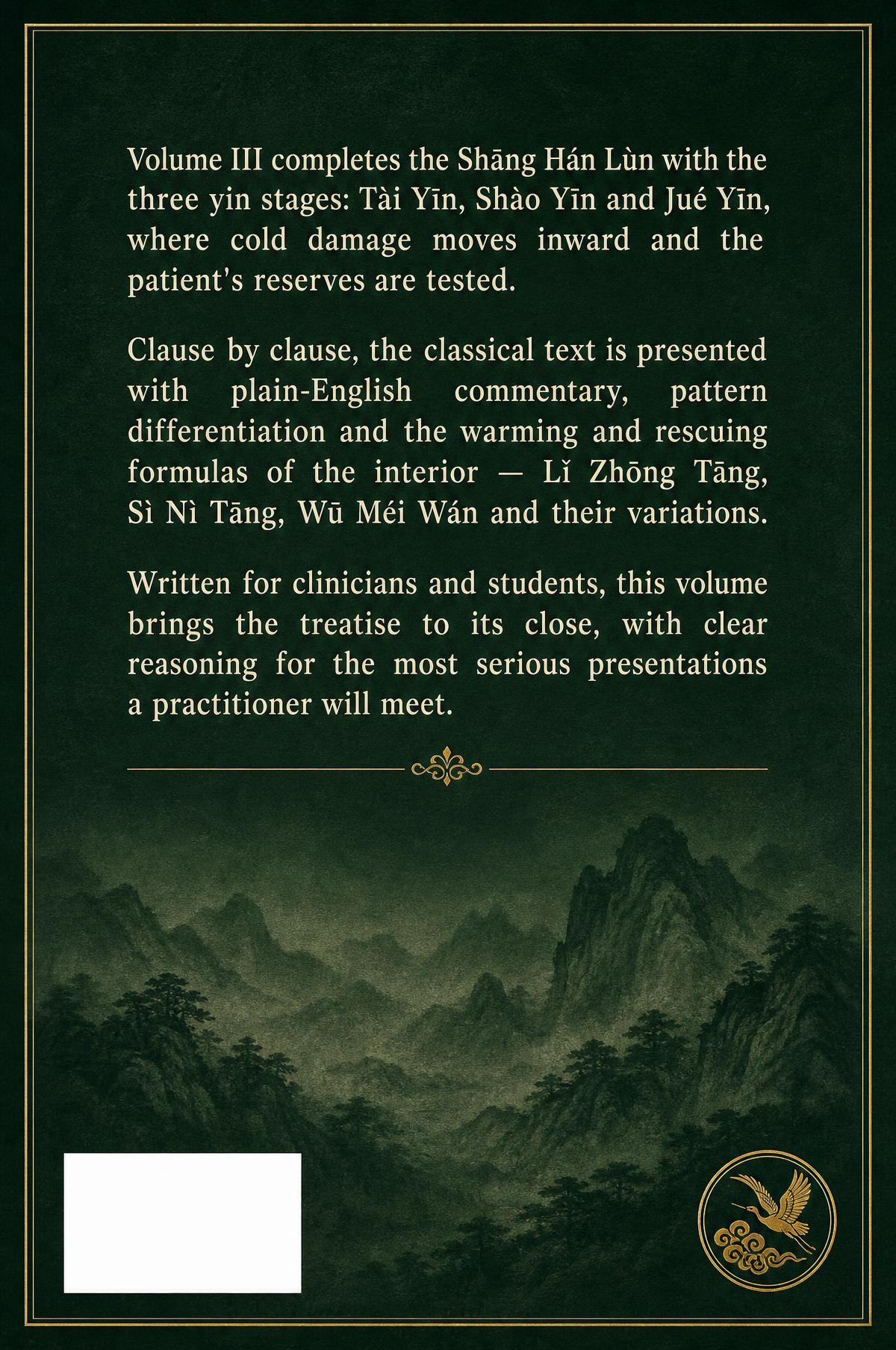
The interior-cold volume, and the end of the book. Tài Yīn and its slack, cold digestion; the whole of Shào Yīn, from the faint pulse and the patient who only wants to sleep through to the rescue formulas and the sore-throat sequence; Jué Yīn with its heat above and cold below. The two closing chapters — sudden turmoil disorder, and relapse after recovery — are folded in here rather than left as a stray fourth volume. Original Sòng text, transcribed formulas, and Australian scheduling handled openly.
126 clauses written. Free sample clauses: 273, 281, 326, 386.
Cover pages
What's inside
Tài Yīn — the cold, weak middle
辨太陰病脈證并治Eight clauses and one idea: the digestion has gone cold and slack. Fullness without hardness, vomiting, diarrhoea and a pain that eases with warmth and pressure — and the standing warning that purging here makes everything worse.
Shào Yīn — the outline and the pulse
少陰病提綱A faint, fine pulse and a patient who only wants to sleep. The opening clauses set out how depleted a Shào Yīn patient really is, and which presentations must never be sweated.
Cold transformation — the Sì Nì group
少陰寒化Where the division does its hardest work: cold limbs, undigested food in the stool, and the graded rescue formulas — Sì Nì Tāng, Tōng Mài Sì Nì Tāng, Zhēn Wǔ Tāng and the Fù Zǐ pairings.
Heat transformation and the throat clauses
少陰熱化與咽痛The other face of Shào Yīn: restless insomnia answered by Huáng Lián Ē Jiāo Tāng, the sore-throat sequence, and the three urgent purgation clauses that close the division.
Jué Yīn — heat above, cold below
辨厥陰病脈證并治The outline clause with its thirst, its hunger without appetite and its warning against purging, and the great mixed formula of the division, Wū Méi Wán.
Reversal cold and the swing between heat and cold
厥熱勝復Counting the days of fever against the days of cold limbs to read where the illness is heading, and separating cold reversal from heat reversal before you reach for a formula.
Vomiting, diarrhoea and the closing clauses
嘔噦下利Clear-food diarrhoea, hiccup, dysenteric diarrhoea with straining, and the formulas that answer them — Bái Tóu Wēng Tāng, Sì Nì Tāng, Wú Zhū Yú Tāng and the Xiǎo Chái Hú Tāng crossover.
Sudden turmoil disorder
辨霍亂病脈證并治Vomiting and diarrhoea together, fluid lost from both ends at once. The rules for telling a cold turmoil from a damp-heat one, with Lǐ Zhōng Wán and Wǔ Líng Sǎn on either side of the decision.
Exchange, relapse and convalescence
辨陰陽易差後勞復病脈證并治The closing chapter of the book, and the one most useful in an ordinary practice: how people relapse after a serious illness through overwork, overeating or resuming sex too soon, and how to feed a recovering patient.
Earlier volumes: Volume I: Tài Yáng covers clauses 1–178, and Volume II: Yáng Míng & Shào Yáng covers 179–272. The front matter sets out the method, the substitution and scheduling notice, and the citation rules used across all three volumes.