
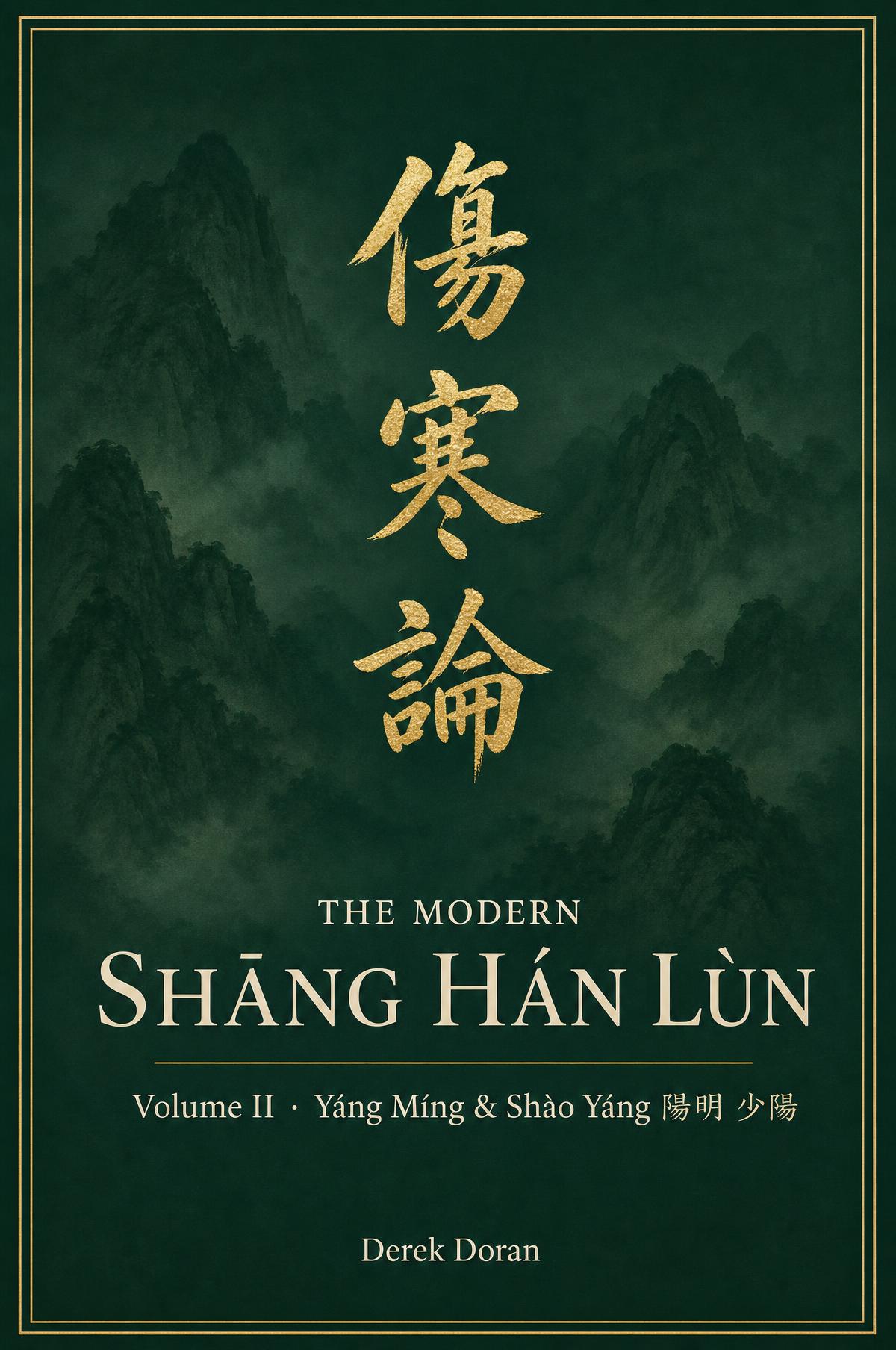
The Modern Shāng Hán Lùn — Volume II
Yáng Míng & Shào Yáng, clauses 179–272
The interior-heat volume. Every clause of the Yáng Míng division — the three chéng qì formulas and the rules for choosing between them, bái hǔ tāng and the water-heat clauses, the jaundice group, the three urgent-purge emergencies — followed by the ten Shào Yáng clauses that define the half-exterior. Original Sòng text, transcribed formulas, and Australian scheduling handled openly.
94 clauses written. Free sample clauses: 180, 208, 236, 263.
What's inside
What Yáng Míng is
陽明病提綱The three doorways into Yáng Míng, the one-line definition (胃家實), and the external signs — heat, spontaneous sweating, and the switch from hating cold to hating heat.
When not to purge
陽明病禁下Zhòng-Jǐng spends as much ink on holding back as on attacking. Vomiting, epigastric hardness and a red face all veto the purge, and 調胃承氣湯 enters as the gentlest of the group.
The chéng qì family
承氣湯類Tidal fever, delirious speech and dry stool. The three chéng qì decoctions graded by force, and the test dose that tells you whether the stool has actually hardened.
Heat without form: bái hǔ and zhū líng
白虎與豬苓Blazing heat with thirst and no bind to attack, the qì-level fever of the three-yáng combination, and the water-heat pattern where purging would be exactly wrong.
Jaundice and static blood
發黃與蓄血Damp-heat with nowhere to vent turns the skin yellow; 茵陳蒿湯 is the answer. Alongside it, the forgetful patient with black stool — heat bound into blood, not into stool.
Urgent purgation and the closing clauses
急下與辨黃The three 急下 emergencies where fluid loss outruns the illness, the mild-formula corrections, and the final jaundice trio that closes the division.
Shào Yáng — the half-exterior
the “Shào Yáng Disease: Pulses, Signs and Treatment” chapter (辨少陽病脈證并治)Ten clauses, and the shortest division in the book. A bitter mouth, a dry throat, dizzy vision — and the standing prohibition against sweating, purging or vomiting a patient whose illness sits between the surface and the interior.
New here? Volume I: Tài Yáng covers clauses 1–178. The front matter sets out the method, the substitution and scheduling notice, and the citation rules used in both volumes.