References and further reading
Everything this book leans on, in one place. The root text is out of copyright and paraphrased directly; the point locations come from a published standard rather than from anybody's drawing; and every research claim in “What we now know” traces to an indexed paper listed below. Where the evidence is thin or negative, the chapters say so instead of quietly leaving it out.
The classical text and editions
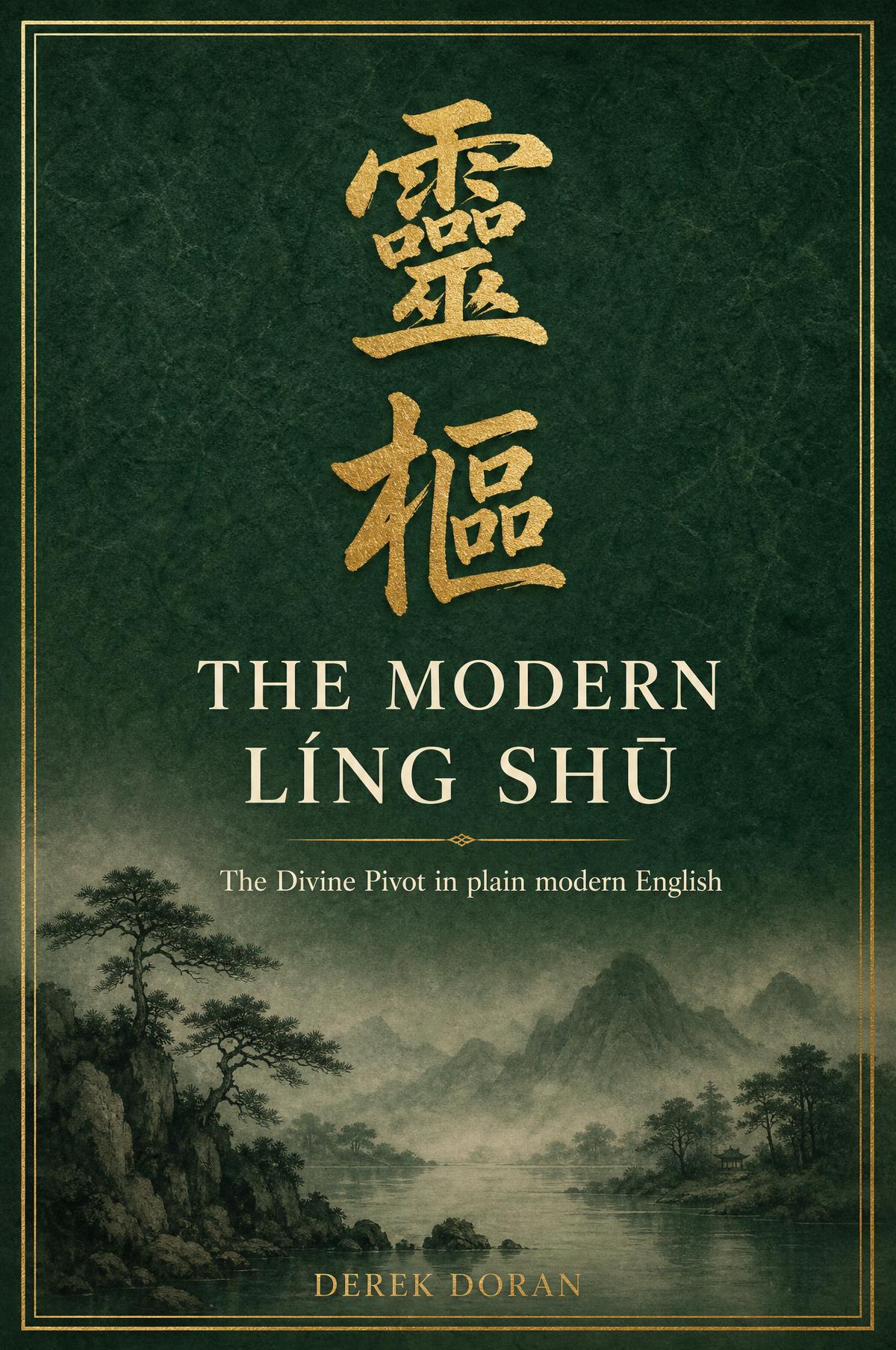
Líng Shū 靈樞 (the Divine Pivot)
The root text: the second half of the Huángdì Nèi Jīng 黃帝內經, received in 81 chapters, Han dynasty compilation of older material. Long out of copyright. Chapter numbering and titles here follow the received order as printed in the standard editions.
Chinese Text Project — Líng Shū Jīng
Open, character-by-character edition of the root text. Every chapter of this book links back to the matching chapter here so the paraphrase can be checked against the Chinese.
Unschuld, P. U. Huang Di Nei Jing Ling Shu: The Ancient Classic on Needle Therapy
University of California Press, 2016. The scholarly English translation used for orientation on chapter titles. Consulted, not adapted — no wording from it appears in this book.
The companion half of the Nèi Jīng. Cited where a Líng Shū chapter only makes sense beside its Sù Wèn parallel.
Standards and reference works
WHO Standard Acupuncture Point Locations in the Western Pacific Region
World Health Organization, 2008. The published standard for every point location and alphanumeric code used in this book. Point locations are never drawn or estimated here — the standard is cited and linked.
WHO International Standard Terminologies on Traditional Chinese Medicine
World Health Organization, 2022. Source for the English renderings of pattern and channel terminology.
STRICTA reporting standards for acupuncture trials
MacPherson H et al., PLoS Medicine, 2010 (PMID 20543992). The reporting standard used when weighing whether an acupuncture trial described its intervention well enough to be worth citing.
Chinese Medicine Board of Australia — codes, guidelines and infection prevention
The registration standards and infection-control expectations that the safety notes in this book are written to.
Research cited in the modern sections
Each entry carries its PubMed ID and links straight to the record, so nothing here has to be taken on trust.
- 1
Vickers AJ, Vertosick EA, Lewith G, et al. (2018). Acupuncture for Chronic Pain: Update of an Individual Patient Data Meta-Analysis. The Journal of Pain.
The largest patient-level analysis of acupuncture for chronic pain, and the basis for the book's repeated line that the effect is real, modest and durable.
- 2
Linde K, Allais G, Brinkhaus B, et al. (2016). Acupuncture for the prevention of tension-type headache. Cochrane Database of Systematic Reviews.
Cited wherever a chapter touches head pain.
- 3
Linde K, Allais G, Brinkhaus B, et al. (2016). Acupuncture for the prevention of episodic migraine. Cochrane Database of Systematic Reviews.
The migraine counterpart to the review above.
- 4
Mu J, Furlan AD, Lam WY, et al. (2020). Acupuncture for chronic nonspecific low back pain. Cochrane Database of Systematic Reviews.
Cited in the channel and sinew chapters, including where the certainty of evidence is rated low.
- 5
Smith CA, Armour M, Lee MS, Wang LQ, Hay PJ (2018). Acupuncture for depression. Cochrane Database of Systematic Reviews.
Cited in the chapters on spirit, mood and the five aspects of mind, where the evidence is weaker than the classical confidence suggests.
- 6
Langevin HM, Yandow JA (2002). Relationship of acupuncture points and meridians to connective tissue planes. The Anatomical Record.
The best-known anatomical account of why channel routes track fascial planes as closely as they do.
- 7
Zhao ZQ (2008). Neural mechanism underlying acupuncture analgesia. Progress in Neurobiology.
The standard review of the spinal and supraspinal mechanisms behind needling analgesia.
- 8
Han JS (2004). Acupuncture and endorphins. Neuroscience Letters.
Cited where the classic's language about qì arriving is set beside the endogenous opioid work.
- 9
White A (2004). A cumulative review of the range and incidence of significant adverse events associated with acupuncture. Acupuncture in Medicine.
The reference behind the safety notes: serious events are rare, and almost all of them are avoidable.
- 10
MacPherson H, Altman DG, Hammerschlag R, et al. (2010). Revised STandards for Reporting Interventions in Clinical Trials of Acupuncture (STRICTA). PLoS Medicine.
Used as the filter for which acupuncture trials are described well enough to be worth citing at all.
Educational content for practitioners and students. Nothing here is individual medical advice, and nothing in it replaces assessment by a registered health practitioner.
Medi-Chi · medichi.online
The Modern Líng Shū — references and further reading
© 2026 Medi-Chi. The Modern Líng Shū. All rights reserved.