    Annual subscribers now receive The Modern Nèi Jīng FREESubscribe AnnuallyClinical Education ToolThis platform provides educational resources for TCM practitioners and students. It does not issue medical certificates, prescriptions, or clinical diagnoses.
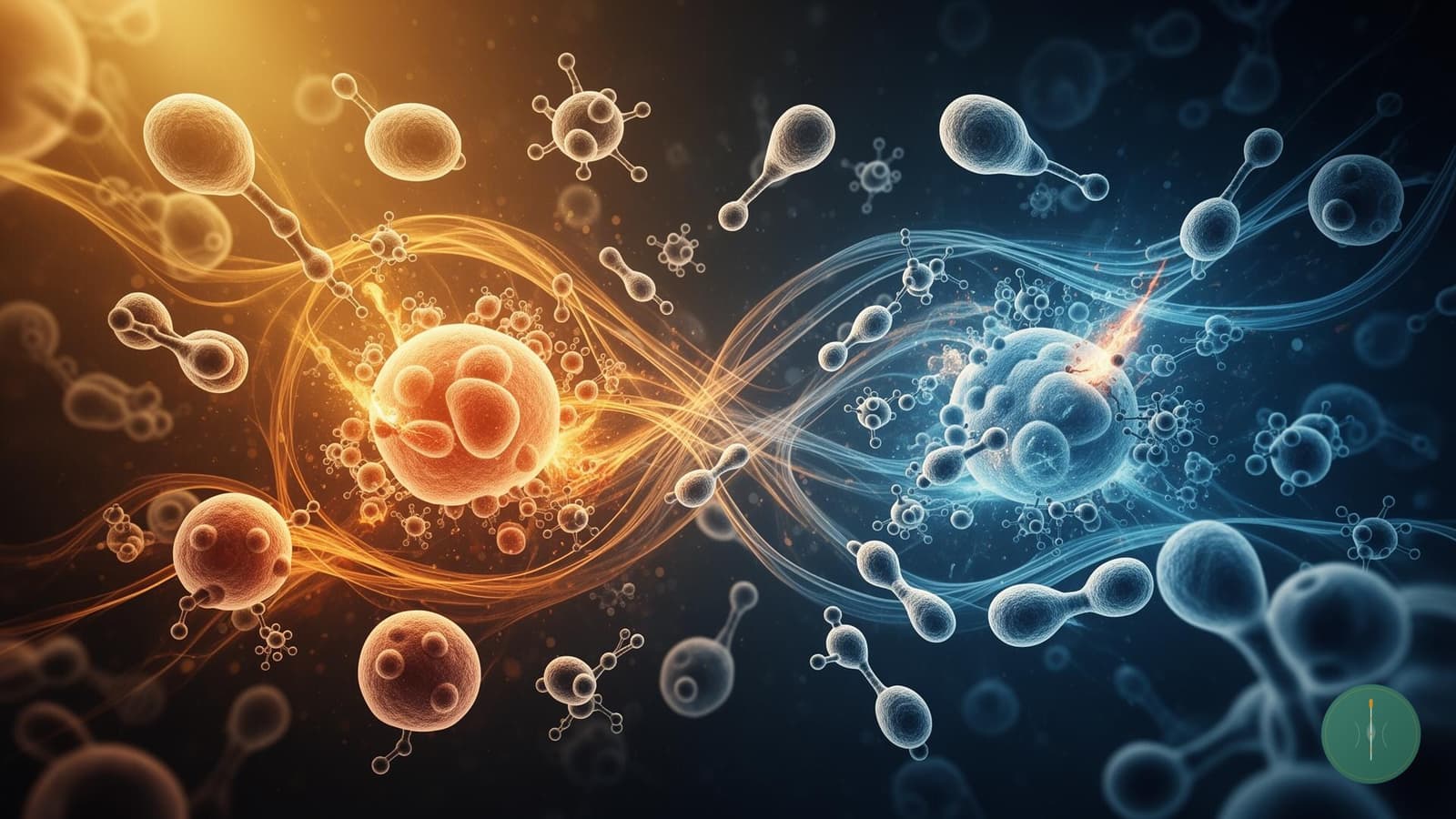
    Abstract immune cells turning inward, evoking the righteous-versus-pathogenic Qi theme of Sù Wèn Chapter 27
    Nèi JīngAutoimmunityImmune SystemMicrobiomeClassical TCM

    Friendly Fire: When Your Immune System Attacks Itself — Modern Nèi Jīng Ch.27

    Medically Reviewed by Derek Doran, BHSc (Acupuncture) · AHPRA Registered · AACMA Member · Updated April 3, 2026

    March 27, 202612 min readBy MediChi Editorial

    The Body at War With Itself

    Autoimmune disease is one of the great paradoxes of modern medicine: the very system designed to protect you — your immune system — turns its weapons inward. Rheumatoid arthritis, Hashimoto's thyroiditis, lupus, multiple sclerosis, type 1 diabetes — these are not infections. They are identity crises at a cellular level.

    This is the central theme of Sù Wèn Chapter 27 (離合真邪論, Lí Hé Zhēn Xié Lùn) — the Treatise on Separating the True from the Evil. In the classical text, the challenge was distinguishing the body's righteous energy (Zhēn Qì) from pathogenic influences (Xié Qì). In 2026, that distinction has become terrifyingly blurred.

    📖 Read the full interactive chapter with classical Chinese source footnotes: Modern Nèi Jīng Chapter 27


    The Palace Coup: Molecular Mimicry

    Huáng Dì's metaphor is vivid: "My Royal Guard is torching the library, convinced the scrolls are invaders."

    This is precisely what happens in molecular mimicry. A pathogen — a virus, a bacterium — enters the body and is eventually cleared. But it leaves behind molecular fragments that structurally resemble your own tissues. Your immune system, trained to hunt that specific shape, begins attacking anything that looks similar (Libbey et al., 2014).

    Consider:

    • Streptococcal infection → molecular mimicry with heart tissue → rheumatic heart disease
    • Epstein-Barr virus → cross-reactivity with myelin → multiple sclerosis risk
    • SARS-CoV-2 → post-viral autoimmune sequelae → long COVID autoimmunity (Al-Aly et al., 2021)

    In TCM terms, the Xié (evil) has not simply invaded — it has disguised itself as the Zhēn (true). The guard can no longer tell who belongs in the palace.


    The Gut Kingdom: Where Immune Identity Is Forged

    Qí Bó points to the gut as the training ground for immune soldiers. Modern immunology agrees: approximately 70% of the immune system resides in the gut-associated lymphoid tissue (GALT). When the microbiome is disrupted — by antibiotics, stress, processed food, or environmental toxins — the immune system's "education" breaks down.

    Intestinal Permeability: The Broken Gate

    The concept of "leaky gut" — increased intestinal permeability — is increasingly linked to autoimmune onset. When the gut barrier fails, partially digested food proteins, bacterial fragments, and toxins escape into the bloodstream, triggering systemic immune responses against tissues that share structural epitopes with these escapees (Mu et al., 2019).

    In the Nèi Jīng framework, this maps directly to Spleen/Stomach dysfunction (脾胃, Pí Wèi). The Spleen governs transformation and transportation — when it fails, turbid substances leak where they shouldn't, creating confusion in the body's defensive layers.

    Free Clinical Tool

    Turn This Knowledge Into a Treatment Plan

    Enter any Western diagnosis and get a complete TCM treatment protocol — acupuncture points, herbal formulas, moxibustion, cupping, and gua sha recommendations.

    The TCM Pattern

    Western MechanismTCM Equivalent
    Intestinal permeabilitySpleen Qì Deficiency with Dampness
    Systemic inflammationDamp-Heat or Toxic Heat
    Immune hyperactivationZhēn Qì confusion / Wèi Qì rebellion
    Tissue destructionBlood Stasis with Heat toxin
    Adrenal/HPA axis dysfunctionKidney Yīn/Yáng Deficiency

    The Long COVID Connection

    The COVID-19 pandemic brought autoimmunity into sharp public focus. Post-infection, many patients developed autoantibodies — immune proteins targeting their own tissues — even after the virus had cleared. This is Huáng Dì's "ghost in the machine": the pathogen is gone, but its shadow continues to wreak havoc.

    Research has documented post-COVID autoimmune phenomena including:

    • New-onset thyroid autoimmunity
    • Autoimmune hepatitis
    • Guillain-Barré syndrome
    • Antiphospholipid syndrome

    These are not secondary infections — they are the immune system's misdirected memory, attacking tissues that "look like" the virus it already defeated (Vojdani et al., 2014).


    The Rising Tide: Why Autoimmunity Is Increasing

    Autoimmune diseases now affect an estimated 5–8% of the global population, and incidence is rising steadily across all demographics. The factors driving this increase read like a catalogue of modern life:

    • Antibiotic overuse — disrupts microbial diversity
    • Ultra-processed diets — promote intestinal permeability and systemic inflammation
    • Environmental toxins — pesticides, heavy metals, and microplastics act as immune triggers
    • Chronic psychological stress — dysregulates the HPA axis, shifting immune balance toward autoimmunity
    • Reduced microbial exposure — the "hygiene hypothesis" suggests too-clean environments leave the immune system under-trained and over-reactive

    In TCM terms, the modern environment creates a perfect storm: Spleen Qì depletion (poor diet and stress), Kidney Essence exhaustion (chronic overwork), and Liver Qì stagnation (suppressed emotions and frustration) — all converging to confuse the body's ability to distinguish self from other.


    Qí Bó's Prescription: Restoring Identity

    Qí Bó's advice is not to simply suppress the immune system — the modern pharmaceutical approach of immunosuppressants, which he likens to "locking down the whole city to catch one confused guard." Instead, he advocates restoring recognition:

    1. Rebuild the Gut Kingdom

    • Restore microbial diversity through fermented foods and diverse plant fibre
    • Address intestinal permeability with gut-healing nutrients (L-glutamine, zinc carnosine, bone broth)
    • Remove inflammatory triggers (gluten, dairy, and processed sugar for susceptible individuals)

    2. Calm the Inflammatory Fog

    • Clear Damp-Heat patterns with cooling, bitter herbs (Huáng Qín, Huáng Lián)
    • Move Blood Stasis to prevent tissue damage accumulation
    • Regulate the Liver to ensure smooth Qì flow and emotional processing

    3. Nourish the Root

    • Tonify Kidney Yīn and Yáng to rebuild constitutional resilience
    • Support Spleen Qì to restore proper transformation and transportation
    • Protect Wèi Qì (defensive Qi) without overstimulating it

    4. Re-establish Self-Recognition

    • Meditation and mindfulness practices to calm the nervous system's threat response
    • Adequate sleep to allow immune recalibration during the restorative Yīn hours
    • Gradual, appropriate microbial re-exposure rather than sterile isolation

    The Clinical Takeaway

    Autoimmune disease is not simply "too much immune system." It is a crisis of identity — the body has lost the ability to recognise itself. The Nèi Jīng's framework of Zhēn vs Xié provides a surprisingly useful clinical lens: rather than asking "how do we suppress the attack?", ask "why has the body forgotten who it is?"

    The answer, invariably, leads back to the foundations: gut integrity, microbial diversity, emotional regulation, constitutional nourishment, and the restoration of the body's innate intelligence.

    As Qí Bó concludes: "The true Way is to re-establish recognition. Calm the guards, rebuild the gut kingdom, clear the inflammatory fog, and remind the system of what is truly Self."


    Explore More on MediChi

    Frequently Asked Questions

    Does the Nei Jing discuss autoimmune disease?

    The Nei Jing predates the modern concept of autoimmunity, but Chapter 27 of the Su Wen — on Wei Qi (defensive Qi) — describes the body attacking itself when defensive Qi becomes disordered, a remarkable conceptual parallel to autoimmunity.

    What is Wei Qi in Chinese medicine?

    Wei Qi is the defensive aspect of Qi that circulates between the skin and muscles, warms the surface, controls the pores, and resists external pathogens. It is the closest TCM analogue to the modern immune system.

    How does TCM treat autoimmune conditions?

    TCM treats autoimmunity by regulating Wei Qi, clearing residual pathogens, tonifying underlying Qi, Blood, Yin, or Yang deficiencies, and resolving the Phlegm or Blood stasis that often accompanies chronic inflammation. Treatment is always individualised.

    All Citations Verified4/4

    Every PubMed citation in this article has been manually verified against its source.

    💡 💡 Tip: Press and hold on citation links to open them in your browser.

    Derek Doran, BHSc (Acupuncture)

    AHPRA Registered (CMR0002211465) · AACMA Member

    Derek is the founder of MediChi and a registered acupuncturist with clinical expertise in integrating Western diagnoses with Traditional Chinese Medicine treatment protocols.

    Clinically reviewed: April 3, 2026
    Found this useful? Share it

    Ready to Apply This in Clinic?

    Medi-Chi translates any Western diagnosis into a complete TCM treatment plan in seconds. Available in 10 languages for clinical practice worldwide.

    ✓ 10 Treatment Styles✓ PubMed Citations✓ 185+ Herbs & 65+ Formulas✓ No Credit Card Required

    Related Articles