Pulse Diagnosis Demystified: The 28 Classical Pulses
Medically Reviewed by Derek Doran, BHSc (Acupuncture) · AHPRA Registered · AACMA Member · Updated April 3, 2026
This article is part of our main reference guide. Read the full guide for the complete, continually updated version.
The Art of Listening Through Your Fingertips
In a modern cardiology lab, a pulse is a number — 72 beats per minute, regular, nothing more. In Chinese medicine, a pulse is a conversation. It tells you about the state of every organ, the balance of Qi and Blood, whether pathology sits at the surface or has burrowed deep inside.
Pulse diagnosis (脈診, mài zhěn) is considered the pinnacle of clinical skill in TCM. The Mài Jīng (脈經), written by Wang Shuhe in the 3rd century CE, systematised 24 pulse types. Later commentators expanded this to the 28 classical pulses that remain the standard today.
This guide will make them accessible, organised, and clinically actionable.
The Three Positions
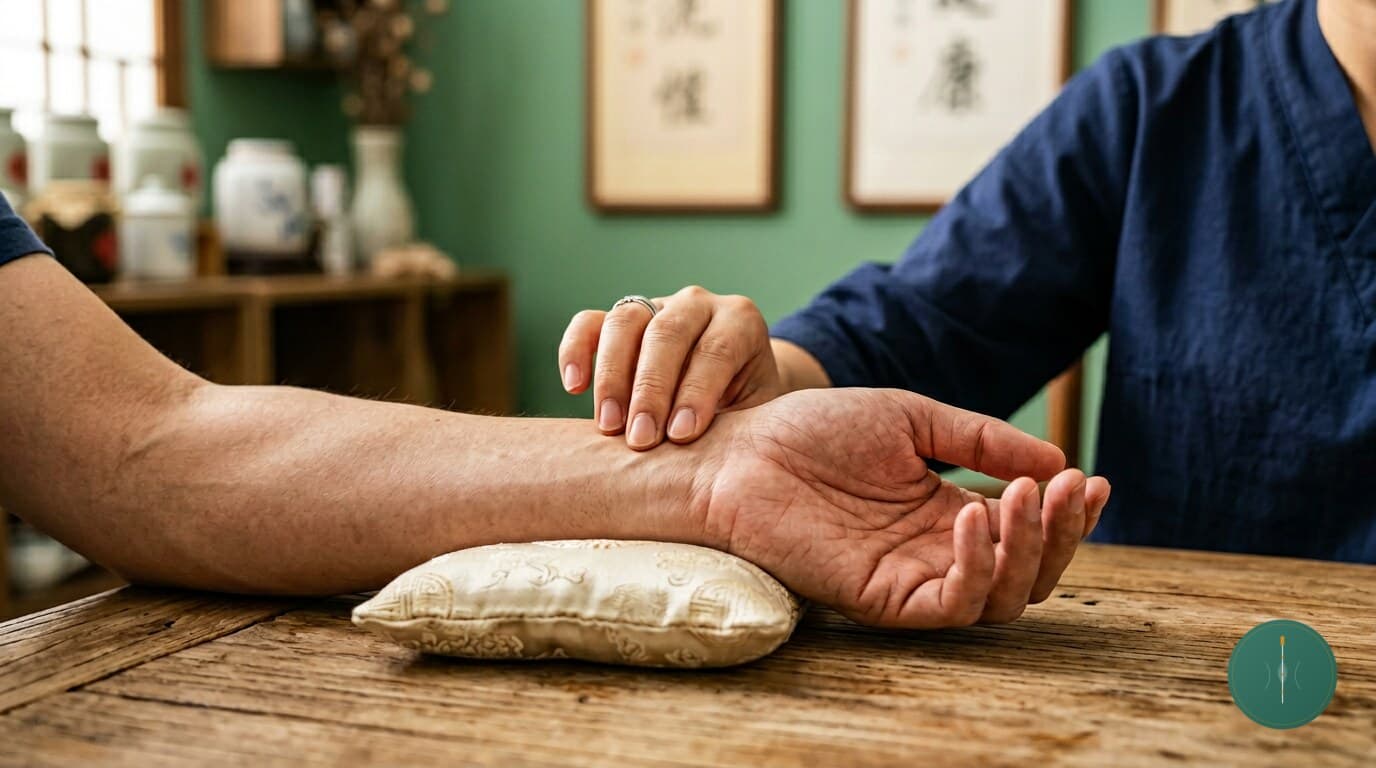
Before feeling pulse qualities, you must understand where to feel. The radial artery at the wrist is divided into three positions under three fingers:
| Position | Finger | Left Hand | Right Hand |
|---|---|---|---|
| Cùn (寸) — Distal | Index | Heart / Pericardium | Lung |
| Guān (關) — Middle | Middle | Liver / Gallbladder | Spleen / Stomach |
| Chǐ (尺) — Proximal | Ring | Kidney Yin | Kidney Yang / Mingmen |
Each position is palpated at three depths: superficial (light touch), middle (moderate pressure), and deep (pressing to bone). This creates an 18-point matrix that maps the entire body.
The Eight Parameters
All 28 pulse types can be understood through eight fundamental parameters:
1. Depth — floating vs. deep
2. Rate — fast vs. slow
3. Width — thin vs. wide
4. Strength — forceful vs. weak
5. Length — long vs. short
6. Shape — smooth, wiry, choppy, etc.
7. Rhythm — regular, irregular, intermittent
8. Tension — taut vs. soft
Mastering these parameters is more important than memorising all 28 names, because every pulse is ultimately a combination of these qualities.
The 28 Classical Pulses, Grouped for Learning
Rather than listing all 28 alphabetically, we'll organise them into clinical families — groups that share a common mechanism.
Surface & Depth Pulses
| Pulse | Chinese | Feel | Clinical Significance |
|---|---|---|---|
| Floating (浮, fú) | Easily felt with light touch, weakens with pressure | Exterior pattern, early-stage invasion of wind-cold or wind-heat | |
| Deep (沉, chén) | Only felt with heavy pressure | Interior pattern, Qi unable to reach the surface | |
| Hidden (伏, fú) | Even deeper than deep — barely perceptible at bone level | Extreme interior cold, or Qi collapse |
Rate Pulses
| Pulse | Chinese | Feel | Clinical Significance |
|---|---|---|---|
| Rapid (數, shuò) | >90 bpm (>5 beats per breath cycle) | Heat pattern — excess or deficiency heat | |
| Slow (遲, chí) | <60 bpm (<4 beats per breath cycle) | Cold pattern — Yang deficiency or excess cold | |
| Moderate (緩, huǎn) | ~72 bpm, relaxed | Normal (healthy) or Spleen-dampness if soggy |
Width & Force Pulses
| Pulse | Chinese | Feel | Clinical Significance |
|---|---|---|---|
| Thin/Thready (細, xì) | Narrow like a silk thread but distinct | Blood or Yin deficiency | |
| Big/Large (大, dà) | Wide, spreading | Excess heat, or deficiency with false expansion | |
| Surging/Flooding (洪, hóng) | Wide, forceful, arrives with power, recedes weakly | Excess heat in the Qi level (Yangming) | |
| Minute/Faint (微, wēi) | Extremely thin, barely perceptible | Severe Qi and Blood deficiency, Yang collapse |
Tension & Shape Pulses
| Pulse | Chinese | Feel | Clinical Significance |
|---|---|---|---|
| Wiry/String-like (弦, xián) | Taut like a guitar string | Liver Qi stagnation, pain, stress | |
| Tight (緊, jǐn) | Twisted rope feel, taut and forceful | Cold, pain, food stagnation | |
| Slippery (滑, huá) | Smooth like pearls rolling on a plate | Phlegm, dampness, food stagnation, pregnancy | |
| Choppy/Rough (澀, sè) | Uneven, like scraping bamboo with a knife | Blood stasis, Blood or Yin deficiency, Essence depletion |
Rhythm Pulses
| Pulse | Chinese | Feel | Clinical Significance |
|---|---|---|---|
| Knotted (結, jié) | Slow with irregular pauses | Cold accumulation, Qi stagnation, phlegm | |
| Hurried (促, cù) | Rapid with irregular pauses | Excess heat with Qi or Blood stagnation | |
| Intermittent (代, dài) | Regular rhythm with regular, predictable pauses | Organ decline, exhaustion, severe Heart patterns |
Special Quality Pulses
| Pulse | Chinese | Feel | Clinical Significance |
|---|---|---|---|
| Leather/Drum (革, gé) | Floating, taut, hollow inside — like pressing a drum | Blood loss, Essence depletion, miscarriage | |
| Soggy/Soft (濡, rú) | Floating, thin, soft — barely there at the surface | Dampness, Qi deficiency | |
| Confined/Firm (牢, láo) | Deep, wiry, forceful, long | Interior cold accumulation, masses | |
| Scattered (散, sàn) | Floating, irregular, disappears under pressure | Kidney Qi exhaustion, critical decline | |
| Hollow (芤, kōu) | Floating, big, but hollow in the centre — like pressing a spring onion stalk | Acute blood loss | |
| Long (長, cháng) | Extends beyond the normal three positions | Excess, Liver Yang rising | |
| Short (短, duǎn) | Only palpable in the middle (Guān) position | Qi deficiency, Qi stagnation | |
| Spinning Bean (動, dòng) | Short, slippery, rapid, trembling — like a bean bouncing | Pain, fright, mixed Heat-Cold patterns |
The Clinical Reasoning Framework
Memorising all 28 is less important than understanding how to combine pulse findings into a clinical picture. Here's the framework:
Step 1: Overall Impression
Before analysing individual positions, note the overall pulse character. Is it generally:
- Fast or slow? → Heat vs. Cold
- Floating or deep? → Exterior vs. Interior
- Forceful or weak? → Excess vs. Deficiency
- Wide or thin? → Qi/Blood abundance vs. depletion
Step 2: Position-Specific Findings
Now compare each position. For example:
- Wiry at the left Guān (Liver position) + rapid overall = Liver Fire
- Thin at both Chǐ positions + deep = Kidney Yin and Yang deficiency
- Slippery at the right Guān (Spleen position) = Dampness or Phlegm in the middle Jiao
Step 3: Integration with Other Pillars
Pulse findings should confirm what you see in tongue diagnosis, and what the patient reports. A wiry pulse with a purple tongue and sharp fixed pain all point to Blood Stasis. When all four pillars converge, your diagnostic confidence is high.
Turn This Knowledge Into a Treatment Plan
Enter any Western diagnosis and get a complete TCM treatment protocol — acupuncture points, herbal formulas, moxibustion, cupping, and gua sha recommendations.
Common Pulse Patterns in Practice
Stress and Anxiety
Pulse: Wiry (弦), often rapid, sometimes thin at the Chǐ positions
The wiry quality reflects Liver Qi constraint — the most common pattern in modern clinical practice. When it's also rapid, Heat is developing from prolonged stagnation.
Chronic Fatigue
Pulse: Deep (沉), weak (弱), thin (細), often slow
This triple combination — deep, weak, and thin — is the hallmark of Qi and Blood deficiency. If the Chǐ positions are particularly weak, Kidney deficiency is the root.
Digestive Issues
Pulse: Slippery (滑) or soggy (濡) at the right Guān position, possibly slow
Slippery indicates Dampness or Phlegm accumulating in the Spleen/Stomach. A soggy quality suggests the Spleen Qi is too weak to transform and transport fluids.
Acute Cold or Flu
Pulse: Floating (浮) and tight (緊)
This is the classic Wind-Cold invasion pulse. The floating quality shows the pathogen is at the surface; the tight quality indicates Cold constriction. Treatment focuses on releasing the exterior with warming, diaphoretic strategies.
Modern Research on Pulse Diagnosis
The scientific study of pulse diagnosis has accelerated in recent years, driven by sensor technology and machine learning.
Pressure waveform analysis has demonstrated that TCM pulse qualities correspond to measurable haemodynamic parameters. Different pulse types produce distinct arterial pressure waveform signatures that can be captured by modern tonometric devices.
Studies on pulse-constitution correlations have shown that TCM constitutional types identified through pulse assessment correspond to measurable physiological differences, including basal metabolic rate, autonomic nervous system activity, and inflammatory markers (Wu & Ko, 2017).
The broader effort to parameterise and quantify traditional diagnostic methods, including pulse, tongue, and facial assessment, has been reviewed systematically, demonstrating that modern technology can capture many features that trained practitioners detect by feel (Matos et al., 2021).
Perhaps most encouragingly, research on the physiological correlates of classical TCM patterns has shown that diagnoses like "Spleen-Qi deficiency" (which produces specific pulse findings) correspond to measurable metabolic differences, validating that pulse assessment is detecting real physiological states rather than subjective impressions (Mun et al., 2017).
Practice Tips for Students
1. Start with rate and depth. These two parameters alone narrow your differential dramatically.
2. Feel your own pulse daily. Learn what "normal" feels like before trying to identify abnormalities.
3. Compare left to right. Asymmetry between the two wrists is often the most clinically significant finding.
4. Don't rush. Classical texts recommend palpating for at least 50 beats (about one minute) before drawing conclusions.
5. Correlate with the tongue. If the pulse says "heat" but the tongue says "cold," re-examine both before committing to a diagnosis.
6. Use a consistent pressure sequence. Start light (floating level), then press to middle, then deep. Lift back up. Note what changes.
Using MediChi for Pattern Differentiation
While pulse diagnosis requires hands-on clinical skill that no app can replace, MediChi's diagnostic tool can help you connect pulse findings to complete pattern differentiations. Enter the pulse qualities you've identified (e.g., "wiry rapid pulse, headache, irritability") to receive pattern analysis with corresponding acupuncture and herbal treatment strategies.
Frequently Asked Questions
What are the 28 classical pulses in Chinese medicine?
How are pulses taken in Traditional Chinese Medicine?
How long does it take to learn pulse diagnosis?
All Citations Verified4/4
Every PubMed citation in this article has been manually verified against its source.
💡 💡 Tip: Press and hold on citation links to open them in your browser.
Derek Doran, BHSc (Acupuncture)
AHPRA Registered (CMR0002211465) · AACMA Member
Derek is the founder of MediChi and a registered acupuncturist with clinical expertise in integrating Western diagnoses with Traditional Chinese Medicine treatment protocols.
Clinically reviewed: April 3, 2026