Auricular Acupuncture: The Complete Clinical Guide to Ear-Based Treatment
Medically Reviewed by Derek Doran, BHSc (Acupuncture) · AHPRA Registered · AACMA Member · Updated April 3, 2026
What Is Auricular Acupuncture?
Auricular acupuncture (耳针, ěr zhēn) is a specialised form of acupuncture that treats the external ear as a microsystem — a map of the entire body in miniature. By stimulating specific points on the ear using needles, ear seeds, pellets, or electrical stimulation, practitioners can influence corresponding organs, systems, and physiological functions throughout the body.
The ear microsystem concept has roots in ancient Chinese medicine, with references in the Huangdi Neijing (Yellow Emperor's Classic) describing the ear's connections to the meridian system. However, the modern systematisation of auricular acupuncture owes much to French physician Dr. Paul Nogier, who in the 1950s mapped the ear as an inverted fetus — the body's anatomy reflected onto the auricle.
Today, auricular acupuncture is one of the most widely practised and researched forms of acupuncture, endorsed by the World Health Organization and integrated into military medicine, addiction recovery, and mainstream pain management.
The Ear Microsystem: Anatomy & Mapping
The Inverted Fetus Model
Nogier's foundational insight was that the ear resembles an inverted fetus — with the head at the lobule, the spine along the antihelix, and the internal organs within the concha. This somatotopic organisation means:
- Ear lobe → Head, brain, eyes, face
- Antihelix → Spine (cervical, thoracic, lumbar, sacral)
- Scaphoid fossa → Upper limbs
- Antihelix inferior crus → Lower limbs, hip
- Concha (superior) → Abdominal organs (liver, spleen, kidney)
- Concha (inferior) → Thoracic organs (heart, lungs)
- Tragus → Adrenal gland, nose, pharynx
- Intertragic notch → Endocrine system
Chinese vs. French Systems
Two major mapping systems exist and are used clinically:
| Feature | Chinese System | French (Nogier) System |
|---|---|---|
| Origin | TCM meridian theory | Neurophysiological reflexology |
| Mapping | Based on Zang-Fu organ relationships | Based on inverted fetus somatotopy |
| Point detection | Tenderness and visual inspection | Electrical conductance (point detectors) |
| Treatment focus | Pattern differentiation | Reflex zone stimulation |
| Point count | ~200 standardised points | ~300+ points including phases |
In practice, experienced auricular acupuncturists integrate both systems. The WHO published a standardised nomenclature of auricular acupuncture points in 1990, largely harmonising the two traditions.
Key Auricular Points
The Master Points
These are the most commonly used points across all clinical applications:
| Point | Location | Function |
|---|---|---|
| Shenmen (神门) | Triangular fossa | Calms the spirit, analgesic, anti-anxiety, master sedation point |
| Point Zero | Centre of the ear (helix root) | Homeostasis, returns body to baseline, master balancing point |
| Sympathetic | Inferior antihelix crus | Regulates autonomic nervous system, vasodilation, anti-spasm |
| Endocrine | Intertragic notch | Hormonal regulation, anti-inflammatory, metabolic balance |
| Subcortex (皮质下) | Inner wall of antitragus | Central nervous system sedation, analgesic |
| Kidney | Superior concha | Tonifies Kidney, strengthens bones, treats tinnitus and lower back pain |
| Liver | Posterior aspect of superior concha | Moves Qi, calms Liver Yang, benefits eyes and sinews |
| Lung | Central concha | Regulates respiration, skin conditions, releases exterior |
Mechanisms of Action
Vagus Nerve Stimulation
One of the most significant modern discoveries is that auricular acupuncture achieves many of its effects through transcutaneous vagus nerve stimulation (taVNS). The ear is the only place on the body surface innervated by the vagus nerve (via the auricular branch, or Arnold's nerve) — specifically at the concha and tragus.
Research has demonstrated that auricular acupuncture at vagally innervated ear points can modulate the parasympathetic nervous system, producing measurable effects on heart rate variability, inflammatory markers, and central pain processing (Usichenko et al., 2017).
Neurophysiological Pathways
Additional mechanisms include:
1. Somatotopic reflex arcs — ear point stimulation activates corresponding spinal segments
2. Endogenous opioid release — auricular electroacupuncture triggers beta-endorphin and enkephalin production
3. Autonomic regulation — modulation of sympathetic/parasympathetic balance
4. Neuroplastic changes — sustained treatment produces lasting cortical reorganisation
5. Anti-inflammatory pathways — vagal activation engages the cholinergic anti-inflammatory pathway
Clinical Protocols
The NADA Protocol (5-Point Ear Acupuncture)
The National Acupuncture Detoxification Association (NADA) protocol is the most widely used standardised auricular acupuncture protocol globally. Developed by Dr. Michael Smith at Lincoln Hospital in the Bronx during the 1970s addiction crisis, it uses five bilateral ear points (Stuyt & Voyles, 2016):
| Point | Function |
|---|---|
| Shenmen | Calms the mind, reduces anxiety and agitation |
| Sympathetic | Regulates the autonomic nervous system, reduces fight-or-flight response |
| Kidney | Strengthens willpower, treats fear, supports detoxification |
| Liver | Moves stagnant Qi, addresses anger and frustration, hepatic detoxification |
| Lung | Regulates grief, strengthens immunity, improves respiration |
Clinical applications beyond addiction:
- Mental health — anxiety, PTSD, depression, insomnia
- Disaster relief — deployed after Hurricane Katrina, 9/11, and in refugee camps
- Criminal justice — used in drug court programmes across the USA
- Perioperative care — pre-surgical anxiety reduction
Research confirms NADA as an effective adjunctive therapy for substance abuse, improving treatment retention and reducing anxiety symptoms (Carter et al., 2017).
Battlefield Acupuncture (BFA)
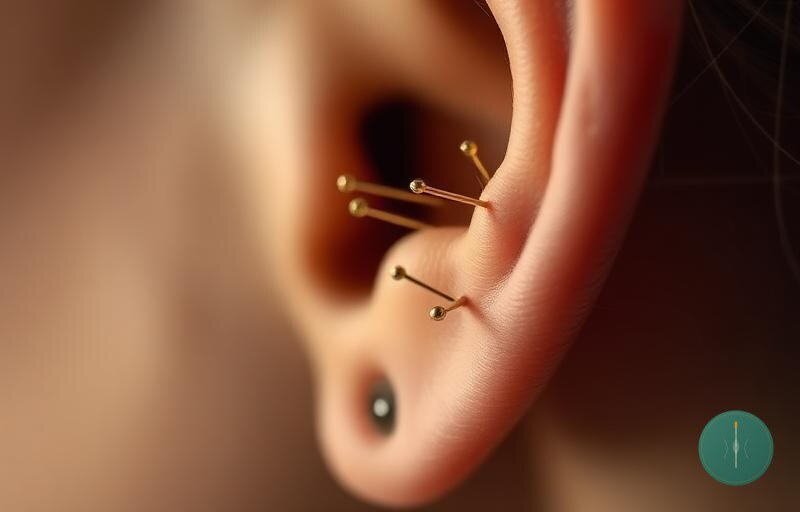
Battlefield Acupuncture was developed by Col. Richard Niemtzow, MD of the US Air Force in 2001 as a rapid-onset auricular protocol for acute pain. It uses semi-permanent ASP (Aiguille Semi-Permanente) gold needles placed sequentially in five ear points (Niemtzow et al., 2006):
| Order | Point | Location |
|---|---|---|
| 1 | Cingulate Gyrus | Posterior inferior antihelix |
| 2 | Thalamus | Concha floor near external auditory meatus |
| 3 | Omega 2 | Triangular fossa |
| 4 | Point Zero | Helix root |
| 5 | Shenmen | Triangular fossa |
Protocol details:
- Needles placed alternating ears (left → right → left, etc.)
- Patient walks between each needle insertion to assess pain reduction
- Treatment stops when adequate pain relief is achieved (often 2–3 needles)
- ASP needles remain in place for 3–5 days and fall out naturally
A systematic review and meta-analysis of Battlefield Acupuncture RCTs confirmed statistically significant pain reduction compared to controls, with rapid onset and minimal adverse effects (Yang et al., 2021).
Turn This Knowledge Into a Treatment Plan
Enter any Western diagnosis and get a complete TCM treatment protocol — acupuncture points, herbal formulas, moxibustion, cupping, and gua sha recommendations.
BFA is now integrated into the Veterans Affairs and Department of Defense healthcare systems, with emergency department trials demonstrating non-inferiority to standard pharmacologic treatment for acute low back pain (Fox et al., 2018).
Evidence Base
Pain Management
Auricular acupuncture has the strongest evidence base for pain management. A landmark systematic review and meta-analysis of RCTs found that auriculotherapy significantly reduced pain intensity across multiple pain types, with particularly strong effects for postoperative pain (Asher et al., 2010).
A subsequent meta-analysis confirmed these findings, demonstrating that auricular therapy is effective for both acute and chronic pain conditions, with effect sizes comparable to pharmacological interventions (Yeh et al., 2014).
Cancer Pain
For cancer patients, auricular therapy offers particular value as a complementary approach. A systematic review of 9 RCTs found that auricular therapy combined with standard drug therapy significantly improved pain relief rates and reduced adverse effects compared to medication alone (Yang et al., 2020).
Perioperative Applications
The most recent meta-analysis of auricular acupuncture for perioperative pain management analysed data from multiple RCTs and found significant reductions in postoperative pain scores, opioid consumption, and pain-related anxiety. The review highlighted auricular acupuncture as a safe, cost-effective adjunct to multimodal analgesia protocols (Zhou et al., 2025).
Treatment Modalities
Auricular Needling
Traditional fine-gauge needles (0.20–0.25mm) inserted 1–2mm into auricular points. Retained for 20–30 minutes. Most precise method but requires practitioner presence.
Ear Seeds (Vaccaria Seeds)
Small seeds from the Vaccaria plant attached to adhesive tape and pressed onto ear points. Patients self-stimulate by pressing the seeds 3–5 times daily. Non-invasive, ideal for home maintenance between treatments.
ASP Needles (Semi-Permanent)
Gold or titanium semi-permanent needles that remain in the ear for days. Used in Battlefield Acupuncture. Provide sustained stimulation without patient compliance requirements.
Auricular Electroacupuncture
Electrical stimulation applied to ear needles, typically at 2Hz (endorphin release) or 100Hz (dynorphin release). Combines point specificity with frequency-dependent neurochemical modulation.
Ear Pellets (Metal/Magnetic)
Stainless steel or magnetic pellets attached to ear points. Similar to ear seeds but with additional pressure or magnetic field effects. Popular in Japanese and Korean auricular practice.
TCM Pattern Integration
In TCM practice, auricular acupuncture points are selected based on pattern differentiation, not just symptoms:
| TCM Pattern | Auricular Point Selection |
|---|---|
| Liver Qi Stagnation | Liver, Shenmen, Sympathetic, Endocrine |
| Heart Blood Deficiency | Heart, Shenmen, Subcortex, Spleen |
| Kidney Yin Deficiency | Kidney, Endocrine, Adrenal, Occiput |
| Spleen Qi Deficiency | Spleen, Stomach, Shenmen, Endocrine |
| Phlegm-Dampness | Lung, Spleen, Triple Warmer, Endocrine |
| Blood Stasis | Liver, Sympathetic, corresponding body zone |
Combining Body and Ear Acupuncture
The most effective clinical outcomes often come from integrating body acupuncture with auricular protocols:
- Body points address the root pattern (本, běn)
- Ear points provide targeted symptomatic relief (标, biāo)
- Example: For migraine with Liver Yang Rising — body: LR-3, GB-20, GB-41; ear: Shenmen, Subcortex, Forehead, Temple, Liver
Safety & Contraindications
Safety Profile
Auricular acupuncture has an excellent safety profile. The most common adverse effects are:
- Mild local discomfort during needle insertion
- Temporary redness at needle sites
- Rare: minor infection at semi-permanent needle sites (preventable with proper hygiene)
Contraindications
- Pregnancy: Avoid strong stimulation of uterine and endocrine ear points
- Ear inflammation: Active otitis externa, frostbite, or broken skin on the auricle
- Haemophilia: Use non-invasive methods (ear seeds, pellets) instead of needles
Getting Started with Auricular Acupuncture
For practitioners new to auricular acupuncture:
1. Learn the anatomy — Master the major auricular landmarks (helix, antihelix, tragus, concha, lobule)
2. Start with master points — Shenmen, Point Zero, Sympathetic, and Endocrine cover a wide clinical range
3. Practice point detection — Use palpation for tenderness and electrical point detectors for precision
4. Begin with the NADA protocol — It's standardised, well-researched, and applicable to many conditions
5. Integrate gradually — Add ear points to your existing body acupuncture treatments
MediChi's diagnostic tool can suggest appropriate auricular point prescriptions alongside body acupuncture protocols. Enter your patient's symptoms to receive integrated treatment recommendations spanning both microsystem and meridian-based approaches.
Frequently Asked Questions
What is auricular acupuncture?
What is the NADA protocol?
Can ear seeds replace acupuncture needles?
Interactive Ear Point Map
Explore auricular acupuncture points on the ear diagram. Filter by NADA or Battlefield Acupuncture protocols.
Hover or tap a point on the ear to see its anatomical location, function, and clinical indications
Point locations follow WHO standardised auricular nomenclature. Filter by protocol to highlight NADA (5-point) or Battlefield Acupuncture (5-point) points.
All Citations Verified10/10
Every PubMed citation in this article has been manually verified against its source.
💡 💡 Tip: Press and hold on citation links to open them in your browser.
Derek Doran, BHSc (Acupuncture)
AHPRA Registered (CMR0002211465) · AACMA Member
Derek is the founder of MediChi and a registered acupuncturist with clinical expertise in integrating Western diagnoses with Traditional Chinese Medicine treatment protocols.
Clinically reviewed: April 3, 2026