Esoteric Acupuncture: Sacred Geometry, Spin Field Theory & the Ayurvedic Bridge
Medically Reviewed by Derek Doran, BHSc (Acupuncture) · AHPRA Registered · AACMA Member · Updated April 3, 2026
What Is Esoteric Acupuncture?
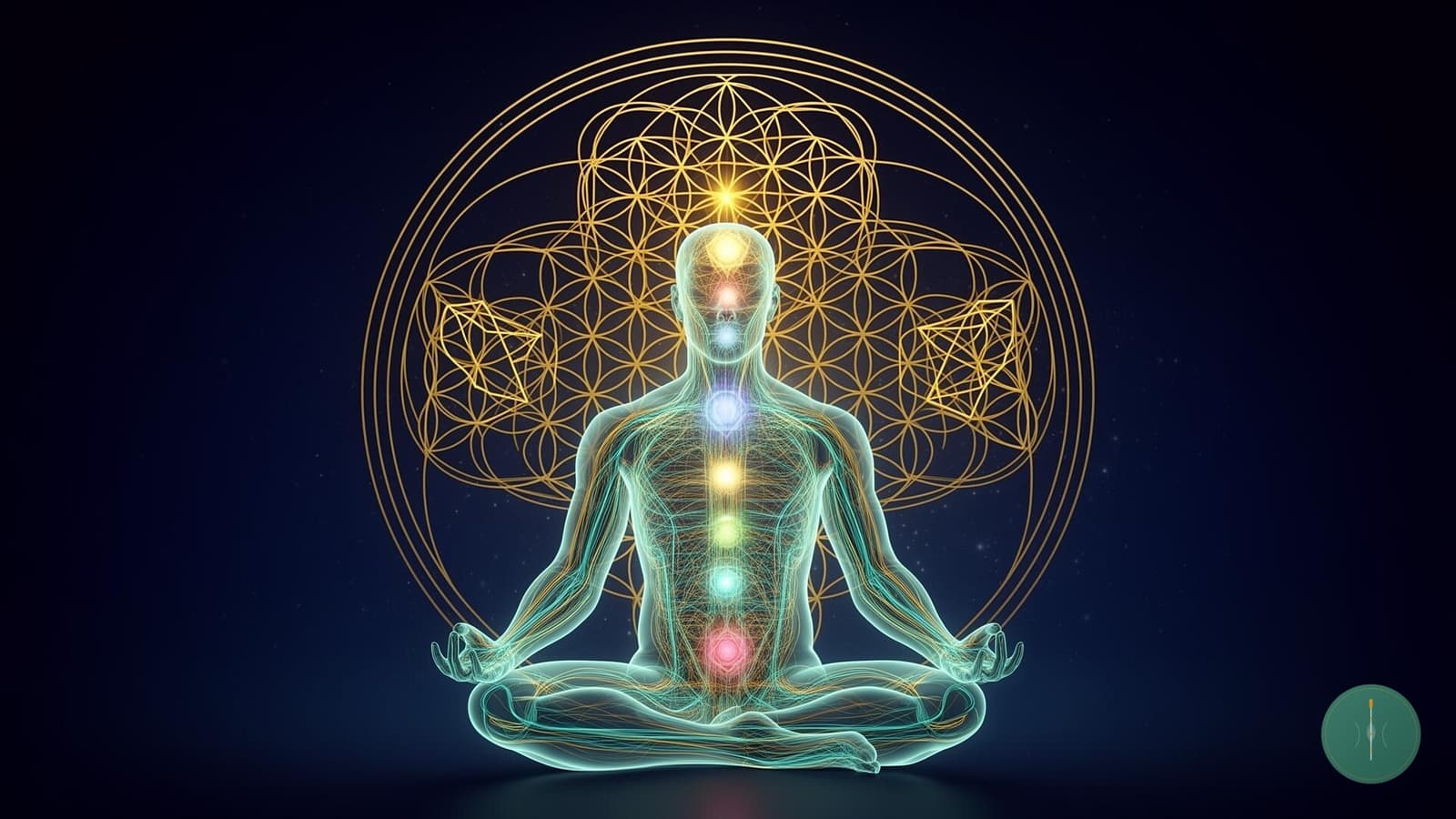
Esoteric Acupuncture is a system developed by Dr. Mikio Sankey (PhD, L.Ac.) that transcends conventional symptom-based needling. Rather than treating physical pathology alone, it uses specific needle sequences arranged in sacred geometric patterns — such as the Star of David, Flower of Life, and Merkaba — to harmonise the body's subtle energy fields and support the evolution of consciousness.
The system integrates three major healing traditions:
- Traditional Chinese Medicine (TCM) — meridian theory and Five Element correspondences
- Ayurvedic medicine — the seven-chakra energy system
- Sacred geometry — universal mathematical patterns found in nature and cosmology
This synthesis is not merely philosophical. Emerging research in biofield science, connective tissue biomechanics, and integrative neuroscience is beginning to provide frameworks for understanding how these traditions may share common physiological substrates.
Sacred Geometry in Needle Placement
The Golden Ratio and Biological Organisation
The golden ratio (φ ≈ 1.618) — found in the Fibonacci sequence, phyllotaxis, DNA helices, and the proportions of the human body — has long fascinated researchers seeking universal organising principles in biology. A comprehensive review in BioSystems examined the evidence for φ across physiology, psychology, and biomechanics, concluding that while some claims are overstated, genuine golden-ratio proportions do appear in multiple biological structures (Iosa et al., 2018).
Esoteric Acupuncture proposes that needle placement along geometric patterns — particularly those derived from the Flower of Life (a pattern of overlapping circles generating hexagonal symmetry) — resonates with these natural proportions. The theory holds that when needles are inserted in a sequence that traces a sacred geometric form, the resulting energetic field achieves greater coherence than conventional point combinations.
Connective Tissue as Geometric Substrate
The fascial network provides a potential biological mechanism for this geometric sensitivity. Langevin and Yandow demonstrated that acupuncture points and meridians correspond to intermuscular or intramuscular connective tissue planes throughout the body, suggesting a continuous fascial web that could transmit mechanical signals across geometric distances (Langevin & Yandow, 2002). A follow-up review confirmed that the fascia network may serve as the anatomical basis for acupoints and meridians, with its piezoelectric and liquid-crystalline properties enabling signal propagation (Bai et al., 2011).
New Encoding Patterns
Dr. Sankey's "New Encoding Patterns" (NEPs) are specific point sequences designed to be needled in a precise order, creating geometric forms on the body. Key patterns include:
- New Unity Pattern — DU-20 → Yintang → REN-17 → REN-4: a vertical axis aligning crown, third eye, heart, and root centres
- Inner Eye Pattern — focuses on activating the pineal gland region through triangular formations around Yintang
- Star of David — two interlocking triangles connecting upper and lower body points, symbolising the union of ascending and descending energies
- Merkaba Pattern — a three-dimensional star tetrahedron mapped across front and back body points
The needling sequence is critical: in Esoteric Acupuncture, the order in which needles are placed determines the direction of energy flow through the geometric form, much as the order of notes determines a melody.
Spin Field Theory and Biofield Science
The Biofield Concept
Central to Esoteric Acupuncture is the concept that the body generates and is organised by electromagnetic and subtle energy fields. The NIH-coined term "biofield" describes this organising principle. Rubik's foundational paper proposed that the biofield acts as a holistic regulatory system distinct from but interacting with the biochemical signalling network (Rubik, 2002).
Rubik and colleagues (including Hammerschlag) expanded this framework in a landmark review defining biofield science as the study of fields that are generated by and surround living systems, noting that electromagnetic, acoustic, and potentially other field phenomena may mediate biological regulation (Rubik et al., 2015). Their clinical review found preliminary evidence supporting biofield therapies for pain, anxiety, and quality of life (Jain et al., 2015).
Spin Fields and Torsion
Dr. Sankey's spin field theory proposes that each acupuncture point and chakra generates a toroidal (doughnut-shaped) vortex field — a concept paralleling modern physics descriptions of spin and torsion in field theory. While direct measurement of such subtle fields remains at the frontier of biophysics, the Indo-Tibetan medical systems have long described energy centres as spinning wheels (the literal meaning of chakra). Jain and colleagues (with Muehsam and Ventura) reviewed these traditions through a biofield lens, finding that Indo-Tibetan descriptions of pranic energy flow bear structural similarities to electromagnetic field descriptions in modern physiology (Jain et al., 2015).
The Subtle Body as Interoceptive Map
A pivotal paper in Annals of the New York Academy of Sciences proposed that the subtle body — the system of chakras, nadis, and meridians described across Asian medical traditions — may correspond to the brain's interoceptive mapping system. The authors argued that meditative practices that engage these subtle body maps produce measurable changes in central nervous system function, supporting a neurophysiological basis for chakra and meridian theory (Loizzo, 2016).
Turn This Knowledge Into a Treatment Plan
Enter any Western diagnosis and get a complete TCM treatment protocol — acupuncture points, herbal formulas, moxibustion, cupping, and gua sha recommendations.
The Ayurvedic–TCM Bridge
Marma Points and Acupuncture Points
One of the most concrete bridges between Ayurveda and TCM lies in the remarkable correspondence between marma points (107 vital energy points in Ayurvedic Sushruta tradition) and acupuncture points (361 classical TCM points). A 2023 comparative study published in the Journal of Ayurveda and Integrative Medicine systematically mapped marma–acupoint correspondences, finding significant anatomical and functional overlap, particularly at sites overlying major neurovascular bundles (Wu & Wang, 2023).
Chakra Acupuncture and Five-Phase Theory
The convergence of Ayurvedic chakra theory with TCM Five Element theory was explored in a 2018 paper in Medical Acupuncture. The authors developed a clinical framework mapping chakra personality archetypes onto Five-Phase personality types, demonstrating practical applications for "the geometry of emotions" — a synthesis that forms one of the theoretical pillars of Esoteric Acupuncture (Chase, 2018).
Chakra–Meridian Correspondence Table
Esoteric Acupuncture maps the seven major chakras to specific TCM points:
| Chakra | Sanskrit Name | TCM Points | Element (TCM) |
|---|---|---|---|
| Crown | Sahasrara | DU-20, DU-24 | Fire (Shen) |
| Third Eye | Ajna | Yintang, DU-24.5 | Water (Zhi) |
| Throat | Vishuddha | REN-22, REN-23 | Metal (Po) |
| Heart | Anahata | REN-17, PC-8, HT-7 | Fire (Shen) |
| Solar Plexus | Manipura | REN-12, ST-36 | Earth (Yi) |
| Sacral | Svadhisthana | REN-6, REN-4 | Water (Zhi) |
| Root | Muladhara | REN-1, DU-1, KI-1 | Earth (Yi) |
A cadaveric study provided neuroanatomical evidence for the Muladhara–pelvic plexus correspondence, demonstrating that the inferior hypogastric plexus maps precisely to the traditional location of the root chakra (Sweta et al., 2017).
Yoga, Meridians, and Functional Integration
The functional relationship between yoga (Ayurvedic movement therapy) and meridian regulation was investigated using electrodermal measures of acupuncture meridians. The study found that specific yoga practices could modulate meridian conductance, suggesting that the Ayurvedic and TCM energy systems share common physiological pathways (Sharma et al., 2014).
Vibrational Dietetics and Consciousness
Esoteric Acupuncture extends beyond needling to encompass vibrational dietetics — the concept that food carries energetic frequencies that affect not just physical health but also consciousness and subtle body coherence. This framework integrates:
- TCM food energetics — classifying foods by temperature (hot/cold), flavour (sour, bitter, sweet, pungent, salty), and meridian tropism
- Ayurvedic rasa theory — the six tastes (sweet, sour, salty, pungent, bitter, astringent) and their effects on the doshas
- Vibrational quality — the concept that whole, organic, minimally processed foods carry higher coherent energy than processed alternatives
Dr. Sankey recommends that patients receiving NEP treatments follow a diet emphasising high-vibration foods (fresh vegetables, sprouted grains, living foods) to support the integration of the geometric energy patterns established during treatment.
Clinical Integration: When to Consider Esoteric Acupuncture
Esoteric Acupuncture is typically indicated as a complementary layer added to conventional TCM treatment, particularly for patients presenting with:
- Emotional or spiritual stagnation — feeling "stuck" despite resolution of physical symptoms
- Post-trauma integration — supporting energetic coherence after physical or psychological trauma
- Meditation and consciousness practices — practitioners seeking to deepen their meditative experiences
- Chronic fatigue or burnout — where conventional treatment has addressed pathology but vitality has not returned
It is not a replacement for symptom-based acupuncture in acute or serious conditions. Rather, it represents an expansion of the treatment paradigm to address higher-frequency aspects of the energetic body.
Research Limitations and Future Directions
It is important to note that while the biofield and connective tissue research cited above provides suggestive frameworks, direct clinical trials of Esoteric Acupuncture as a distinct modality are currently lacking. The sacred geometry and spin field components remain largely theoretical, drawing on pattern recognition across traditions rather than reductionist experimental evidence.
Future research priorities include:
- Randomised controlled trials comparing NEP protocols against standard TCM point combinations
- Biofield measurement studies (EEG, HRV, biophoton emission) during NEP treatments
- Systematic mapping of marma–acupoint–chakra correspondences with modern imaging
- Investigation of needle sequence effects on fascial signal propagation
Using MediChi for Esoteric Acupuncture
MediChi's Esoteric Acupuncture page features an interactive sacred geometry diagram where you can explore the major New Encoding Patterns — including the New Unity, Inner Eye, Star of David, and Merkaba patterns — with point-by-point needle sequences and clinical applications. Visit the Esoteric Acupuncture reference to explore these patterns interactively.
Frequently Asked Questions
What is esoteric acupuncture?
How does sacred geometry relate to acupuncture point selection?
Is esoteric acupuncture suitable for all patients?
All Citations Verified12/12
Every PubMed citation in this article has been manually verified against its source.
💡 💡 Tip: Press and hold on citation links to open them in your browser.
Derek Doran, BHSc (Acupuncture)
AHPRA Registered (CMR0002211465) · AACMA Member
Derek is the founder of MediChi and a registered acupuncturist with clinical expertise in integrating Western diagnoses with Traditional Chinese Medicine treatment protocols.
Clinically reviewed: April 3, 2026