Digital Demeanor: Can Your Doctor Still Read Your Face Through a Screen? — Modern Nèi Jīng Ch.15
Medically Reviewed by Derek Doran, BHSc (Acupuncture) · AHPRA Registered · AACMA Member · Updated April 3, 2026
The Lost Art of Truly Seeing
Before blood panels, MRIs, and genomic sequencing, a skilled physician could assess your prognosis from the colour of your face. Not metaphorically — literally. The five facial colours (五色, wǔ sè) were a diagnostic technology so precise that the Sù Wèn devoted entire chapters to their clinical application.
Chapter 15 (玉版論要, Yù Bǎn Lùn Yào — Treatise on the Essentials of the Jade Editions) is one of the most clinically consequential chapters in the Nèi Jīng. It addresses the correlation between complexion, pulse, and prognosis — including when the signs indicate death.
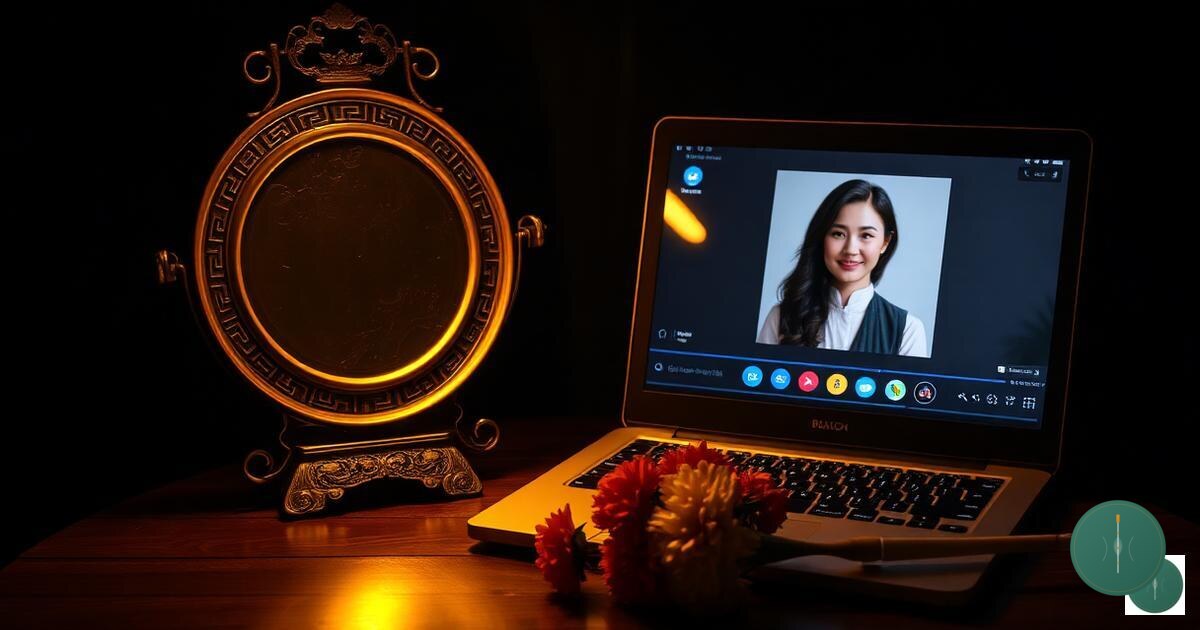
In 2026, this art faces an unprecedented challenge: the patient's face is mediated by screens, altered by filters, and illuminated by blue light rather than daylight.
📖 Read the full interactive chapter with classical Chinese source footnotes: Modern Nèi Jīng Chapter 15
The Five Colours: A Diagnostic Framework
In TCM, the face is a microcosm of the internal organs. Each region corresponds to a specific Zàng organ, and the colour that appears there reveals the state of that organ's Qì, Blood, and Spirit:
| Facial Colour | Associated Organ | Healthy Sign | Pathological Sign |
|---|---|---|---|
| Green/Blue (青) | Liver | Faint, lustrous tint at temples | Dark, stagnant blue → Liver Qì stagnation, pain |
| Red (赤) | Heart | Gentle flush at cheeks | Intense red → Heart Fire; dull red → Blood stasis |
| Yellow (黄) | Spleen | Warm, golden glow | Sallow, waxy yellow → Spleen Qì deficiency, Dampness |
| White (白) | Lung | Clear, bright complexion | Pale, bloodless → Qì/Blood deficiency, Cold |
| Black (黑) | Kidney | Subtle depth at chin/under-eyes | Dark, ashen → Kidney exhaustion, Water pathology |
The critical distinction is between a lustrous colour (有光澤, yǒu guāng zé) — indicating the Qì is intact even if pathology is present — and a withered colour (枯, kū) — indicating the vital essence is depleted. A lustrous pathological colour has a better prognosis than a withered normal colour.
The Screen Problem: Blue Light, Filters, and Flatscreens
Huáng Dì's concern in the modern retelling is pragmatic: "With filters on social media, perpetual screen glare, and the artificial glow of energy drinks, how can a practitioner truly discern the underlying vital Qì?"
The challenges are real and clinically significant:
1. Blue Light Distortion
LED and OLED screens emit disproportionate blue-spectrum light (440–490 nm). Patients who spend 8+ hours screen-exposed may present with a bluish cast that mimics Liver disharmony — but it's environmental, not endogenous. Equally, the practitioner's own screen during a telehealth call may colour-shift the patient's complexion.
2. Camera Compression
Most consumer webcams compress colour data aggressively. Subtle shifts in yellow (Spleen pathology) or green (Liver stagnation) can be flattened into a uniform skin tone, eliminating the diagnostic signal entirely.
3. Beauty Filters
Auto-beauty filters — now default in many video platforms — actively remove diagnostic information: dark circles (Kidney deficiency), uneven pigmentation (Blood stasis), and pallor (Qì deficiency) are algorithmically "corrected."
4. Artificial Lighting
Incandescent light flatters the complexion; fluorescent light drains it. A patient in warm home lighting may appear more lustrous (better prognosis) than they actually are, while a patient under office fluorescents may appear more pathological.
Computerised Complexion: AI Meets Wàng Zhěn
Interestingly, researchers have begun developing computational systems to standardise facial colour analysis in TCM. By using calibrated imaging under controlled lighting conditions, these systems can extract the five-colour parameters from facial photographs with greater consistency than the human eye in sub-optimal conditions (Zhao et al., 2014).
Machine learning models trained on thousands of annotated facial images can now classify TCM complexion patterns with clinically meaningful accuracy, particularly when combined with other diagnostic inputs like tongue imaging (Li et al., 2012).
However, these tools remain supplements — not replacements — for the trained practitioner's holistic assessment. A computer can measure hue; only a clinician can assess shén (spirit) — the quality of animation, vitality, and presence that distinguishes a living complexion from mere data points.
Turn This Knowledge Into a Treatment Plan
Enter any Western diagnosis and get a complete TCM treatment protocol — acupuncture points, herbal formulas, moxibustion, cupping, and gua sha recommendations.
The Pulse Contradiction: When Colours Lie
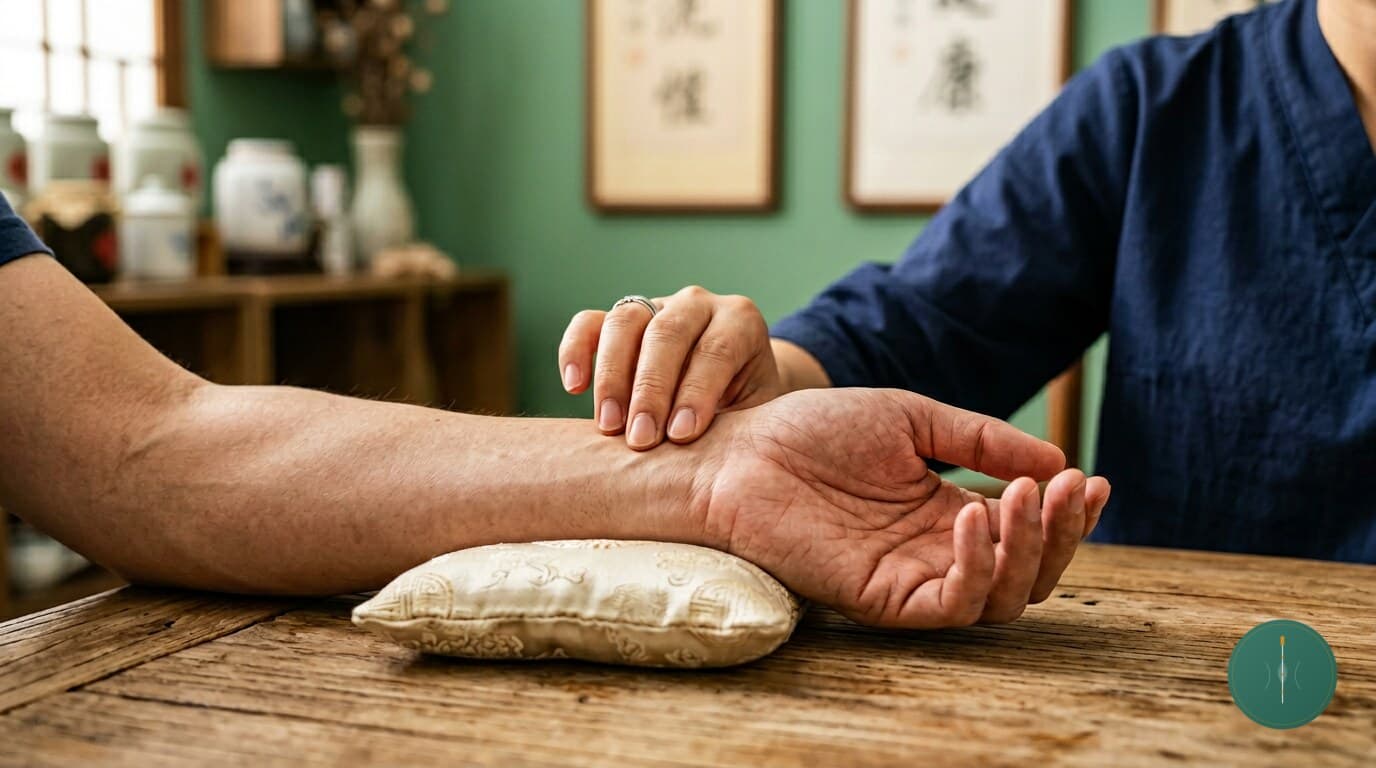
Chapter 15 emphasises a critical prognostic principle: when the complexion and pulse contradict each other, the prognosis is grave.
Qí Bó's instruction is direct: "If the complexion appears vibrant, yet the pulse is weak and thready, or conversely, a pallid complexion accompanies a full, strong pulse, these contradictions are critical."
This is not merely historical curiosity. In modern practice:
- A patient who "looks well" (good facial colour) but has a weak, thready pulse may be masking severe Qì depletion — common in adrenal fatigue, late-stage chronic illness, or pharmaceutical suppression of symptoms
- A patient who "looks terrible" (pallid, dark complexion) but has a strong, wiry pulse may have an acute excess condition trapped beneath constitutional deficiency
Pulse diagnosis remains the indispensable counterweight to visual observation (Bilton et al., 2016). This is precisely why telehealth alone — without physical palpation — is inherently limited for TCM assessment.
Wearables: A Partial Bridge?
Heart rate variability (HRV) data from wearable devices can provide some objective physiological data during remote consultations. However, wearable accuracy varies significantly across devices and skin tones, and the data captures only a fraction of what a skilled practitioner detects in the pulse — depth, width, rhythm quality, and organ-position specificity are all lost (Shcherbina et al., 2017).
The Biohacking Paradox
Huáng Dì raises another modern concern: "What about those who biohack their appearances — supplements, cosmetic procedures, even IV drips — to alter their natural presentation?"
Qí Bó's answer is characteristically grounded: "The superficial can never truly obscure the profound."
This maps directly to clinical experience. A patient who uses retinoids, collagen supplements, and cosmetic fillers may appear more youthful, but:
- The lustre (or lack thereof) of the skin cannot be faked
- The spirit in the eyes (shén in the gaze) is unaffected by topical interventions
- The quality of the voice, the smell of the body, and the pulse under the fingers all tell the story the face may try to hide
In TCM, the Four Pillars work as a system of cross-validation. Any single pillar can be deceived; the four together are remarkably reliable.
Chronic Stress: The Universal Complexion Destroyer
Perhaps the most relevant modern factor is chronic psychological stress. The Nèi Jīng consistently links emotional states to organ function and complexion. Modern psychoneuroimmunology confirms this: chronic stress dysregulates the HPA axis, increases inflammatory cytokines, and impairs microcirculation — all of which directly affect skin colour and quality (Dhabhar, 2014).
In TCM terms:
- Chronic anger/frustration → Liver Qì stagnation → greenish/dusky complexion
- Chronic worry/overthinking → Spleen Qì depletion → sallow yellow
- Chronic fear/overwork → Kidney essence exhaustion → dark under-eyes, ashen tone
- Chronic grief → Lung Qì deficiency → pale, lacklustre white
The modern lifestyle — relentless notifications, financial precarity, information overload, and social comparison via curated feeds — creates a compound complexion pattern that the classics describe as "the five injuries" (五勞, wǔ láo).
Clinical Takeaway: Seeing Beyond the Screen
The art of complexion diagnosis is not obsolete — it is more necessary than ever. But it must adapt:
For In-Person Practice
- Observe the patient in natural light whenever possible
- Always correlate the complexion with the pulse — never diagnose on colour alone
- Look for the lustre (shén in the complexion), not just the hue
- Note the distribution of colour changes (which facial zone? which organ?)
For Telehealth
- Ask patients to disable beauty filters and use natural lighting
- Request a brief tongue photo under standardised conditions — tongue diagnosis is more camera-resilient than complexion (Yi et al., 2024)
- Supplement visual observation with HRV data from wearables where available
- Always schedule in-person pulse assessment for serious or ambiguous presentations
The Deeper Lesson
As Qí Bó reminds us: "The body, regardless of the era, remains an honest messenger. Our task is to learn its language, to look beyond the surface, and to understand the profound interactions of spirit, Qì, and Blood in the dance of life and death."
The technology changes. The body's honesty does not.
Explore More on MediChi
- Modern Nèi Jīng — All Chapters — Read the complete modern retelling of the Yellow Emperor's Classic
- Tongue Diagnosis Tool — AI-powered tongue analysis for remote assessment
- AI Diagnosis Tool — Translate any Western condition into a TCM treatment plan
- Pulse Diagnosis Guide — Master the 28 classical pulse types
- Four Pillars of TCM Diagnosis — The complete diagnostic framework
Frequently Asked Questions
What is complexion diagnosis in TCM?
Can TCM diagnosis work through telehealth?
How do the five facial colours map to organs in TCM?
All Citations Verified6/6
Every PubMed citation in this article has been manually verified against its source.
💡 💡 Tip: Press and hold on citation links to open them in your browser.
Derek Doran, BHSc (Acupuncture)
AHPRA Registered (CMR0002211465) · AACMA Member
Derek is the founder of MediChi and a registered acupuncturist with clinical expertise in integrating Western diagnoses with Traditional Chinese Medicine treatment protocols.
Clinically reviewed: April 3, 2026