Understanding the Four Pillars of TCM Diagnosis: Inspection, Auscultation, Inquiry & Palpation
Medically Reviewed by Derek Doran, BHSc (Acupuncture) · AHPRA Registered · AACMA Member · Updated April 3, 2026
The Foundation of TCM Clinical Practice
In Western medicine, diagnosis often begins with lab tests, imaging, and biomarkers. In Traditional Chinese Medicine, the diagnostic process begins — and often ends — with the practitioner's own senses.
The Sì Zhěn (四诊), or Four Diagnostic Methods, have been the cornerstone of TCM clinical assessment since the Nàn Jīng (难经) and the Huáng Dì Nèi Jīng (黄帝内经). Together, they provide a multi-dimensional clinical picture that guides pattern differentiation (Biàn Zhèng, 辨证) and treatment strategy.
"The superior physician observes the spirit; the mediocre physician observes the body; the inferior physician observes the disease."
— Huáng Dì Nèi Jīng
Pillar 1: Inspection (Wàng Zhěn, 望诊)
Wàng (望) means "to observe." This pillar is considered the most important by many classical sources — the physician who can diagnose through observation alone was regarded as a master.
What You Observe
- Shén (神) — Vitality and Spirit: The patient's overall presence. Bright eyes, coherent speech, and fluid movement indicate good Shén. Dull eyes, scattered attention, or listlessness indicate Shén disturbance.
- Complexion (Sè, 色): Facial colour reveals organ and pattern states:
- Pale/white → Blood or Yáng deficiency
- Red/flushed → Heat (full or empty)
- Yellow → Dampness or Spleen deficiency
- Blue-green/dark → Blood stasis, pain, or Liver pathology
- Black/dark under eyes → Kidney deficiency
- Body shape and posture: Obesity may indicate Phlegm-Damp; emaciation may indicate Yīn or Blood deficiency.
- Movement: Restless movement indicates excess or Heat; slowness and lethargy indicate deficiency or Cold.
Tongue Diagnosis (Shé Zhěn, 舌诊)
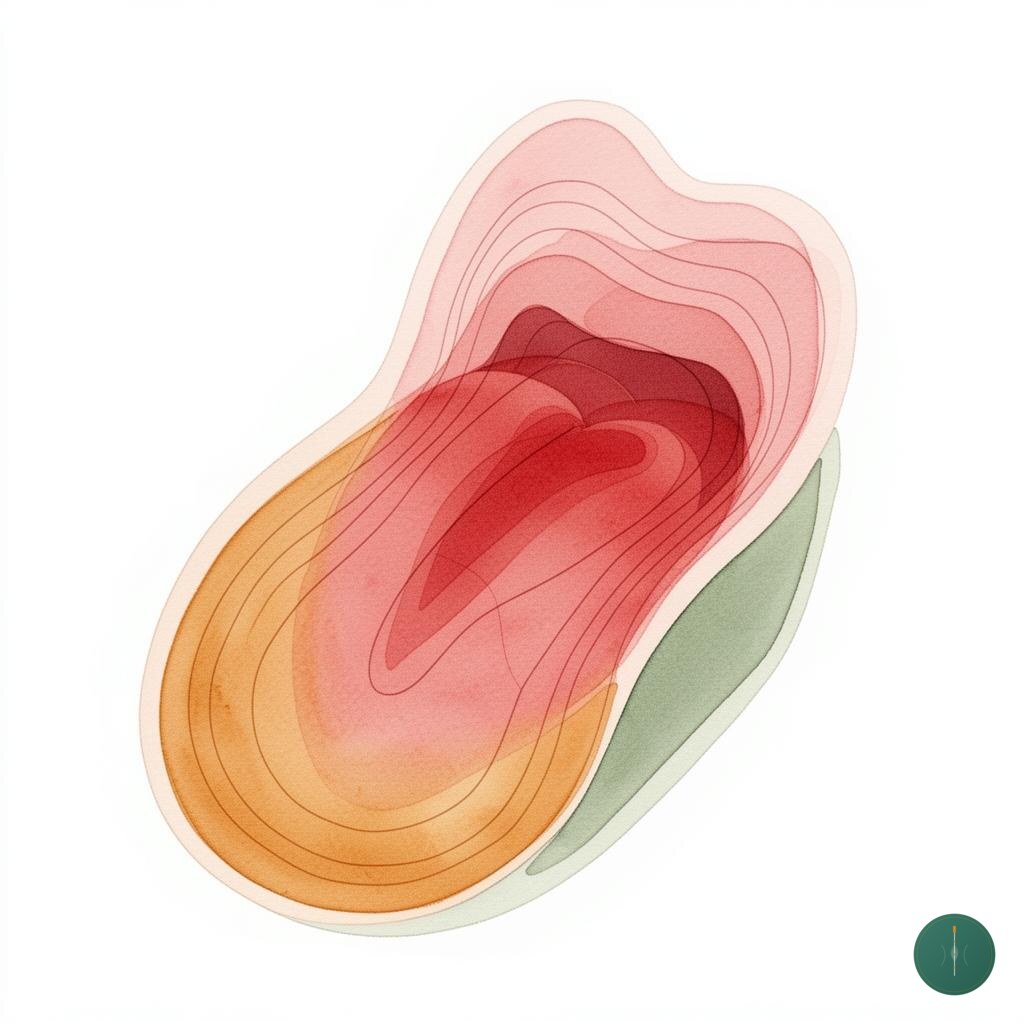
Tongue diagnosis is the most developed and clinically relied-upon aspect of inspection. The tongue is considered a map of the internal organs — each region reflects a different Zàng-Fǔ organ system.
Tongue Body (Shé Zhì, 舌质):
| Feature | Clinical Significance |
|---|---|
| Pale | Qì or Blood deficiency, Cold |
| Red | Heat (excess or deficiency) |
| Dark red/crimson | Extreme Heat, Blood level Heat |
| Purple | Blood stasis |
| Swollen with teeth marks | Spleen Qì deficiency, Dampness |
| Thin | Blood or Yīn deficiency |
| Stiff/deviated | Wind (internal or external) |
Tongue Coating (Shé Tāi, 舌苔):
| Feature | Clinical Significance |
|---|---|
| Thin white | Normal, or early-stage external condition |
| Thick white | Cold-Damp, internal Cold |
| Yellow | Heat |
| Thick greasy | Phlegm-Damp or Food stagnation |
| Peeled/no coating | Stomach or Kidney Yīn deficiency |
| Grey/black | Extreme Cold or extreme Heat |
💡 Clinical tip: Always examine the tongue in natural light. Artificial lighting and recent food/drink can distort colour assessment. Ask the patient to avoid coffee, coloured foods, and tongue scraping before the visit.
Research has increasingly supported the diagnostic validity of tongue assessment. Tania et al. (2019) published a comprehensive review of advances in automated tongue diagnosis, finding strong correlations between tongue features and TCM pattern classifications. O'Brien & Birch (2009) further reviewed the reliability of traditional East Asian medicine diagnoses, including tongue assessment methods.
Pillar 2: Auscultation & Olfaction (Wén Zhěn, 闻诊)
Wén (闻) means both "to listen" and "to smell" — this pillar combines auscultation (listening) and olfaction (smelling) into a single diagnostic method.
Listening
- Voice quality: A loud, forceful voice indicates excess; a weak, breathy voice indicates deficiency.
- Breathing: Loud, coarse breathing suggests Lung Heat or Phlegm; shallow, weak breathing suggests Lung Qì deficiency.
- Cough: A dry cough indicates Yīn deficiency or Dryness; a productive cough with copious phlegm indicates Phlegm-Damp.
- Sighing: Frequent sighing indicates Liver Qì stagnation.
- Hiccups/belching: Stomach Qì rebelling upward.
- Groaning: Kidney deficiency (the sound associated with the Water element).
Smelling
- Body odour: A sour smell relates to Liver; a burnt smell relates to Heart; a fragrant/sweet smell relates to Spleen; a rank/fishy smell relates to Lung; a putrid smell relates to Kidney.
- Breath: Foul breath may indicate Stomach Heat or Food stagnation.
- Stool and urine odour: Strong odours indicate Heat; minimal odour indicates Cold or deficiency.
While less emphasised in modern clinical practice, the Nèi Jīng considered olfactory diagnosis essential. Each of the Five Elements produces a characteristic smell that skilled practitioners can detect.
Pillar 3: Inquiry (Wèn Zhěn, 问诊)
Wèn (问) means "to ask." This is often the most time-intensive pillar and yields the richest clinical data. The classical framework is based on the Ten Questions (Shí Wèn, 十问), attributed to the Qīng Dynasty physician Zhāng Jǐng-Yuè (张景岳).
The Ten Questions Framework
1. Chills and Fever — Distinguishes external from internal, Hot from Cold patterns. Chills predominating suggest Cold or exterior Wind-Cold; fever predominating suggests Heat.
2. Perspiration — Spontaneous sweating (Qì deficiency, Wèi Qì weakness); night sweats (Yīn deficiency); no sweating with fever (exterior excess).
3. Head and Body — Headache location maps to affected meridians: frontal (Yáng Míng), temporal (Shào Yáng), occipital (Tài Yáng), vertex (Jué Yīn). Body aches indicate Bì syndrome or external pathogen invasion.
4. Urination and Stool — Frequent clear urine (Kidney Yáng deficiency); dark scanty urine (Heat); loose stools (Spleen Qì deficiency); constipation (Heat, Qì stagnation, or Blood/Yīn deficiency).
5. Diet and Appetite — No appetite (Spleen Qì deficiency); excessive hunger (Stomach Heat/Fire); cravings for specific flavours indicate organ imbalances.
6. Chest and Abdomen — Chest oppression (Phlegm, Qì stagnation); epigastric fullness (Food stagnation); hypochondriac pain (Liver Qì stagnation).
7. Hearing and Vision — Tinnitus (Kidney deficiency or Liver Fire); blurred vision (Liver Blood deficiency); floaters (Liver Yīn deficiency).
8. Sleep — Insomnia with difficulty falling asleep (Blood deficiency); waking at 3–5am (Liver or Lung pattern); excessive sleepiness (Spleen Qì deficiency, Dampness).
Turn This Knowledge Into a Treatment Plan
Enter any Western diagnosis and get a complete TCM treatment protocol — acupuncture points, herbal formulas, moxibustion, cupping, and gua sha recommendations.
9. Gynecological/Reproductive History — Menstrual cycle regularity, colour, volume; fertility; sexual function; menopausal symptoms.
10. Past History and Lifestyle — Previous illnesses, medications, emotional stressors, work patterns, diet, exercise, and constitutional tendencies.
🏥 MediChi's diagnostic questionnaire is built directly on this Ten Questions framework, collecting data on duration, severity, time-of-day patterns, temperature tendencies, emotional state, digestion, sleep, and energy — digitising the classical Wèn Zhěn method.
Pillar 4: Palpation (Qiè Zhěn, 切诊)
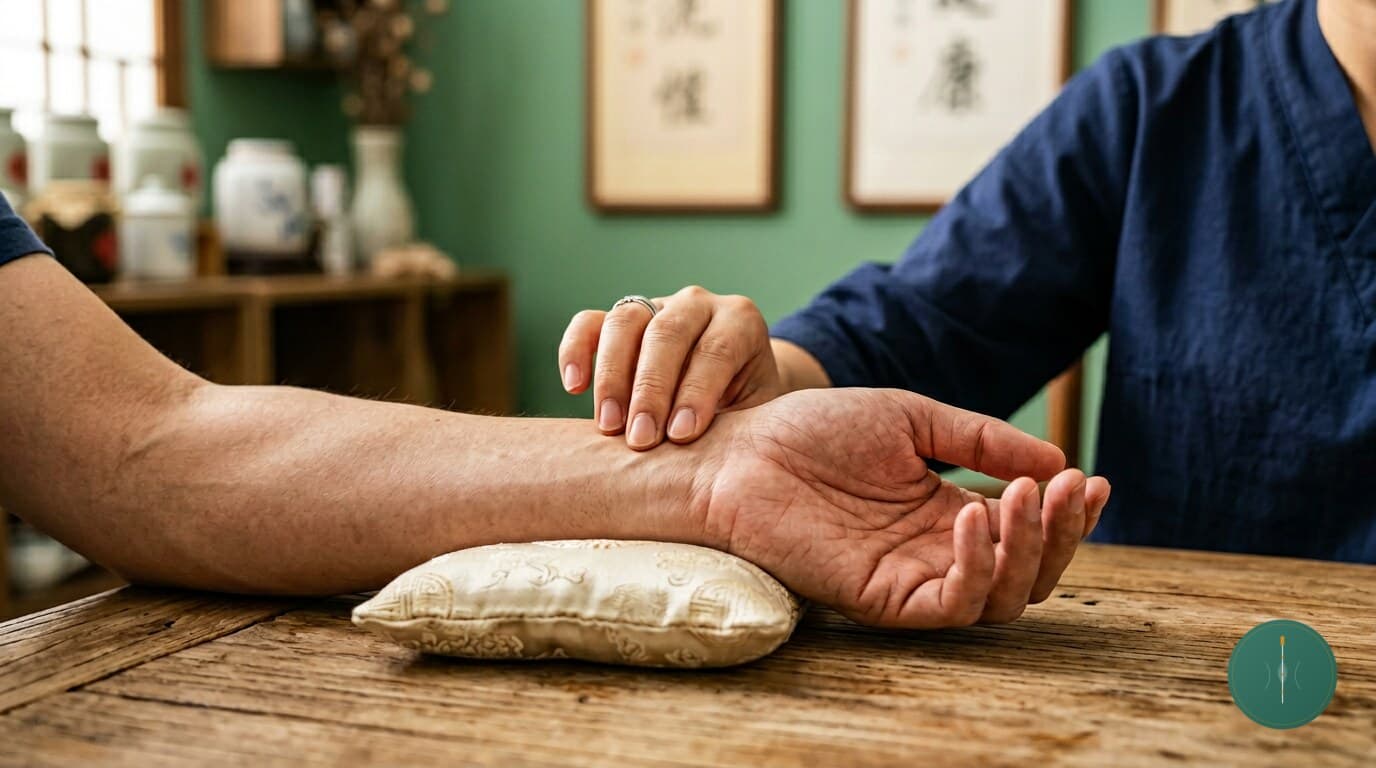
Qiè (切) means "to press" or "to touch." Palpation encompasses pulse diagnosis and body palpation — and pulse diagnosis alone could fill an entire textbook.
Pulse Diagnosis (Mài Zhěn, 脉诊)
The radial pulse is taken at the wrist in three positions, each reflecting different organ systems:
| Position | Left Hand | Right Hand |
|---|---|---|
| Cùn (寸) — Distal | Heart / Pericardium | Lung |
| Guān (关) — Middle | Liver / Gallbladder | Spleen / Stomach |
| Chǐ (尺) — Proximal | Kidney Yīn | Kidney Yáng / Míng Mén |
The practitioner assesses the pulse at three depths (superficial, middle, deep) across all three positions, evaluating:
- Rate: Fast (Heat), slow (Cold)
- Strength: Forceful (excess), weak (deficiency)
- Width: Thin/thready (Blood/Yīn deficiency), large/surging (Heat)
- Shape: Wiry/taut (Liver Qì stagnation, pain), slippery (Phlegm, Dampness, pregnancy), choppy (Blood stasis)
- Depth: Floating (exterior pattern), deep/sinking (interior pattern)
- Rhythm: Regular, irregular, intermittent (Heart Qì or Yáng deficiency)
The classical texts describe 28 pulse qualities (二十八脉), though in clinical practice most practitioners work fluently with 8–12 key pulse types. Ko et al. (2013) demonstrated that structured pulse diagnosis protocols can achieve meaningful interobserver reliability, validating traditional methods through modern research design.
💡 Clinical tip: Take the pulse for a minimum of one minute. The first few seconds often reflect the patient's anxiety about the visit — wait for the pulse to settle before recording your findings.
Body Palpation
Beyond the pulse, practitioners also palpate:
- Abdomen (Fù Zhěn, 腹诊): Widely used in Japanese acupuncture (Hara diagnosis). Tenderness, tension, or pulsation in specific regions maps to organ dysfunction.
- Meridian palpation: Ashi (tender) points, nodules along meridian pathways, and temperature differences between body regions.
- Back-Shū points: Pressing the Bladder meridian paravertebral points to assess organ function and reactivity.
Integrating the Four Pillars
No single pillar provides a complete diagnosis. The art of TCM diagnosis lies in cross-referencing findings across all four methods. Consider this clinical scenario:
Patient presents with insomnia and fatigue.
| Pillar | Finding | Interpretation |
|---|---|---|
| Inspection | Pale complexion, swollen tongue with teeth marks, thin white coating | Spleen Qì deficiency |
| Auscultation | Soft voice, sighing | Qì deficiency + Liver Qì stagnation |
| Inquiry | Worry, poor appetite, loose stools, wakes at 3am, unrefreshing sleep | Spleen deficiency + Liver involvement |
| Palpation | Thin, weak pulse at Guān (right); wiry at Guān (left) | Spleen Qì deficiency + Liver Qì stagnation |
Integrated pattern: Heart-Spleen Blood Deficiency with Liver Qì Stagnation → Treatment principle: Tonify Heart and Spleen, nourish Blood, soothe the Liver → Formula: Modified Guī Pí Tāng with Xiāo Yáo Sǎn elements.
Lu et al. (2009) demonstrated that TCM pattern differentiation can identify specific patient subgroups more likely to respond to biomedical therapies, validating the clinical utility of the four pillars approach. Li et al. (2015) further advanced evidence-based patient classification using TCM diagnostic data, bridging the gap between traditional pattern recognition and reproducible clinical assessment.
Common Diagnostic Errors
1. Over-relying on a single pillar — A dramatic tongue finding should be corroborated by pulse and inquiry data.
2. Ignoring the Shén — If the patient has good Shén despite alarming symptoms, the prognosis is better than the symptoms suggest.
3. Confusing excess with deficiency — A patient who is loud and agitated may have excess Heat, or may have empty Heat from Yīn deficiency. The pulse and tongue differentiate.
4. Neglecting lifestyle inquiry — Two patients with identical tongue and pulse findings may need completely different treatments based on lifestyle factors.
5. Not re-examining — The Four Pillars are not a one-time assessment. Re-evaluate at every visit to track pattern evolution.
Practice Exercise
Next time you see a patient, try this structured approach:
1. Before the patient speaks: Observe their Shén, complexion, posture, and movement (Wàng).
2. As they describe their complaint: Listen to voice quality, breathing, and sighing patterns (Wén).
3. During inquiry: Follow the Ten Questions framework systematically (Wèn).
4. At the pulse: Spend a full 60 seconds. Note rate, depth, strength, and quality at all six positions (Qiè).
5. Integrate: Write down your findings from all four pillars before formulating your pattern diagnosis.
Using MediChi for Diagnostic Training
MediChi's AI-powered diagnostic tool demonstrates the Sì Zhěn integration process in action. Enter a Western condition like "chronic fatigue" or "migraine" and complete the clinical questionnaire — which mirrors the Ten Questions framework — to see how the AI synthesises your input into a coherent TCM pattern differentiation with acupuncture, herbal, and adjunct therapy recommendations.
🔗 Try it now: Run a diagnosis on the homepage | Explore the Pattern Differentiation guide
Frequently Asked Questions
What are the four pillars of TCM diagnosis?
Which of the four pillars is most important?
How long does a four-pillar TCM intake take?
All Citations Verified5/5
Every PubMed citation in this article has been manually verified against its source.
💡 💡 Tip: Press and hold on citation links to open them in your browser.
Derek Doran, BHSc (Acupuncture)
AHPRA Registered (CMR0002211465) · AACMA Member
Derek is the founder of MediChi and a registered acupuncturist with clinical expertise in integrating Western diagnoses with Traditional Chinese Medicine treatment protocols.
Clinically reviewed: April 3, 2026