    Annual subscribers now receive The Modern Nèi Jīng FREESubscribe AnnuallyClinical Education ToolThis platform provides educational resources for TCM practitioners and students. It does not issue medical certificates, prescriptions, or clinical diagnoses.
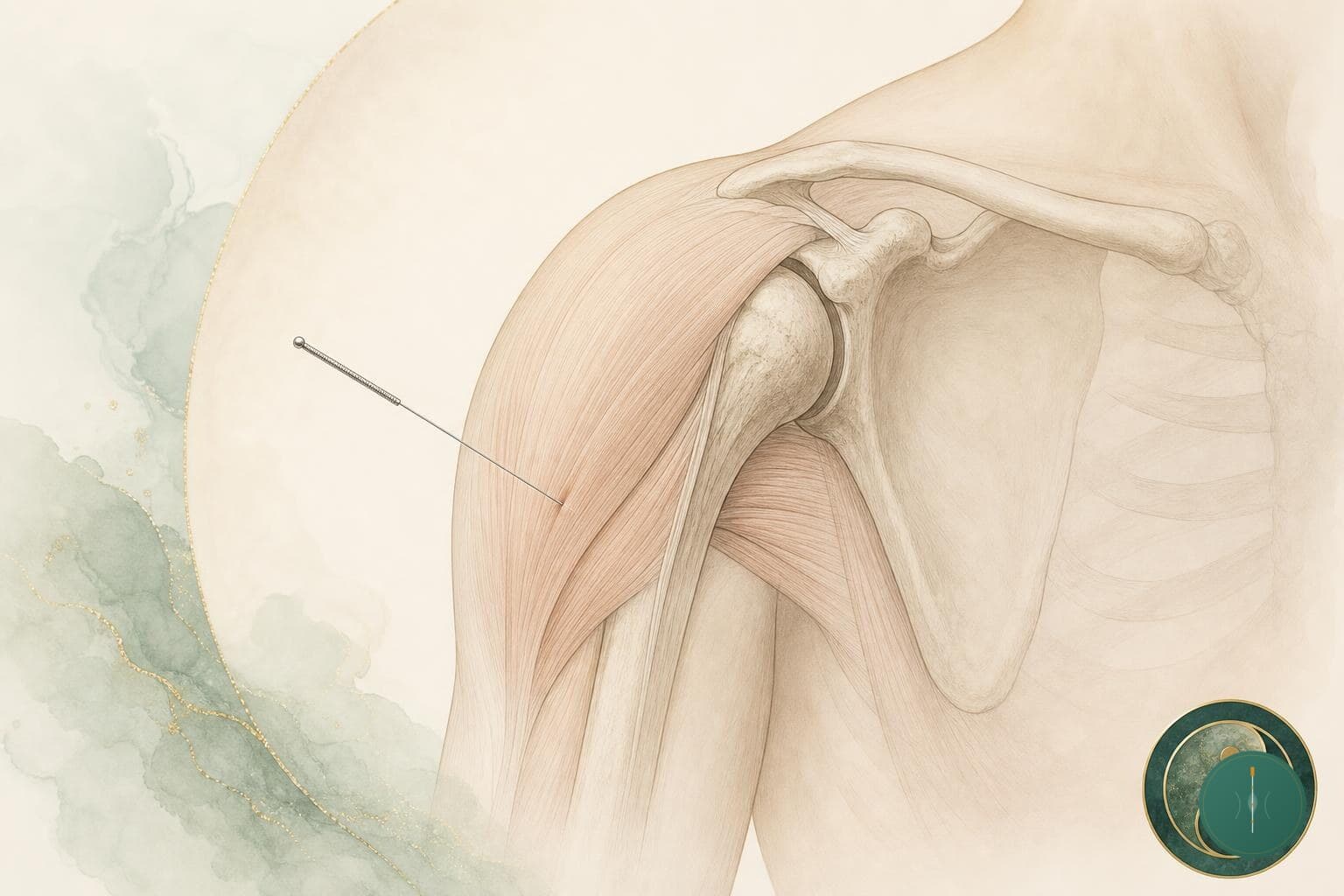
    Soft anatomical line illustration of a human shoulder joint with a single fine acupuncture needle near the deltoid, jade and gold accents, with the Medi-Chi brand mark in the lower right
    Frozen ShoulderAdhesive CapsulitisAcupunctureMusculoskeletalPattern DifferentiationClinical Practice

    Frozen Shoulder and Acupuncture: A Clinical Guide for Practitioners and Patients

    Medically Reviewed by Derek Doran, BHSc (Acupuncture) · AHPRA Registered · AACMA Member · Updated May 19, 2026

    May 19, 202612 min readBy Derek Doran, BHSc (Acupuncture)

    A Condition That Rewards Staging

    Frozen shoulder is one of those diagnoses where the when matters as much as the what. Treat a freezing-phase shoulder with the technique you'd use in the thawing phase and you'll set the patient back a fortnight. Treat a thawing-phase shoulder with the technique you'd use in the freezing phase and you'll achieve nothing. The condition is the same. The clinical task isn't.

    The good news for the acupuncture profession is that the modern evidence base now backs what experienced clinicians have always known — that needling, used at the right phase and combined with movement therapy, makes a measurable difference to pain, range of motion and quality of life. A 2024 systematic review and meta-analysis in Pain Management Nursing combined acupuncture with physical therapy and showed consistent improvements over physical therapy alone (Xu B et al., 2024). A 2026 systematic review in Medical Acupuncture extended that finding across general shoulder pain populations (Trinh K et al., 2026). A 2025 network meta-analysis in Healthcare ranked acupuncture favourably among multiple therapies for painful shoulder conditions (Chen KH et al., 2025).

    This article is the working clinical playbook for treating adhesive capsulitis with acupuncture — the staging, the pattern differentiation, the point selection by phase, and the realistic conversation to have with the patient before the first needle goes in.

    What Frozen Shoulder Actually Is

    In Western terms, adhesive capsulitis is a progressive inflammation and fibrosis of the glenohumeral joint capsule. The capsule thickens, contracts and adheres to the humeral head, producing the characteristic loss of both active and passive range of motion in a capsular pattern — external rotation is hit hardest, then abduction, then internal rotation.

    It runs through three overlapping phases:

    1. Freezing (painful inflammatory) phase — weeks 6 to 36. Pain dominates. Night pain disrupts sleep. Range of motion begins to drop.

    2. Frozen (adhesive) phase — months 4 to 12. Pain settles somewhat; stiffness becomes the headline complaint.

    3. Thawing (resolution) phase — months 12 to 30+. Range of motion gradually returns, often incompletely.

    It's most common in the 40–60 age bracket, in women slightly more than men, and over-represented in patients with diabetes, thyroid disease and a recent period of shoulder immobilisation (post-surgery, sling, sleeping pattern change). In Derek's WorkCover and general clinic experience in Australia, the typical presentation is a tradie or office worker who slept funny one night, "tweaked" the shoulder, and six weeks later cannot reach behind their back.

    What Frozen Shoulder Is in Chinese Medicine

    The classical TCM names tell the story. Jiān níng zhèng (肩凝症, "congealed shoulder") describes the felt experience — something thick, sticky, immobile. Lòu jiān fēng (漏肩风, "leaking shoulder wind") describes the typical exposure history — wind-cold sneaking in through an uncovered shoulder, especially after sweat, sleep or middle-aged Qi decline. Wǔ shí jiān (五十肩, "fifty-year-old shoulder") simply describes the demographic.

    Pattern-wise, frozen shoulder is almost always a Bi syndrome at the shoulder channels — most often Wind-Cold-Damp Bi at the Large Intestine, Small Intestine, San Jiao and Lung channels that course over the shoulder. Underneath the Bi presentation sits one of two constitutional pictures:

    • Qi and Blood deficiency Bi — older patients, gradual onset, the channel is "empty" and easily invaded. The shoulder feels heavy, cold, and aches more with rest than with use.
    • Qi stagnation and Blood stasis Bi — sharper, fixed pain, often a clear traumatic or postural trigger, worse with movement and at night.

    Reading the underlying constitutional pattern is what tells you whether the treatment plan needs to lean on moxa and tonification (deficiency Bi) or on strong reducing technique, bleeding and cupping (stasis Bi). Get this part wrong and you can needle accurately for weeks without much movement.

    For the broader Bi-syndrome framework see our meridian theory and Blood Stasis patterns articles.

    The First Visit: Differentiating, Staging, Excluding

    Before treatment, three things have to be established at the first visit. Skip any of them and the plan won't hold up.

    1. Confirm it's actually frozen shoulder

    The differential matters. Rotator cuff tendinopathy, subacromial impingement, AC joint arthritis, cervical radiculopathy, calcific tendinopathy and referred visceral pain (gallbladder, cardiac) can all present as a painful, stiff shoulder. The defining feature of adhesive capsulitis is loss of passive external rotation with the elbow at the side — the patient cannot move it, and you cannot move it either. If passive range is preserved and only active range is restricted, you're not looking at a true frozen shoulder.

    A short structured assessment at the first visit (Hawkins-Kennedy, Neer, empty can, passive external rotation, scapular rhythm) takes five minutes and pays for itself across the next twelve weeks.

    2. Stage it

    PhaseDurationDominant complaintTreatment leaning
    Freezing6 weeks – 9 monthsPain, especially at nightPain modulation, gentle channel work, no aggressive ROM
    Frozen / Adhesive4 – 12 monthsStiffnessStronger needling, electroacupuncture, cupping, persistent ROM work
    Thawing12 – 30+ monthsResidual restriction, fatigueLight maintenance, home program, reinforcement

    3. Screen for red flags and contraindications

    Unexplained weight loss, night pain unrelieved by position, history of cancer, neurological deficit in the limb, sudden traumatic onset with deformity — these need referral, not needling. Diabetic patients with very poor glycaemic control, anticoagulated patients and patients with severe osteoporosis need a modified plan and clear communication with their GP.

    frozen shoulder · diagnosis guide + points

    Get the full frozen shoulder protocol

    Staging drives everything in adhesive capsulitis. The subscription gives you stage-aware pattern work and the matching point protocol.

    • Freezing, frozen and thawing stages mapped to Wind-cold, Blood-stasis and deficiency patterns
    • Point protocols around LI 15, TB 14, SI 9, SI 10, LI 4 and ST 38 with range-of-motion needling notes
    • Range-of-motion outcome tracking across the course

    7-day free trial · No card required to start · Herb and point references stay free

    Point Selection by Phase

    The point selection below is the working clinic protocol Derek uses, drawn from classical Bi-syndrome practice and refined against the recent RCT and meta-analytic evidence on technique-specific outcomes (Tran DP et al., 2025; Xu CC et al., 2024).

    Freezing Phase — Quiet Channel Work, No Provocation

    The mistake in this phase is being too aggressive. The capsule is inflamed; pushing it produces a flare that costs you days. The point of needling here is pain modulation and channel opening, not range of motion.

    • Local channel points (light technique): LI15 (Jiānyú), SI9 (Jiānzhēn), SJ14 (Jiānliáo), LI14 (Bìnào).
    • Ashi points around the deltoid and posterior cuff — palpate first, then needle the tender spots with shallow oblique insertion.
    • Distal pain-modulation points: LI4 (Hégǔ), LI11 (Qūchí), SI3 (Hòuxī) for posterior shoulder, GB34 (Yánglíngquán) as the influential point of sinews.
    • Contralateral mirror points (the unaffected side) for severely painful presentations — gentle needling on the opposite LI15 / SI9 / SJ14 borrows from balance-method logic and gets pain modulation without provoking the affected joint.
    • Moxibustion to GV14 and BL13/BL18 if the patient is cold-sensitive and the pulse is deep — supports Yang and helps the channels move.

    Session length: 20–25 minutes, light to moderate stimulation, no electroacupuncture yet.

    Frozen / Adhesive Phase — Persistent, Mechanical, Combined

    This is the phase where the modern evidence base earns its keep. The combination of acupuncture + structured physical therapy outperforms either alone in the 2024 Pain Management Nursing meta-analysis (Xu B et al., 2024). A 2025 Bayesian network meta-analysis in the Journal of Pain Research placed Tuina combined with acupuncture and combined with other modalities at the top of the effectiveness rankings for scapulohumeral periarthritis (Wang S et al., 2025).

    • Local channel points (stronger technique): LI15, SI9, SI10 (Nàoshū), SJ14, LI14, plus SI11 (Tiānzōng) and SI12 (Bǐngfēng) for posterior cuff restriction. Needling depth and stimulation are firmer than in the freezing phase.
    • Electroacupuncture across the deltoid (LI15 ↔ LI14 or SI9 ↔ SI10), 2–4 Hz mixed with 50 Hz for 15–20 minutes. The 2025 RCT in Journal of Pharmacopuncture showed that needle type and stimulation modality meaningfully affect outcomes — long-needle and electrical stimulation modalities outperformed simple filiform needling in carefully measured outcomes (Tran DP et al., 2025).
    • Warming needle (wēn zhēn jiǔ) at LI15 or SI9 in cold-Bi presentations — moxa cone on the needle handle, two cones per point.
    • Cupping over the deltoid, supraspinatus and infraspinatus — flash cupping for sensitive patients, sliding cup over oiled skin for tougher presentations. Excellent for breaking up superficial adhesion and a useful diagnostic too — the cup mark colour tells you about the underlying stasis.
    • Distal points: GB34, ST38 (Tiáokǒu) needled with active shoulder mobilisation — the classical empirical point combination for frozen shoulder. While needling ST38 deeply on the affected side, ask the patient to slowly raise, abduct and rotate the affected arm. The pain and range often shift in real time. This is the one point combination every clinician should know.
    • Tuina before or after needling — friction and cross-fibre work on the rotator cuff, capsular stretches, and gentle joint mobilisation within the patient's tolerance.

    Sessions are 30–40 minutes, twice weekly for the first three to four weeks if the patient can afford it, then weekly.

    Thawing Phase — Maintenance, Not Heroics

    The patient's range is returning. The job now is to keep them on track and prevent recurrence on the other side (which happens in roughly 20 to 30% of cases over the following five years).

    • Light local needling: LI15, SI9, SJ14 — quiet retention, no electroacupuncture.
    • Constitutional treatment focused on Spleen Qi and Liver Blood: ST36 (Zúsānlǐ), SP6 (Sānyīnjiāo), LV3 (Tàichōng), BL18 (Gānshū), BL20 (Píshū). This is where the constitutional layer matters — a Yang-deficient patient gets moxa to CV4 and BL23; a Qi-stagnation patient gets LV3, LI4 and gentle pacing advice.
    • Home exercise is non-negotiable — wall walks, towel stretches, pendulum work, doorway stretches. The patients who maintain a daily five-minute home program through the thawing phase don't relapse. The ones who stop don't.

    Sessions taper to fortnightly, then monthly, then seasonal tune-ups.

    What the Western Evidence Says — and What Patients Will Ask

    Patients will arrive with questions about corticosteroid injection, hydrodilatation, platelet-rich plasma and surgery. The honest, evidence-aware position is the one that earns trust.

    Corticosteroid injection remains the most common Western first-line intervention. It modulates pain in the freezing phase but does not change the natural history of the condition. Acupuncture can begin two to three weeks after injection once the post-injection flare has settled.

    Platelet-rich plasma (PRP) has growing evidence as an alternative to cortisone. A 2026 systematic review and meta-analysis in Frontiers in Medicine compared PRP head-to-head with corticosteroid in adhesive capsulitis and found PRP performed at least as well, with some advantages on longer-term function and fewer concerns about repeated steroid exposure (Xu C et al., 2026). For practitioners, the takeaway is that the Western injection landscape is shifting — patients may present already pre-treated with PRP, and the acupuncture plan is the same.

    Hydrodilatation and capsular release are reserved for refractory cases. Acupuncture and Tuina have a clear post-procedure rehabilitation role.

    Surgery (manipulation under anaesthesia, arthroscopic release) is a last resort and not without complications.

    The honest framing for the patient is this: frozen shoulder resolves on its own, eventually, in most cases — but the natural history is long, painful and rarely returns the patient to full pre-condition range. Acupuncture combined with structured movement therapy shortens the painful phase, increases the recovered range of motion, and reduces the residual stiffness. It is not a miracle cure, and any practitioner who promises one isn't trustworthy. It is a reliably useful intervention with a maturing evidence base (Trinh K et al., 2026; Xu B et al., 2024; Chen KH et al., 2025).

    A Realistic Course of Treatment

    For a typical frozen-phase presentation, a workable plan looks like this.

    • Weeks 1–3: twice weekly. Local + distal needling, electroacupuncture across the deltoid, cupping, and ST38 with active mobilisation each session. Pain diary at home.
    • Weeks 4–8: weekly. Same approach, gradually shifting weight onto range-of-motion work and Tuina. Begin introducing constitutional points.
    • Weeks 9–12: weekly to fortnightly. Continue local work as needed; consolidate the home exercise program; start tapering toward maintenance.
    • Months 4–6: fortnightly to monthly maintenance. Focus on prevention of contralateral involvement and on constitutional rebalance.

    Patients who follow this rhythm typically report meaningful pain reduction within three to four sessions and meaningful range-of-motion gains by week six to eight. Patients who present in the late frozen phase or with poorly controlled diabetes will run longer.

    The Practitioner Disclaimer

    Frozen shoulder is a condition where the clinical relationship matters as much as the technique. Be honest about timelines. Document range of motion at every visit (a simple goniometer is enough — the data wins arguments later). Coordinate with the patient's GP, especially where injections, imaging or surgical consultation are on the table. And do not over-promise.

    The pattern is clear in the modern literature — acupuncture plus movement, staged properly, beats either alone. That is the offer to make. It is also enough.


    Bring This Plan Into Your Practice

    Frequently Asked Questions

    Does acupuncture actually help frozen shoulder?

    The current evidence base says yes, particularly when acupuncture is combined with structured movement therapy. A 2024 systematic review and meta-analysis in Pain Management Nursing pooled trials of acupuncture plus physical therapy versus physical therapy alone and found significantly greater improvements in pain and range of motion in the combined-treatment arm. A 2026 systematic review in Medical Acupuncture reached a similar conclusion across general shoulder pain populations. Acupuncture is best understood as a force multiplier on rehabilitation rather than a standalone fix.

    How many sessions of acupuncture does frozen shoulder usually take?

    Frozen shoulder is a slow condition by nature — the natural history runs 12 to 30 months untreated. A realistic acupuncture course is 8 to 16 sessions over 8 to 12 weeks, then a maintenance phase. The freezing phase responds quickest to pain modulation. The frozen (adhesive) phase needs persistent work on range of motion. The thawing phase needs the lightest touch but the most consistent home exercise. Patients who do their movement homework between sessions get there much faster than those who don't.

    What's the TCM name for frozen shoulder?

    Several. The most common is jiān níng zhèng (肩凝症, 'congealed shoulder'). It's also called lòu jiān fēng (漏肩风, 'leaking shoulder wind'), wǔ shí jiān (五十肩, 'fifty-year-old shoulder') for the typical age of onset, and dòng jié jiān (冻结肩, 'frozen shoulder' — a direct calque). The cluster of classical names captures the pattern perfectly: a middle-aged patient whose shoulder seizes after wind-cold exposure, sleep on the affected side, or a period of overuse.

    Should I avoid acupuncture if I've had a corticosteroid injection?

    No, the two are compatible and often complementary. Cortisone reduces the inflammatory pain that limits early rehab; acupuncture, manual therapy and graded movement then extend the window of usable range. A reasonable rhythm is to begin acupuncture two to three weeks after a steroid injection, once the post-injection flare has settled, and to coordinate with the GP, rheumatologist or orthopaedic surgeon so everyone is working from the same plan. The 2026 platelet-rich plasma versus corticosteroid meta-analysis in Frontiers in Medicine is a reminder that Western options are also evolving — staying in conversation with the referring doctor matters.

    All Citations Verified8/8

    Every PubMed citation in this article has been manually verified against its source.

    💡 💡 Tip: Press and hold on citation links to open them in your browser.

    Derek Doran, BHSc (Acupuncture)

    AHPRA Registered (CMR0002211465) · AACMA Member

    Derek is the founder of MediChi and a registered acupuncturist with clinical expertise in integrating Western diagnoses with Traditional Chinese Medicine treatment protocols.

    Clinically reviewed: May 19, 2026
    Found this useful? Share it

    frozen shoulder · diagnosis guide + points

    Take the frozen shoulder protocol into your next consult

    Staging drives everything in adhesive capsulitis. The subscription gives you stage-aware pattern work and the matching point protocol.

    • Freezing, frozen and thawing stages mapped to Wind-cold, Blood-stasis and deficiency patterns
    • Point protocols around LI 15, TB 14, SI 9, SI 10, LI 4 and ST 38 with range-of-motion needling notes
    • Range-of-motion outcome tracking across the course
    • Home mobility patient handout

    7-day free trial · No card required to start · Herb and point references stay free

    Condition pages covering the topics in this article — pattern differentiation, point selection and safety notes.

    Related Articles