Knee Osteoarthritis: Notes From the Clinic
Medically Reviewed by Derek Doran, BHSc (Acupuncture) · AHPRA Registered · AACMA Member · Updated June 1, 2026
Why I'm Writing This One in First Person Too
Last week I wrote about lower back pain from the chair. Knee osteoarthritis is the obvious companion piece — it's the second condition I see more than almost anything else, especially in patients over fifty, and the conversation in the room is almost identical: "I've been told to lose weight, take paracetamol, and wait for a replacement." That advice isn't wrong, exactly, but it's a thin offer. Acupuncture, used properly, gives these patients a real third option between pills and surgery, and the evidence behind it is sturdier than most patients have ever been told.
The Scale of It
Osteoarthritis is the most common form of arthritis worldwide and the knee is the joint most often affected. The Australian Institute of Health and Welfare estimates that around 2.1 million Australians live with osteoarthritis, with knee OA the single biggest contributor to total knee replacement demand. The World Health Organization puts the global figure near 600 million people. Prevalence climbs steeply after age fifty and is higher in women, in patients with prior knee injury, and in people carrying additional body weight.
So statistically, when a patient over fifty walks into the clinic limping and pointing at the front of their knee, knee OA is the front-runner before I've asked a single question.
What I'm Actually Listening For in the First Ten Minutes
I'm not trying to be clever in the first session. I'm trying to sort the patient into a sensible category and rule out anything that doesn't belong in my chair.
- Onset and pattern of pain. Insidious, gradual, worse with use, eased by rest? That's the classic OA fingerprint. Sudden swelling without trauma, redness, fever or night pain at rest? That's an inflammatory or septic flag and changes the plan immediately.
- Stiffness. Morning stiffness lasting less than thirty minutes fits OA. Stiffness lasting over an hour, especially with multiple joints involved, makes me think about an inflammatory arthropathy and pick up the phone to the GP.
- Mechanical symptoms. Catching, locking or true giving-way points me toward a meniscal or ligamentous component rather than pure OA.
- Function. Stairs, getting out of a low chair, kneeling, walking distance before they have to stop. These are the questions that anchor a meaningful baseline and let us know whether treatment is actually working.
- The story they tell themselves about it. "My knee is bone on bone, I just have to wait it out." Most patients have been handed a frightening narrative built around an X-ray report. Naming that early — and pointing out that imaging severity and pain severity correlate surprisingly weakly — is half the treatment.
The Western Picture in Plain English
Knee osteoarthritis is a whole-joint condition, not just "worn cartilage". The current understanding takes in cartilage loss, subchondral bone remodelling, low-grade synovitis, meniscal degeneration and changes in the surrounding muscle and capsule. The NICE NG226 guideline and the Bannuru et al. 2019 OARSI guidelines converge on the same core message for non-surgical management: structured exercise and weight management are the foundation, topical NSAIDs are first-line pharmacology, and a range of adjunctive non-pharmacological options — including acupuncture — sit alongside them. Long-term opioids and routine arthroscopic washouts are out. Imaging is helpful for diagnosis and surgical planning but a poor guide to symptom severity.
A smaller group has a clearer surgical trajectory — advanced tricompartmental disease, mechanical block, severe deformity. These patients still benefit from conservative care while they wait, but the destination is replacement and I'm honest about that early.
The Chinese Medicine Picture
Classical medicine reads chronic knee pain as xī bì (膝痹) — a localised expression of the broader Bi syndrome (痹证) family described in the Sù Wèn. The Inner Classic frames Bi as Wind, Cold and Damp combining and lodging in the channels and joints, with the dominant pathogen colouring the picture: Wind makes the pain wander, Cold makes it sharp and worse with cold, Damp makes it heavy, fixed and swollen.
The patterns I see most often in my chair, in rough order:
- Cold-Damp Bi (寒湿痹) of the knee. Worse in cold, damp weather. Better with heat. Heavy, dull, deep ache, often with a feeling of stiffness that takes a few minutes to "warm out of" in the morning. The most common pattern I see in older Australian patients.
- Damp-Heat Bi (湿热痹). Hot, swollen, worse at the end of the day, often with a yellow greasy tongue coat. I see this in acute flares, in patients with overlapping inflammatory drivers, and in some post-injury knees that haven't settled.
- Liver and Kidney deficiency (肝肾不足) with Bi overlay. The classic older patient picture. Dull, weak, achy knees that buckle on stairs, with sore lower back, nocturia, poor sleep, and a deep-weak pulse. The Bi pathogens land easily because the substrate is depleted.
- Qi stagnation and Blood stasis (气滞血瘀) in chronic post-traumatic knees. Sharp, fixed, stabbing pain with a clear injury history. Worse at night, worse with sustained postures, often with a purplish tongue and a wiry-choppy pulse. Common after old ACL reconstructions and meniscal tears that "never came right".
Most real patients aren't a single clean pattern — they're usually one constitutional layer (Liver–Kidney deficiency) plus an overlay (Cold-Damp Bi, Blood stasis, or both). For the underlying framework see my pieces on meridian theory, Blood Stasis patterns and Dampness in TCM diagnosis.
Assessment First: Quads, Hip and Gait
Before I pick up a needle I want a quick read of the mechanics. The single most useful screening I do is to watch the patient stand up from a low chair and walk ten metres. A knee that buckles into valgus on weight acceptance, a hip that drops on the swing side, or a foot that collapses into pronation are telling me the joint is being loaded badly long before any cartilage gave up.
Then a short hands-on screen: active and passive range of motion, joint line and patellar tenderness, an effusion sweep test for swelling, and a brief look at hip range. I'll feel the quadriceps — particularly vastus medialis — and the gluteus medius for bulk and tone, because weakness here is one of the strongest predictors of knee OA progression and one of the most reversible things I can influence.
The muscle groups I'm thinking about at this point are predictable: quadriceps (especially vastus medialis), hamstrings, gluteus medius and maximus, adductors, gastrocnemius and soleus, and the iliotibial band.
Treatment Plan: Acupuncture Inside a Load-Management Frame
I tell every knee OA patient the same thing on day one: needles are part of the answer, not the whole answer. The clinical job is to reduce pain enough that they can start or restart a structured exercise programme — quadriceps and hip strengthening, low-impact aerobic work, and where relevant a sensible conversation about weight. The OARSI guidelines and NICE NG226 both put exercise at the centre of management, and the acupuncture evidence is strongest when needling is layered on top of that, not used in place of it.
Get the full knee osteoarthritis protocol
Knee OA is one of the best-evidenced indications you treat. The subscription gives you the pattern work and the documentation that makes that evidence usable in a referral.
- Cold-damp Bi, damp-heat and Liver-Kidney deficiency presentations differentiated
- Point protocols around ST 35, Xiyan, ST 36, GB 34 and SP 9, with moxa indications
- Function and VAS tracking across a treatment course
7-day free trial · No card required to start · Herb and point references stay free
How I Actually Needle a Knee
The specific points matter less than the pattern reading, the depth, the technique and the response on the table. That said, here are the points I reach for most often and why.
Local Points
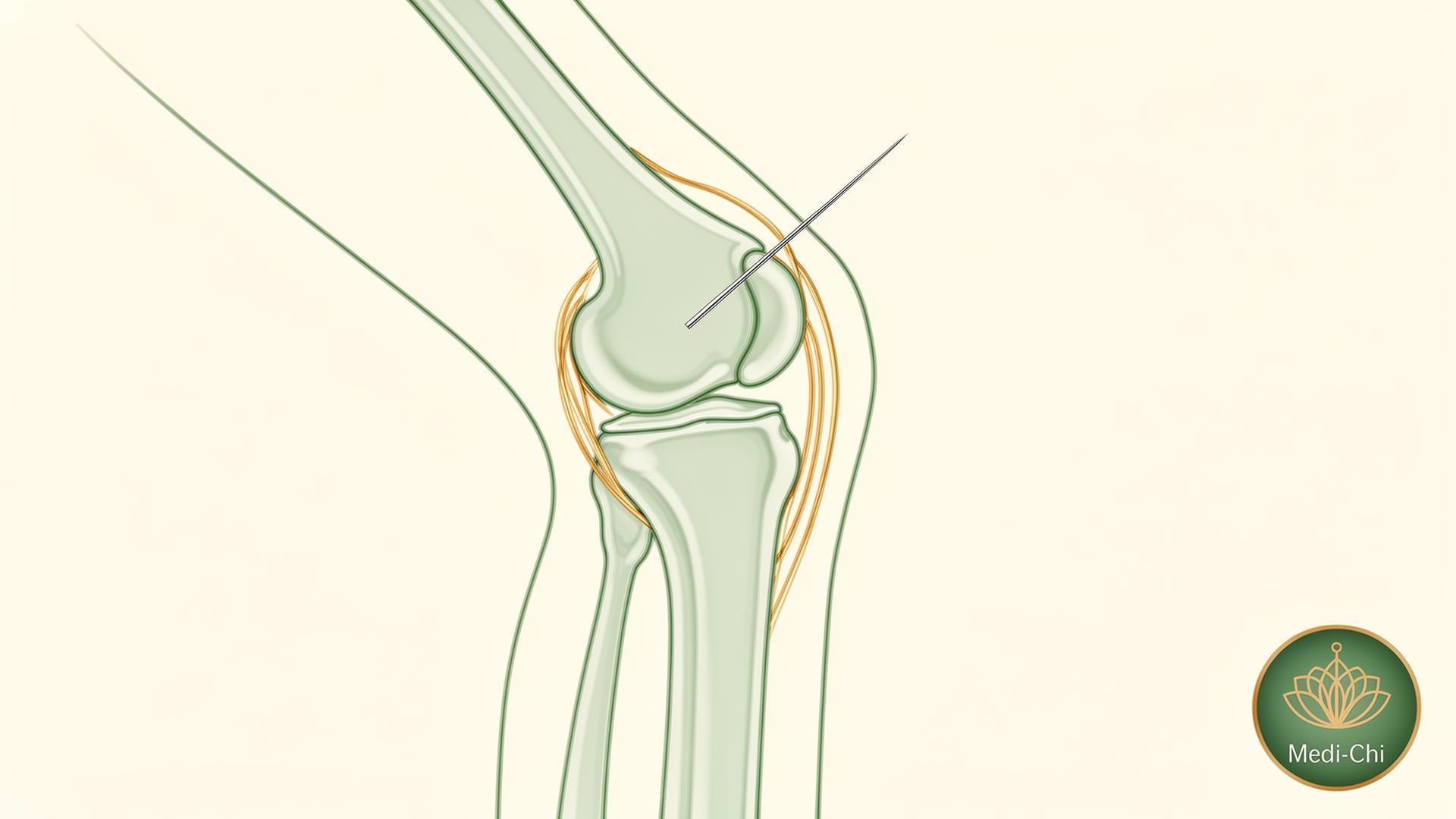
- ST35 (Dúbí, 犊鼻) and Nèixīyǎn (内膝眼, M-LE-16). The two "knee eyes" — lateral and medial to the patellar tendon with the knee flexed. Almost always needled together. They open the joint space and are the workhorse local combination in knee Bi.
- SP9 (Yīnlíngquán, 阴陵泉). Below the medial tibial condyle. The point of choice for Dampness expressing in the lower limb, and tender on palpation in almost every Cold-Damp or Damp-Heat knee.
- ST34 (Liángqiū, 梁丘). Xi-cleft point of Stomach. My go-to for acute pain flares of the knee, especially when the front of the joint is the loudest.
- GB34 (Yánglíngquán, 阳陵泉). Influential point for sinews, head of the fibula. Always in a Bi syndrome point prescription touching the lateral knee or the iliotibial band.
- SP10 (Xuèhǎi, 血海). Above the medial knee, "sea of blood". Useful where there's a Blood stasis flavour or a hot, swollen joint.
- Hèdǐng (鹤顶, M-LE-27). Extra point at the superior pole of the patella. Often the point that changes things when ST35 and the knee eyes plateau.
Distal and Pattern Points
- KI3 (Tàixī, 太溪) and BL23 (Shènshū, 肾俞) — to tonify the Kidney substrate in older patients.
- LR8 (Qūquán, 曲泉) — Liver water point at the medial knee crease, supports the Liver–Kidney axis and sits perfectly within the field of treatment.
- SP6 (Sānyīnjiāo, 三阴交) — crossing point of the three Yin channels of the leg. Almost always in the prescription for chronic knee OA.
- ST36 (Zúsānlǐ, 足三里) — tonifies Stomach and Spleen, supports the lower limb broadly, helps with the deconditioning that surrounds chronic knees.
- LI4 (Hégǔ, 合谷) and LR3 (Tàichōng, 太冲) — the Four Gates, useful where there's a strong pain and tension overlay.
Technique Notes
I use 30 mm and 40 mm 0.22 mm or 0.25 mm needles for the local knee work, with shallow oblique insertion at ST35 and the knee eyes (typically 10–20 mm directed toward the joint centre). I stay well clear of the popliteal fossa, the common peroneal nerve at the fibular head, and any obviously swollen, hot or fluctuant area. I'll often add gentle electroacupuncture at 2 Hz across ST35–Nèixīyǎn for ten to twenty minutes in chronic non-inflamed knees, which my patients consistently rate as the most useful part of the session for walking comfort over the following few days. Moxibustion — either indirect over ginger or a moxa stick over ST35, SP9 and GB34 — is a default in Cold-Damp Bi presentations, and contraindicated wherever the joint is hot, red or swollen.
Adjuncts I Lean On
- Cupping over quadriceps, ITB and gluteals. Useful for the surrounding soft-tissue tone that is almost always contributing.
- Gua sha along the medial knee and adductors. Helpful for chronic Liver-channel tension at the medial joint line.
- Heat — patient homework. A simple wheat bag over the front of the knee for fifteen minutes before bed in cold weather is one of the single most cost-effective interventions I prescribe in Cold-Damp presentations.
- Exercise referral. I work alongside exercise physiologists and physiotherapists, and I'll write the referral myself if the patient hasn't already been linked in. Quadriceps strengthening is non-negotiable.
What the Evidence Actually Says
The honest picture is that the evidence for acupuncture in knee OA is genuinely positive but not unanimous, and I think patients deserve that honesty.
On the positive side: the Vickers 2018 individual patient data meta-analysis pooled high-quality acupuncture trials across chronic pain conditions, including a knee osteoarthritis subgroup, and found acupuncture produced statistically and clinically meaningful pain reduction versus both sham and no acupuncture, with benefit holding at twelve months. The Cochrane review by Manheimer and colleagues reached a similar conclusion for short-term pain and function in peripheral joint OA.
On the cautious side: the 2014 JAMA trial by Hinman and colleagues tested needle and laser acupuncture against sham laser in chronic knee pain and found no clinically important difference between groups at twelve weeks. That trial used a limited per-protocol point selection and a low session frequency, which most clinicians read as relevant context, but it remains a fair and well-conducted reality check on the size of the effect we should claim.
The way I weigh this in clinic is straightforward: the pooled effect is real and clinically meaningful, but it's a modest effect, and patients who treat acupuncture as one component of a structured plan that also includes exercise and weight management consistently do better than patients who treat it as a standalone fix.
Red Flags I Don't Needle
A clean knee OA presentation is a low-risk case. A small number of presentations are not, and they don't get needled in my room — they get referred.
- Hot, red, suddenly swollen joint with fever. Septic arthritis until proven otherwise. Same-day GP or ED.
- Acute haemarthrosis. Tense, warm swelling within hours of an injury. Image and refer.
- Suspected fracture, deep vein thrombosis, or significant ligamentous instability. Image and refer.
- Inflammatory arthropathy picture — prolonged morning stiffness, multiple joint involvement, systemic symptoms. GP and rheumatology referral; I can still treat for symptom control once they're under appropriate medical care.
A Realistic Conversation with the Patient
I tell my knee OA patients three things on day one, every time:
1. Acupuncture can meaningfully reduce your knee pain, but it isn't a cure for the structural changes. What it buys you is space to move, and movement is what changes the trajectory.
2. Strength matters more than anything I do with a needle. If we can get your quadriceps and glutes working again, your knee will be more comfortable five years from now than it is today.
3. If you've been told you need a replacement, that's still on the table. Conservative care doesn't take the option away — it often makes the surgery, when it happens, easier to recover from.
Closing
Knee osteoarthritis is one of those conditions where the clinical relationship matters as much as the technique. Be honest about what acupuncture can and cannot do. Treat the joint inside a load-management frame. Coordinate with the patient's GP, exercise physiologist, and where relevant the orthopaedic team. And do not over-promise.
The pattern in the modern literature is reasonably clear — acupuncture plus structured exercise outperforms either alone, and most patients can get meaningful pain reduction and functional improvement without ever stepping into an operating theatre. That is the offer to make. It is also enough.
Bring This Plan Into Your Practice
- Open the AI Diagnosis Tool — Generate a pattern-specific treatment plan for the knee in front of you
- Acupuncture Points Reference — Look up ST35, SP9, GB34, SP10 and ST36 with depth, technique and safety notes
- Lower Back Pain Clinical Notes — Last week's companion piece on chronic mechanical pain
- Blood Stasis Patterns — The stasis layer under so many chronic post-traumatic joints
- Dampness in TCM Diagnosis — The constitutional layer behind most Cold-Damp Bi presentations
Frequently Asked Questions
Does acupuncture actually work for knee osteoarthritis?
How many sessions does knee osteoarthritis usually need?
What's the TCM name for knee osteoarthritis?
Is acupuncture safe if I'm waiting for a knee replacement?
All Citations Verified7/7
Every PubMed citation in this article has been manually verified against its source.
💡 💡 Tip: Press and hold on citation links to open them in your browser.
Derek Doran, BHSc (Acupuncture)
AHPRA Registered (CMR0002211465) · AACMA Member
Derek is the founder of MediChi and a registered acupuncturist with clinical expertise in integrating Western diagnoses with Traditional Chinese Medicine treatment protocols.
Clinically reviewed: June 1, 2026