Lower Back Pain: Notes From the Clinic
Medically Reviewed by Derek Doran, BHSc (Acupuncture) · AHPRA Registered · AACMA Member · Updated May 25, 2026
Why I'm Writing This One in First Person
Most weeks I write these clinical pieces from a slightly removed, "here's the playbook" perspective. This week I wanted to write a bit closer to the chair — because lower back pain is the condition I treat more than any other, and I've changed how I work it up several times over the years. If you're a patient trying to make sense of what acupuncture can actually do for your back, or a practitioner sorting out your own approach, this is roughly what's in my head when someone limps into the room and points at L5.
The Scale of It
Back problems sit near the top of every Australian chronic disease ledger. The Australian Institute of Health and Welfare estimates around four million Australians live with a back problem at any given time, and back pain is consistently among the leading causes of disability and lost productivity in the country. Safe Work Australia's 2024 figures keep "body stressing" — the category that includes most back injuries — as the single largest mechanism behind serious workers' compensation claims, year after year.
So when a patient walks in with lower back pain, statistically I already know I'm meeting one of the most common presentations in Australian primary care. What I don't know yet is which lower back pain I'm looking at.
What I'm Actually Listening For in the First Ten Minutes
The first conversation matters more than anything I do with a needle. I'm not trying to be clever in the first session — I'm trying to sort the patient into a sensible category. A few things I'm specifically listening for:
- Onset. Did this come on slowly over months, or was there a clear moment — a lift, a sneeze, a fall? Insidious onset usually points me toward a constitutional pattern with overlay Damp or stagnation. A single mechanical event puts Blood stasis and Qi stagnation right at the top of the list.
- What makes it worse. Cold, damp weather? Long sitting? Standing? First thing in the morning? End of the day? Each of these maps cleanly onto a different TCM pattern.
- What makes it better. Movement, rest, heat, pressure? A back that loves heat and gentle movement is almost always telling me Cold-Damp or Kidney Yang deficiency. A back that wants ice and dislikes being touched is usually telling me Damp-Heat or acute Blood stasis.
- Sleep. If pain is waking the patient at the same time every night, or there's pain at rest with no mechanical trigger, my red-flag antenna goes up.
- Bowel, bladder, saddle sensation. I always ask. Cauda equina is rare but missing it is unforgivable. Any positive answer here ends the consult and starts a referral.
- What they think is going on. People are usually right about more than we credit them for, and what they're frightened of shapes how they hold themselves. Naming the fear early — "you're worried it's a disc, let's actually look at that" — calms the system before I've even palpated.
The Western Picture in Plain English
Most of what walks into the clinic is chronic nonspecific lower back pain — pain that's been around for more than twelve weeks, where imaging either hasn't been done or hasn't found a structural explanation that adequately accounts for the symptoms. The NICE NG59 guideline and the WHO chronic low back pain guideline both make the same broad point: for this group, the evidence supports staying active, structured movement therapy, manual therapy, psychological support where indicated, and selected non-pharmacological options including acupuncture. Imaging and strong opioids are not the first answer for most patients.
A smaller group has a clearer structural driver — disc bulge with radicular pain, facet joint pain, sacroiliac dysfunction, spondylolisthesis. These cases still respond to conservative care, but they ask for a more careful plan and closer communication with the patient's GP.
And then a small but important group has a red-flag picture — progressive neurological loss, suspected fracture or malignancy, infection, inflammatory spondyloarthropathy. These don't get needled, they get referred.
The Chinese Medicine Picture
The Sù Wèn puts it as plainly as it gets: yāo zhě, shèn zhī fǔ yě (腰者,肾之府也) — "the lumbar region is the residence of the Kidneys." That single line shapes how almost every classical doctor reads chronic lower back pain. Even when the immediate trigger is mechanical, the substrate that lets the injury settle in and stay is usually Kidney-related.
The patterns I see most often in my chair, in rough order:
- Cold-Damp Bi (寒湿痹) in the lumbar channels. Worse in cold, damp weather. Better with heat. Heavy, dull, fixed ache. Common in tradies, outdoor workers, anyone who sleeps in a draught.
- Damp-Heat Bi (湿热痹). Less common but unmistakable. Hot, swollen, worse at the end of the day, often with a yellow greasy tongue coat. I see this in younger patients with inflammatory drivers and in the early post-acute phase of some traumatic injuries.
- Qi stagnation and Blood stasis (气滞血瘀). Sharp, fixed, stabbing pain. A clear traumatic or postural trigger. Worse at night, worse with sustained postures, often with a purplish tongue and a wiry-choppy pulse. The classic post-lifting "I haven't been right since" presentation.
- Kidney Yang deficiency (肾阳虚) lumbar pain. Older patient. Cold lower back and knees. Dull ache that's better with warmth, pressure and rest. Pale tongue, deep-weak pulse. Fatigue, nocturia, low libido in the background.
- Kidney Yin deficiency (肾阴虚) lumbar pain. Often quieter and more insidious. Dull ache with warm sensations, night sweats, dry mouth, red tongue with little coat, thin-rapid pulse. Common in perimenopausal women and patients running on adrenaline for years.
Most real patients aren't a single clean pattern — they're usually one constitutional layer plus an overlay. Cold-Damp Bi on top of Kidney Yang deficiency is probably my single most common write-up.
For the underlying framework see my pieces on meridian theory, Blood Stasis patterns and Dampness in TCM diagnosis.
Assessment First: Straight Leg Raise, Leg Length and Hip Tilt
Before I pick up a needle I want a quick read of the mechanics. The single most useful screening test I do is a supine straight leg raise. With the patient lying face up I ask them to lift one straight leg at a time. If they genuinely can't lift the leg, or lifting it reproduces sharp radicular pain down the back of the thigh, that's a flag for possible disc involvement and the treatment plan and referral conversation change immediately. If both legs lift cleanly with only a stretch sensation, I'm a lot more comfortable that I'm dealing with a primarily soft-tissue and postural picture.
From there I check leg length and hip tilt with the patient still supine. A functional leg length difference — one medial malleolus sitting noticeably higher than the other — combined with an anterior or rotated pelvis tells me the pain is very often being driven by chronically contracted hip and trunk muscles pulling the pelvis out of neutral, rather than by anything structural inside the spine. Patients will sometimes arrive convinced they have "a disc", and they may well have one on imaging, but the actual pain generator is their posture and muscle tone. Both can be true at once — the imaging finding and the postural driver — and treating the driver is usually where the relief comes from.
The muscle groups I'm thinking about at this point are predictable: psoas major and minor and piriformis as the main culprits, with erector spinae (spinalis, longissimus), quadratus lumborum, gluteus medius/maximus and the iliotibial band as the supporting cast.
Get the full low back pain protocol
The subscription extends these clinic notes into a full protocol: local, distal and pattern-based selection with the documentation to support a referral.
- Cold-damp, Blood-stasis and Kidney-deficiency back pain differentiated in one view
- Point protocols around BL 23, BL 25, BL 40, GB 30 and Yaotongxue with depth and safety notes
- WorkCover-ready progress notes and VAS outcome tracking
7-day free trial · No card required to start · Herb and point references stay free
Acu-Bowen: Why I Often Treat Before I Needle
On a lot of first visits I won't needle the lower back at all. I'll start with Acu-Bowen — a hybrid technique developed by Australian acupuncturist Kevin Ryan that applies Bowen therapy moves directly over key acupuncture points. It's gentle, the patient stays clothed, and it does two things at once: it releases the contracted hip and trunk muscles that are pulling the pelvis out of alignment, and it lets the patient's nervous system drop a gear before any needles come out. Most people who arrive guarded and braced will visibly soften within the first few minutes on the table, which makes everything that follows more effective.
After the Acu-Bowen work, with the patient still lying face up, I'll often needle lower back extra points to the back of each hand — small, well-tolerated distal points that influence the lumbar region without asking a sore back to roll over. I pair those with the pattern-specific points I've selected for that patient (Kidney layer, Cold-Damp, Blood stasis, etc.). Recheck the leg length and hip tilt at the end; if the asymmetry has eased and the patient reports their back feels lighter, we've confirmed that the postural driver was real and we have a clear roadmap for the next few sessions.
I'll then progress to direct lumbar needling at visit two or three once the patient trusts the room and the tissue has stopped guarding.
How I Actually Needle a Lower Back
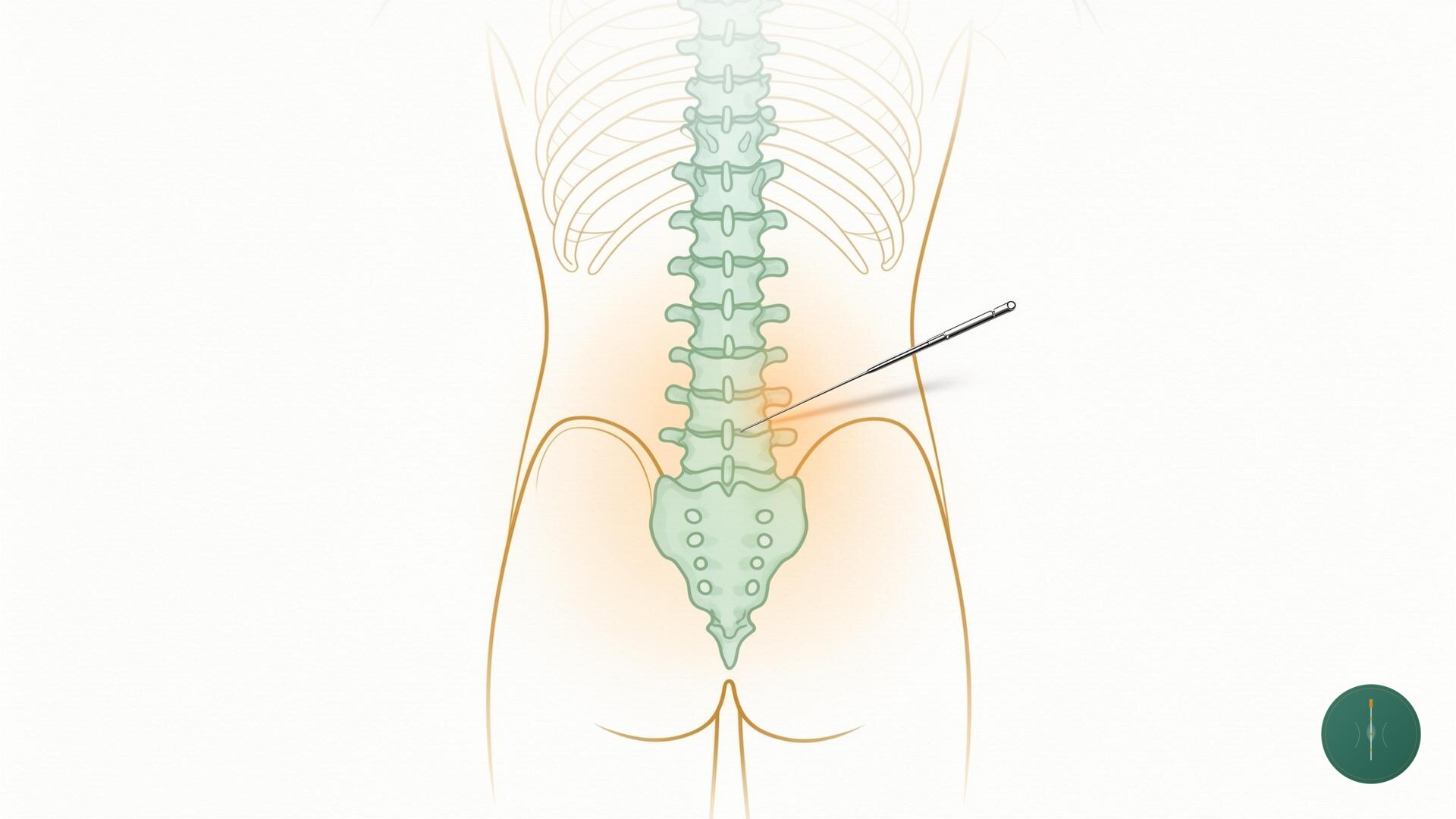
I'll be upfront — I don't think the specific points matter as much as the pattern reading, the depth, the technique and the patient's response on the table. That said, here are the points I reach for most often and why.
Local Points
- BL23 (Shènshū, 肾俞) — back-shu of the Kidneys, the workhorse point of lumbar treatment. I tonify it in almost every chronic case.
- BL25 (Dàchángshū, 大肠俞) — back-shu of the Large Intestine, at L4. Tender on palpation in a huge proportion of mechanical lower back presentations.
- BL26 (Guānyuánshū, 关元俞) — at L5. Often the point that actually changes things in chronic low lumbar pain when BL23 and BL25 plateau.
- GV4 (Mìngmén, 命门) and GV3 (Yāoyángguān, 腰阳关) — midline points along the Governing Vessel. GV4 with moxa is almost a default in Kidney Yang deficiency presentations.
- Huátuó Jiājǐ (华佗夹脊) points beside L2–L5. I use these constantly. They give me segmental access without going near the spinal canal.
- Ashi points. I palpate the paraspinals, quadratus lumborum, gluteus medius and the upper edge of the iliac crest carefully every visit. Where the tissue tells me something, I needle it.
Distal Points That Actually Earn Their Keep
- BL40 (Wěizhōng, 委中) — the command point of the lumbar region in the classical four-command-points framework. The line "腰背委中求" — "for the lower back, seek Wěizhōng" — has been right more times than I can count. I needle it bilaterally in almost every acute or sub-acute presentation.
- BL60 (Kūnlún, 昆仑) — gentle, reliable, opens the whole Bladder channel down the leg. Useful when there's any radiation into the buttock or hamstring.
- GB30 (Huántiào, 环跳) — when the pain pattern has any gluteal or sciatic involvement, this is the one. Strong needling, longer needle, careful angle.
- GB34 (Yánglíngquán, 阳陵泉) — influential point of sinews, broadly useful for any musculoskeletal Bi.
- SI3 (Hòuxī, 后溪) paired with BL62 (Shēnmài, 申脉) to open the Governing Vessel — particularly nice in stiff, midline-dominant presentations.
- KD3 (Tàixī, 太溪) and KD7 (Fùliū, 复溜) — for the constitutional Kidney layer in chronic recurrent presentations.
What I Add and What I Don't
- Moxa. I use it freely in Cold-Damp and Kidney Yang patterns — warm needle on BL23 and GV4, or a moxa box over the lumbar region. I don't use it in Damp-Heat presentations or in inflamed, acute hot backs.
- Cupping. Sliding cups over oiled paraspinals are one of the highest value-per-minute interventions in stagnant, stiff backs. The cup marks also give me an honest reading of where the stasis actually sits.
- Electroacupuncture. I use it across paired Huátuó Jiājǐ points or BL23 ↔ BL25 in stubborn chronic cases — usually 2–4 Hz mixed with 50 Hz for 15–20 minutes.
- What I don't do. I don't go deep into the paraspinals with a long needle in patients I haven't worked with before. I don't needle near the kidneys with the patient turned in a way I can't see. And I don't ever needle a lower back without being clear in my own head what pattern I'm treating and what change I'm hoping to see by session three.
What the Evidence Actually Says — And How I Use It
I want my patients to know I'm not running on tradition alone. The most useful single paper I quote at the table is the Vickers et al. individual patient data meta-analysis updated in 2018. It pooled 39 high-quality trials across more than 20,000 patients with chronic pain (back, neck, shoulder, osteoarthritis and headache) and found acupuncture produced statistically and clinically meaningful pain reductions over both sham and no-acupuncture controls, with benefit persisting at twelve months. That's a serious dataset and a serious result.
The 2020 Cochrane review of acupuncture for chronic nonspecific low back pain reaches a compatible conclusion specifically for the population I see most: acupuncture improves pain and function more than no treatment and at least matches other active conservative options. The 2023 WHO guideline on non-surgical management of chronic primary low back pain in adults includes acupuncture among its recommended non-pharmacological options.
So when a patient asks "does this actually work?" — my honest answer is, yes, for the population you sit in, the evidence is now clear enough to be confident. It isn't a guaranteed result for every patient (nothing is), and it works best as part of a plan that includes movement, sleep, and sometimes a conversation with the GP about other contributors. But the days of having to apologise for the evidence base are over.
A Realistic Course of Treatment
For chronic nonspecific lower back pain, the plan I tend to offer looks like this:
- Weeks 1–3: twice weekly. Local + distal needling, cupping, warming needle in Cold-Damp patterns. We're aiming to reduce pain and increase confidence in movement.
- Weeks 4–6: weekly. Same approach, but with more emphasis on range and load tolerance. Begin or continue a daily home movement program.
- Weeks 7–10: fortnightly. Constitutional points come into focus — KD3, BL23, GV4 — and we plan a maintenance rhythm.
- From there: monthly or seasonal tune-ups for patients with a long-standing recurrent pattern, especially the desk-bound and the tradies, who have very different drivers but very similar relapse curves.
I usually tell people: if we haven't moved your pain or function meaningfully by session six, I owe you a rethink, not just six more sessions of the same thing.
What I Tell Every Patient at the End of Visit One
Three things, more or less verbatim.
1. Move every day, even when it hurts a bit. Backs that get rested into stiffness do worse than backs that are gently used. "Hurt does not always equal harm" is one of the more important sentences in modern pain science.
2. Sleep matters more than you think. A few weeks of broken sleep will keep a back painful that should have settled. We work on this.
3. This is almost always more boring than you fear. Most chronic lower back pain is not a hidden surgical emergency. The work is patient, structured and repetitive. The reward is a back that quietly does its job again.
That last line is the one I really want patients to leave with. Acupuncture is a tool — a good one, with a credible evidence base and a long clinical track record. It's not magic. It's part of a plan. When the plan is built around the actual pattern in front of me and the patient does their share between sessions, lower back pain almost always softens. I still find that quietly satisfying every time.
Take This Plan Into Your Practice (or Your Own Back)
- Open the AI Diagnosis Tool — Generate a pattern-specific treatment plan for the back in front of you
- Acupuncture Points Reference — Look up BL23, BL25, BL40, GV4 and GB30 with depth, technique and safety notes
- Blood Stasis Patterns — Companion guide to the stasis layer under so much chronic lumbar pain
- Dampness in TCM Diagnosis — The other constitutional layer to read carefully
- WorkCover Acupuncture in Australia — Documentation and reporting framework for occupational back injuries
- Frozen Shoulder Clinical Guide — Last week's companion piece on staged musculoskeletal Bi
Frequently Asked Questions
Does acupuncture work for chronic lower back pain?
How many sessions does it usually take?
What's the TCM name for lower back pain?
Is acupuncture safe if I have a disc bulge or sciatica?
All Citations Verified6/6
Every PubMed citation in this article has been manually verified against its source.
💡 💡 Tip: Press and hold on citation links to open them in your browser.
Derek Doran, BHSc (Acupuncture)
AHPRA Registered (CMR0002211465) · AACMA Member
Derek is the founder of MediChi and a registered acupuncturist with clinical expertise in integrating Western diagnoses with Traditional Chinese Medicine treatment protocols.
Clinically reviewed: May 25, 2026