The Triple Burner: TCM's Most Misunderstood Organ
Medically Reviewed by Derek Doran, BHSc (Acupuncture) · AHPRA Registered · AACMA Member · Updated July 5, 2026
Why This Organ Confuses Everyone
If you polled a room full of acupuncture students on which Zang Fu organ they understood least, the San Jiao (三焦) would win every time. That's not a failure of the students — it's a fair reaction to the fact that the Triple Burner is the one organ in the classical system that has no clean Western anatomical equivalent. The Nàn Jīng itself acknowledges this in Difficulty 38, where the San Jiao is described as having "a name but no form" (有名无形).
That single phrase has generated two thousand years of commentary. It's also the reason a lot of practitioners quietly skip the San Jiao in their pattern reading, treat the channel as a random collection of shoulder and head points, and never quite know what to do when a patient's presentation sits squarely in Shao Yang territory. That's a shame, because once you accept that the Triple Burner is a functional system rather than an organ, it becomes one of the most useful frames in clinical Chinese medicine.
This piece is my attempt to unwind the confusion the way I do for my own patients — starting with what the classics actually say, then how the three Jiao behave in the body, and finally how I use the channel most weeks in clinic.
What the Classics Actually Say
The two foundational descriptions come from the Huángdì Nèijīng Sùwèn and the Nàn Jīng, and they're worth quoting because most modern confusion comes from reading later commentary before reading the source.
In Sùwèn Chapter 8 — the famous "twelve organ-officials" passage — the San Jiao is described as the official in charge of ditches and waterways, from which the pathways of water emerge. That framing is not incidental. The classical authors were telling us the San Jiao's core job is to keep fluid moving through the body, at every level, in the right direction. It is a plumbing metaphor, and it is meant to be taken seriously.
In Nàn Jīng Difficulty 31, the San Jiao is divided into its three regions and paired with specific functions: the Upper Jiao is like a mist (如雾), the Middle Jiao is like a foam or a fermenter (如沤), and the Lower Jiao is like a drainage ditch (如渎). This isn't poetry — it's a clinical description. Fluid at the top of the body should be finely dispersed like mist. Fluid in the middle should be actively churned and transformed. Fluid at the bottom should be draining, cleanly and downward.
Nàn Jīng Difficulty 38 then adds the twist that everyone remembers: the San Jiao has a name without a form. And Difficulty 66 anchors the whole system by naming the San Jiao as the pathway through which Yuán Qì (原气) — the original Qi rooted in the Kidneys — distributes to every organ, every channel and every corner of the body. That is the deepest layer of the San Jiao's function, and the one that quietly matters most in clinic.
The Three Jiao in the Body
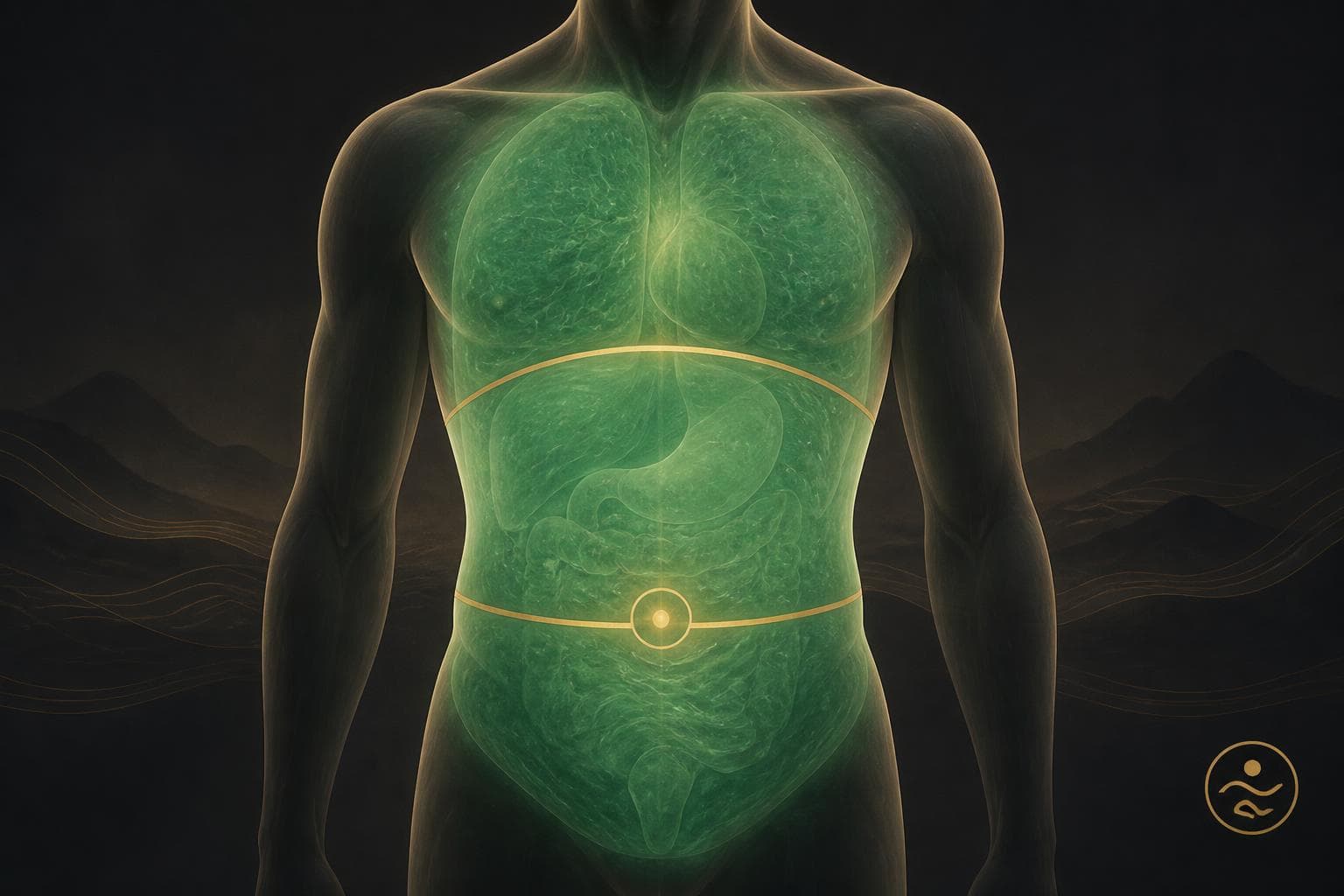
Set the philosophy aside for a moment and think about the trunk in three horizontal bands. That is what the San Jiao is describing.
The Upper Jiao (上焦) — above the diaphragm
Home of the Heart and Lungs. Its job is to disperse Qi and fluids upward and outward like a fine mist, warming the skin, moistening the muscles, and maintaining the defensive layer of the body. Upper Jiao dysfunction shows up as chest oppression, shortness of breath, cough, palpitations, upper body dryness, and Wèi Qì weakness (the recurrent-cold pattern I've written about in the Wèi Qì and immunity guide).
The Middle Jiao (中焦) — between the diaphragm and the umbilicus
Home of the Spleen and Stomach. Its job is to churn, ferment and transform food and fluids — the classical image of a fermenter is very close to what a physiologist would recognise as gastric digestion plus small-bowel absorption. Middle Jiao dysfunction is the largest single category of patients I see: bloating, poor appetite, loose stools, fatigue after eating, tiredness in the limbs, difficulty holding weight, dampness patterns of every kind. When patients say "my digestion has never been strong," they are almost always describing a Middle Jiao problem.
The Lower Jiao (下焦) — below the umbilicus
Home of the Kidneys, Bladder, Small Intestine, Large Intestine, Liver (functionally) and the uterus. Its job is separation and downward drainage — clear from turbid, urine from stool, retained fluids from excreted fluids. Lower Jiao dysfunction is the world of urinary problems, oedema of the legs, bowel disorders, menstrual disturbance, low back pain, and the whole Kidney-Yang-fails-to-warm picture. When drainage fails at this level, everything above it starts to back up.
A short clinical shortcut I use in my own reading: top complains, middle sags, bottom leaks or blocks. Once you can hear which of those three verbs the patient is using, you already know which Jiao to look at first.
How the Three Jiao Talk to Each Other
The most useful thing about the San Jiao frame is not the three regions themselves — it's the reminder that they have to work together. A dry cough that won't shift often turns out to be Middle Jiao dampness pushing turbid fluid upward. Chronic loose stools in a stressed patient often turn out to be a Liver-overacting-Spleen picture blocking the Lower Jiao's ability to separate clear from turbid. Ankle oedema in a middle-aged woman often turns out to be Middle Jiao Yang failing to move fluids downward through a competent Lower Jiao. If you look only at the region where the symptom sits, you'll be right about half the time and wrong the rest.
The San Jiao is the bookkeeper that keeps the three regions coordinated. When the bookkeeper is asleep, the accounts don't balance.
Yuán Qì and the Deeper Layer
The line from Nàn Jīng Difficulty 66 — that the San Jiao is the pathway of Yuán Qì — is not an ornament. It has direct clinical consequences.
Turn This Knowledge Into a Treatment Plan
Enter any Western diagnosis and get a complete TCM treatment protocol — acupuncture points, herbal formulas, moxibustion, cupping, and gua sha recommendations.
Yuán Qì (原气) is the original Qi stored at the Míngmén (the "Gate of Life" between the Kidneys). It has to reach every channel, every organ and every extremity for the body to function normally. The San Jiao is the vessel through which that distribution happens — which is why the Yuán-source (原) points on every channel are, functionally, the places where the San Jiao delivers Yuán Qì to that channel. The Sù Wèn tells us that the source points are the points to needle when the Yuán Qì of an organ is compromised — and in practice this maps very cleanly onto the patients you see who present with deep, systemic depletion that doesn't fit into a single organ pattern. Chronic fatigue that has spread across every system. Post-viral syndromes. The elderly patient whose everything is quietly running down.
When I see those patients, the San Jiao channel is usually part of the plan.
For related constitutional work, my Zang-Fu organ theory piece sits alongside this one, and the Four Pillars of TCM diagnosis explains how I actually build a Jiao-by-Jiao reading in the clinic.
The San Jiao Channel in Clinical Practice
The San Jiao channel — TE1 to TE23, per the WHO Standard Acupuncture Point Locations — runs from the ulnar corner of the ring-finger nail, up the ulnar side of the forearm, over the lateral elbow, up the posterior aspect of the arm, over the shoulder, up the side of the neck, around the ear and to the lateral end of the eyebrow. It is a workhorse channel for anything that sits on the lateral head, the lateral neck, the lateral shoulder or the ear.
Paired with the Gallbladder as the Shao Yang level of the body, the San Jiao channel is also central to the classical Shao Yang syndrome — the alternating chills-and-warmth, bitter taste, dizziness, chest and hypochondrial oppression picture from the Shāng Hán Lùn that shows up regularly in modern chronic-stress and post-viral presentations.
Points I Reach For Most
Point locations and depths follow the WHO Standard Acupuncture Point Locations. You can also look these up with technique and safety notes in the Acupuncture Points Reference.
- TE5 (Wàiguān, 外关). Two cùn proximal to the wrist crease on the extensor side, between radius and ulna. The command point of the Yang Wei vessel and, in my clinic, the single most-used San Jiao point. Reliable for lateral head and neck pain, migraine on the temple, upper limb Bi patterns, and any Shao Yang picture. Almost always paired with GB41 to open the Yang Wei confluence.
- TE3 (Zhōngzhǔ, 中渚). Between the fourth and fifth metacarpals, on the back of the hand. My default for temporal headache with hand tension, tinnitus with an obvious channel component, and stiff fourth or fifth fingers. Small point, big return.
- TE6 (Zhīgōu, 支沟). Three cùn proximal to the wrist. Classical use for constipation from Qi stagnation, and for lateral chest pain in Shao Yang presentations. One of the quieter points that earns its keep.
- TE14 (Jiānliáo, 肩髎). Posterior to the acromion. My workhorse for the lateral aspect of shoulder impingement, especially where LI15 alone doesn't get in far enough.
- TE15 (Tiānliáo, 天髎). On the superior angle of the scapula. Excellent for the upper trapezius / levator scapulae complex that sits behind so many desk-neck presentations — see my recent tech neck clinic notes for the wider frame.
- TE17 (Yìfēng, 翳风). In the depression behind the earlobe. My first point for ear conditions — tinnitus, sudden hearing loss, otitis-related dizziness — and one of the classical points for Bell's palsy. Shallow oblique needling only; the parotid gland and facial nerve are close.
- TE21 (Ěrmén, 门). Anterior to the ear, opened with the mouth ajar. Paired with SI19 and GB2 for the "three ears" combination in tinnitus and jaw involvement.
- TE23 (Sīzhúkōng, 丝竹空). Lateral end of the eyebrow. Local point for lateral head and eye pain, often paired with GB1.
Combinations That Earn Their Keep
- TE5 + GB41 — the Yang Wei / Dài Mài opening pair. My default combination for one-sided head, neck, shoulder and ear complaints in the Shao Yang zone. If I had to pick one two-point combination to keep for the rest of my career, this would be a serious contender.
- TE5 + LI4 — broad Yang-channel opening for lateral head, face and upper limb pain. Simple, well-tolerated, reliable.
- TE6 + ST25 — stagnation-type constipation with lateral chest oppression. A very useful pair in stressed patients whose bowels have gone quiet.
- TE17 + SI19 + GB2 — the three-point ear combination for tinnitus, blocked ears and jaw-side ear pain.
- TE14 + LI15 + Jiānqián — lateral and anterior shoulder impingement, usually with local Ashi work and cupping over the deltoid.
A Word on Modern Anatomy
I get asked at every open evening whether the San Jiao "is" the fascial system, the interstitium, the mesentery or the lymphatics. The honest answer is that each of those modern maps captures a real slice of what the classics were pointing at — fluid movement between compartments, coordination across regions, drainage and dispersion — but none of them is a full match. That's fine.
The classical authors weren't wrong to describe a system that Western anatomy hadn't yet mapped. Modern authors like Maciocia argue convincingly that trying to force the San Jiao into a single Western structure loses more than it gains. In clinic, I treat the San Jiao as a functional system — the coordination of Qi, fluids and Yuán Qì across the three regions — and use the channel and its points on that basis. That framing has never once let me down at the treatment table.
A Simple Jiao-by-Jiao Reading You Can Use Tomorrow
When a new patient sits down, before I even open the intake form, I do a rough three-level scan:
1. Upper Jiao check. How's the breathing, the chest, the skin, the recurrent-cold history? Any dispersion problem sits here.
2. Middle Jiao check. How's the appetite, the digestion, the energy after meals, the stool consistency? Any transformation problem sits here.
3. Lower Jiao check. How's urination, bowel movement, menstruation, low back and knees, ankle swelling? Any separation-and-drainage problem sits here.
Then I ask which of those three regions the presenting complaint sits in, and whether one of the other two is quietly driving it. That single question resolves a surprising number of otherwise messy cases. If a Middle Jiao dampness is pushing fluid upward into an Upper Jiao cough, treating the cough won't hold — you have to drain the Middle. If a Lower Jiao Yang deficiency is failing to warm the Middle, treating the Middle Jiao dampness in isolation is temporary at best. The San Jiao frame prevents this kind of category error.
What I Tell Patients About the Triple Burner
Very little, honestly — and never by that name at first. Patients who arrive convinced their "Triple Burner is blocked" have usually read something on the internet that will not survive contact with clinical reality. What I do explain, when it's useful, is that Chinese medicine looks at the body in three regions — a top, a middle and a bottom — and that keeping the three coordinated is often more important than fixing any one of them in isolation. That framing is enough for almost every patient and it happens to be exactly what the classics were pointing at.
Take This Further
- Open the AI Diagnosis Tool — Generate a pattern-differentiated plan that reads Upper, Middle and Lower Jiao contributions for the case in front of you
- Acupuncture Points Reference — Look up TE5, TE3, TE14, TE17, TE21 and TE23 with depth, technique and safety notes
- Zang-Fu Organ Theory — The wider organ-system context around the San Jiao
- Four Pillars of TCM Diagnosis — How to build the Jiao-by-Jiao reading in a real intake
- Wèi Qì and Immunity — Deeper dive on the Upper Jiao dispersion picture
- Dampness in TCM Diagnosis — The Middle Jiao pattern behind so many chronic presentations
Related Posts
- Zang-Fu Organ Theory: Beyond Western Anatomy — Sits directly alongside this piece as the wider organ-system frame
- Wèi Qì and Immunity: TCM's Defensive System — The Upper Jiao's most clinically useful function
- Dampness in TCM Diagnosis and Treatment — Middle Jiao failure of transformation, patient by patient
- Tech Neck Syndrome: Clinic Notes — Where TE14, TE15 and TE5 do their heaviest lifting week to week
Frequently Asked Questions
What is the Triple Burner (San Jiao) in Traditional Chinese Medicine?
Is the San Jiao a real organ?
What does the San Jiao channel treat?
Which San Jiao points are most useful in practice?
All Citations Verified4/4
Every PubMed citation in this article has been manually verified against its source.
💡 💡 Tip: Press and hold on citation links to open them in your browser.
Derek Doran, BHSc (Acupuncture)
AHPRA Registered (CMR0002211465) · AACMA Member
Derek is the founder of MediChi and a registered acupuncturist with clinical expertise in integrating Western diagnoses with Traditional Chinese Medicine treatment protocols.
Clinically reviewed: July 5, 2026