
A reading schedule for The Medi-Chi TCM Textbook
All 26 chapters laid out week by week, each with the modern classic to read alongside it. Tick chapters off as you go — your progress is kept on this device, so no account is needed.
Choose a pace
Week 1
Part 1 · Foundations and theoryGoals for this week
- Chapter 1: be able to explain pattern, biàn zhèng, scope in your own words.
- Learn 3 key terms from chapter 1, then pass its quiz.
- Chapter 2: be able to explain yin yang, theory, foundations in your own words.
- Learn 3 key terms from chapter 2, then pass its quiz.
- Write a short note tying chapters 1 and 2 together before moving on.
- 1How Chinese medicine reasons
What a TCM pattern actually is, how it differs from a Western diagnosis, and why the two sit side by side rather than in competition.
Free - 2Yīn and Yáng
The oldest and most-abused idea in the medicine, treated as a working clinical tool: relative, dynamic, and always about a specific thing.
Read alongside
 The Modern Nèi Jīng
The Sù Wèn is where this way of reasoning is first set out — start with the opening chapters on the pattern of life.
Week 2
Part 1 · Foundations and theoryGoals for this week
- Chapter 3: be able to explain five element, wu xing, theory in your own words.
- Learn 4 key terms from chapter 3, then pass its quiz.
- Chapter 4: be able to explain qi, blood, jing in your own words.
- Learn 5 key terms from chapter 4, then pass its quiz.
- Write a short note tying chapters 3 and 4 together before moving on.
- 3The Five Phases
Wǔ Xíng as a map of relationships between organ systems — generation, control, and the two pathological cycles — rather than a table to memorise.
- 4Qì, Blood, Fluids, Essence and Shén
The vital substances: what each one does, how each one fails, and the signs that separate a deficiency from a stagnation.
Read alongside
- The Modern Nèi Jīng
The Five Phase correspondences are laid out chapter by chapter in the Sù Wèn's great treatises.
 The Modern Líng Shū
The Líng Shū is more concrete about how Qì and Blood actually move in the channels.
Companion study units
- Unit 3 — The Five Phases and the great treatisesThe Modern Nèi Jīng · Sù Wèn chapters 8–11 and the five-movement treatises
- Unit 4 — The substances a life is built fromThe Modern Nèi Jīng · Sù Wèn chapters 12–18 on Qì, Blood, fluids and Essence
- Unit 8 — Spirit, sleep and the Qì of the dayThe Modern Líng Shū · Líng Shū chapters 8, 18 and 80
Week 3
Part 1 · Foundations and theoryGoals for this week
- Chapter 5: be able to explain zang fu, organs, patterns in your own words.
- Learn 2 key terms from chapter 5, then pass its quiz.
- Chapter 6: be able to explain aetiology, six evils, emotions in your own words.
- Learn 3 key terms from chapter 6, then pass its quiz.
- Write a short note tying chapters 5 and 6 together before moving on.
- 5The Zàng-Fǔ organ systems
Twelve organ systems described by function rather than anatomy, with the deficiency and excess patterns each one produces.
- 6Causes of disease
External evils, internal emotions and the neither-external-nor-internal causes — plus the modern additions that classical aetiology never had to describe.
Read alongside
- The Modern Nèi Jīng
Sù Wèn chapters 8 through 11 describe the organs as offices of state — the source of the Zàng-Fǔ model.
Companion study units
- Unit 3 — The Five Phases and the great treatisesThe Modern Nèi Jīng · Sù Wèn chapters 8–11 and the five-movement treatises
- Unit 7 — Constitution, body type and the person in front of youThe Modern Líng Shū · Líng Shū chapters 64 and 72
- Unit 5 — Causes of disease: wind, cold, damp and the emotionsThe Modern Nèi Jīng · Sù Wèn chapters 19–24 and the aetiology treatises
- Unit 8 — Spirit, sleep and the Qì of the dayThe Modern Líng Shū · Líng Shū chapters 8, 18 and 80
Week 4
Part 1 · Foundations and theoryGoals for this week
- Chapter 7: be able to explain channels, meridians, eight extras in your own words.
- Learn 3 key terms from chapter 7, then pass its quiz.
- Chapter 8: be able to explain diagnosis, four examinations, intake in your own words.
- Learn 4 key terms from chapter 8, then pass its quiz.
- Write a short note tying chapters 7 and 8 together before moving on.
- 7Channels and collaterals
The channel system as the anatomy of the medicine: twelve primary channels, eight extraordinary vessels, and the secondary systems that explain the stubborn cases.
- 8The four examinations
Looking, hearing and smelling, asking, and palpating — how the four methods are weighted and what to do when they disagree.
Free
Read alongside
- The Modern Líng Shū
The Divine Pivot is the channel text — pathways, branches and the collaterals in detail.
- The Modern Nèi Jīng
The Sù Wèn on looking, listening, asking and palpating as one act of examination.
Companion study units
Week 5
Part 2 · DiagnosisGoals for this week
- Chapter 9: be able to explain tongue, diagnosis in your own words.
- Learn 2 key terms from chapter 9, then pass its quiz.
- Chapter 10: be able to explain pulse, diagnosis in your own words.
- Learn 3 key terms from chapter 10, then pass its quiz.
- Write a short note tying chapters 9 and 10 together before moving on.
- 9Tongue diagnosis
Body, coat, moisture and shape — the four variables of the tongue, what each tracks, and the artefacts that mislead.
- 10Pulse diagnosis
Three positions, three depths, and the handful of pulse qualities that actually change what you do.
Read alongside
- The Modern Nèi Jīng
Classical descriptions of the tongue and complexion as a window on the interior.
- The Modern Líng Shū
Líng Shū on palpating the channels and the pulse of the Qì.
Week 6
Part 2 · DiagnosisGoals for this week
- Chapter 11: be able to explain eight principles, ba gang, diagnosis in your own words.
- Learn 2 key terms from chapter 11, then pass its quiz.
- Chapter 12: be able to explain differentiation, six stages, four levels in your own words.
- Learn 3 key terms from chapter 12, then pass its quiz.
- Write a short note tying chapters 11 and 12 together before moving on.
- 11The Eight Principles
Exterior/interior, cold/heat, deficiency/excess and Yīn/Yáng — the first pass that every other differentiation system builds on.
- 12The differentiation systems
Zàng-Fǔ, six stages, four levels, Sān Jiāo, Qì-Blood-Fluids and channel differentiation — which system to reach for and when.
Read alongside
 The Modern Shāng Hán Lùn
Zhāng Zhòng-Jǐng's clauses are the Eight Principles worked out on real cases before they were ever named.
 The Modern Shāng Hán Lùn
Yáng Míng and Shào Yáng — the interior and half-interior stages.
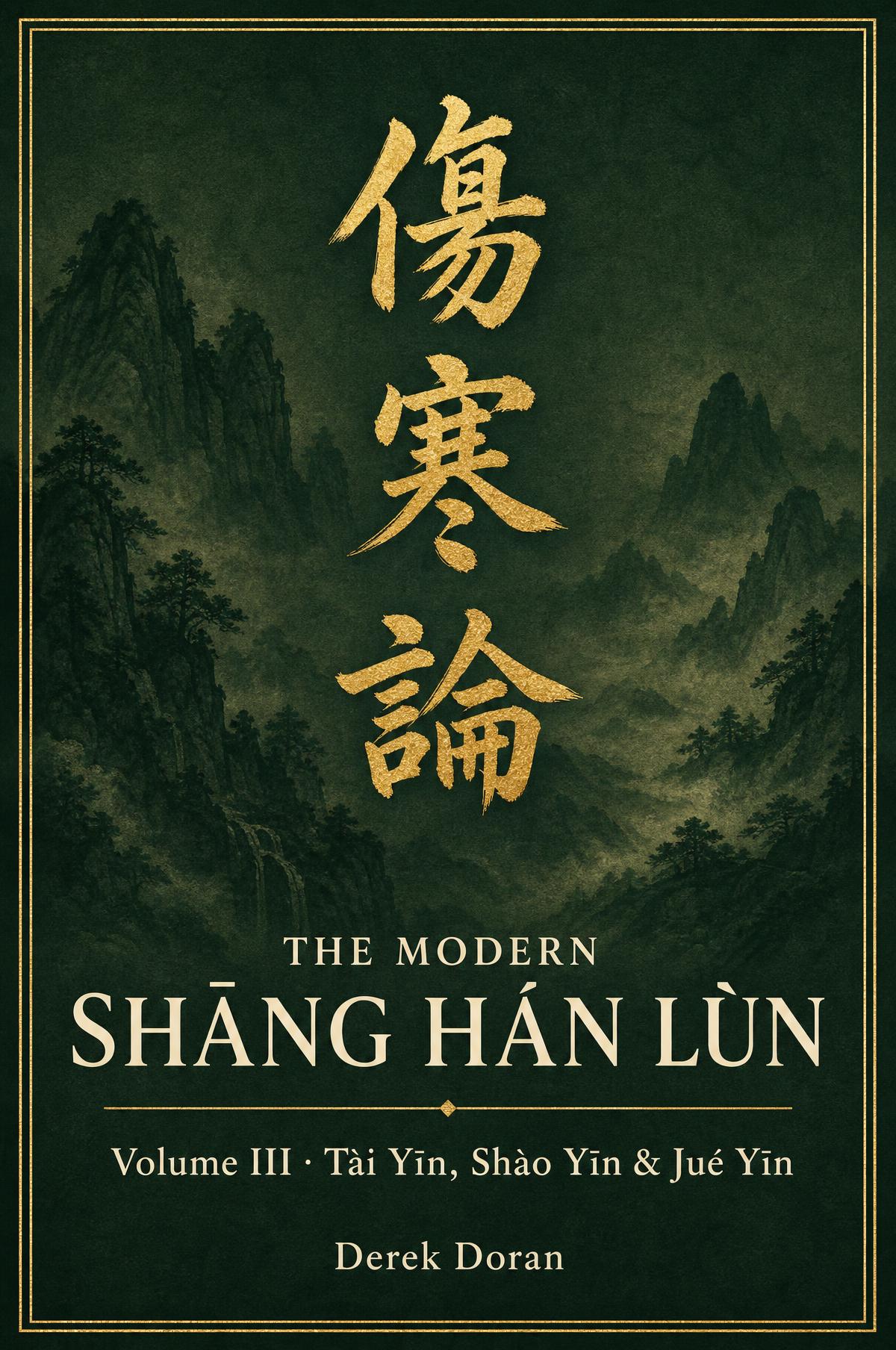 The Modern Shāng Hán Lùn
The three Yīn stages, where differentiation gets genuinely difficult.
Companion study units
- Unit 11 — Treatment strategy and the rootThe Modern Nèi Jīng · Sù Wèn chapters 66–74
- Unit 1 — How to read a clauseThe Modern Shāng Hán Lùn · Volume I, opening clauses 1–11
- Unit 12 — The Shāng Hán Lùn in modern practiceThe Modern Shāng Hán Lùn · Volumes I–III, closing review
- Unit 8 — Spirit, sleep and the Qì of the dayThe Modern Líng Shū · Líng Shū chapters 8, 18 and 80
- Unit 7 — Shào Yáng: the half-exterior, half-interiorThe Modern Shāng Hán Lùn · Volume II, the Shào Yáng clauses
Week 7
Part 3 · Herbal medicineGoals for this week
- Chapter 13: be able to explain materia medica, herb properties in your own words.
- Learn 3 key terms from chapter 13, then pass its quiz.
- Chapter 14: be able to explain materia medica, categories in your own words.
- Learn 3 key terms from chapter 14, then pass its quiz.
- Write a short note tying chapters 13 and 14 together before moving on.
- 13Reading a herb
Nature, flavour, direction, channel entry and toxicity — the five properties that tell you what a single herb will do before you have memorised a thing about it.
- 14The herb categories
The standard functional categories of the materia medica, each with its representative herbs and the pattern it answers.
Read alongside
- The Modern Shāng Hán Lùn
Each clause names the herbs by function and dose — the best way to learn how a single herb behaves.
- The Modern Shāng Hán Lùn
The Yáng Míng formulas show the purging and clearing categories at full strength.
Companion study units
- Unit 2 — Guì Zhī Tāng and the wind-strike patternThe Modern Shāng Hán Lùn · Volume I, the Guì Zhī Tāng clauses and modifications
- Unit 3 — Má Huáng Tāng and the closed exteriorThe Modern Shāng Hán Lùn · Volume I, the Má Huáng Tāng clauses
- Unit 5 — Yáng Míng: the interior heat stageThe Modern Shāng Hán Lùn · Volume II, the Yáng Míng clauses
- Unit 6 — The Chéng Qì familyThe Modern Shāng Hán Lùn · Volume II, the three Chéng Qì clauses
- Unit 7 — Shào Yáng: the half-exterior, half-interiorThe Modern Shāng Hán Lùn · Volume II, the Shào Yáng clauses
Week 8
Part 3 · Herbal medicineGoals for this week
- Chapter 15: be able to explain formulas, fang ji, modification in your own words.
- Learn 2 key terms from chapter 15, then pass its quiz.
- Chapter 16: be able to explain safety, TGA, interactions in your own words.
- Learn 2 key terms from chapter 16, then pass its quiz.
- Write a short note tying chapters 15 and 16 together before moving on.
- 15How a formula is built
Chief, deputy, assistant and envoy — formula architecture, the major families, and how modification actually works.
- 16Herbal safety and regulation
Interactions, contraindications, quality and the regulatory frame an Australian practitioner works inside.
Read alongside
- The Modern Shāng Hán Lùn
Guì Zhī Tāng and its modifications are the classical lesson in formula architecture.
- The Modern Shāng Hán Lùn
Late-stage formulas show how a prescription is rebuilt when the pattern shifts.
Companion study units
- Unit 2 — Guì Zhī Tāng and the wind-strike patternThe Modern Shāng Hán Lùn · Volume I, the Guì Zhī Tāng clauses and modifications
- Unit 6 — The Chéng Qì familyThe Modern Shāng Hán Lùn · Volume II, the three Chéng Qì clauses
- Unit 8 — Tài Yīn: the cold, damp interiorThe Modern Shāng Hán Lùn · Volume III, the Tài Yīn clauses
- Unit 9 — Shào Yīn: the depleted stageThe Modern Shāng Hán Lùn · Volume III, the Shào Yīn clauses
- Unit 11 — Formula architecture across the six stagesThe Modern Shāng Hán Lùn · Volumes I–III, reading the formulas as one set
- Unit 3 — Má Huáng Tāng and the closed exteriorThe Modern Shāng Hán Lùn · Volume I, the Má Huáng Tāng clauses
- Unit 4 — Errors, transmission and what goes wrongThe Modern Shāng Hán Lùn · Volume I, the mistreatment clauses
- Unit 10 — Jué Yīn: heat above, cold belowThe Modern Shāng Hán Lùn · Volume III, the Jué Yīn clauses
Week 9
Part 4 · Acupuncture practiceGoals for this week
- Chapter 17: be able to explain points, categories, nomenclature in your own words.
- Learn 4 key terms from chapter 17, then pass its quiz.
- Chapter 18: be able to explain needling, technique, de qi in your own words.
- Learn 2 key terms from chapter 18, then pass its quiz.
- Write a short note tying chapters 17 and 18 together before moving on.
- 17Points and point categories
WHO nomenclature, the cùn measuring system, and the classical point categories that do most of the work in a prescription.
Free - 18Needling technique
Insertion, depth, angle, dé qì, tonifying and reducing manipulation, and retention — the mechanics that decide whether the point selection matters.
Read alongside
- The Modern Líng Shū
The Líng Shū names the point categories — Shū-Stream, transport and command points — and what each is for.
Companion study units
- Unit 1 — Nine needles and first principlesThe Modern Líng Shū · Líng Shū chapters 1–3
- Unit 2 — The channels in fullThe Modern Líng Shū · Líng Shū chapters 10–13
- Unit 3 — Point categories and the transport pointsThe Modern Líng Shū · Líng Shū chapters 2, 4 and 44
- Unit 10 — Needling, timing and restraintThe Modern Nèi Jīng · Sù Wèn chapters 56–65
- Unit 4 — Needle techniqueThe Modern Líng Shū · Líng Shū chapters 7, 9 and 50
Week 10
Part 4 · Acupuncture practiceGoals for this week
- Chapter 19: be able to explain point selection, prescription, strategy in your own words.
- Learn 2 key terms from chapter 19, then pass its quiz.
- Chapter 20: be able to explain moxa, cupping, gua sha in your own words.
- Learn 3 key terms from chapter 20, then pass its quiz.
- Write a short note tying chapters 19 and 20 together before moving on.
- 19Building a point prescription
Local, adjacent, distal and empirical selection, the standard combining rules, and how to keep a prescription honest.
- 20Moxibustion, cupping and the adjunct techniques
Moxa, cupping, gua sha, electroacupuncture, plum blossom and auricular tacks — what each adds and when each is the wrong choice.
Read alongside
- The Modern Líng Shū
Classical point combinations, and the reasoning that puts them together.
Companion study units
- Unit 11 — Treatment strategy and the rootThe Modern Nèi Jīng · Sù Wèn chapters 66–74
- Unit 3 — Point categories and the transport pointsThe Modern Líng Shū · Líng Shū chapters 2, 4 and 44
- Unit 5 — Building a prescriptionThe Modern Líng Shū · Líng Shū chapters 19–26
- Unit 6 — Moxibustion and the adjunct methodsThe Modern Líng Shū · Líng Shū chapters 51 and 60, with the bleeding passages
Week 11
Part 4 · Acupuncture practiceGoals for this week
- Chapter 21: be able to explain safety, red flags, referral in your own words.
- Learn 2 key terms from chapter 21, then pass its quiz.
- Chapter 22: be able to explain traditions, evidence, lineage in your own words.
- Learn 3 key terms from chapter 22, then pass its quiz.
- Write a short note tying chapters 21 and 22 together before moving on.
- 21Safety, red flags and scope
Anatomical danger zones, adverse events, infection control, and the referral thresholds that sit above every pattern discussion in this book.
- 22Why the traditions differ
Fifteen treatment traditions, three kinds of authority behind them, and an honest account of what each kind of authority can and cannot claim.
Free
Read alongside
- The Modern Líng Shū
The forbidden points and cautions — the oldest safety chapter in the medicine.
- The Modern Nèi Jīng
Almost every tradition claims descent from the Nèi Jīng; reading it shows what they each took.
Companion study units
- Unit 10 — Needling, timing and restraintThe Modern Nèi Jīng · Sù Wèn chapters 56–65
- Unit 9 — Safety, cautions and the forbidden pointsThe Modern Líng Shū · Líng Shū chapters 55, 61 and the prohibition passages
- Unit 12 — Cosmology, cycles and the limits of the modelThe Modern Nèi Jīng · Sù Wèn chapters 75–81 and the five-movement six-Qì treatises
- Unit 10 — What the traditions took from the Divine PivotThe Modern Líng Shū · Líng Shū chapters 5, 6 and 78, read as a summary
Week 12
Part 5 · The fifteen traditionsGoals for this week
- Chapter 23: be able to explain traditions, chinese, tung in your own words.
- Learn 2 key terms from chapter 23, then pass its quiz.
- Chapter 24: be able to explain japanese, korean, vietnamese in your own words.
- Learn 4 key terms from chapter 24, then pass its quiz.
- Write a short note tying chapters 23 and 24 together before moving on.
- 23The Chinese-lineage systems
Classical TCM, the eight extraordinary vessels, five element, horary, Master Tung, Jin three-needle, wrist-ankle and scalp acupuncture.
- 24Japanese, Korean, Vietnamese and Tibetan practice
Four national traditions with their own diagnostic anchors: abdominal palpation, four-needle five-phase technique, facial reflexology, and the three nyépa.
Read alongside
- The Modern Shāng Hán Lùn
The Chinese-lineage systems trace their formula reasoning straight back to these clauses.
- The Modern Líng Shū
Japanese and Korean practice stay closest to the Líng Shū's light needling and palpation.
Week 13
Part 5 · The fifteen traditionsGoals for this week
- Chapter 25: be able to explain constitutional, jeffrey yuen, esoteric in your own words.
- Learn 2 key terms from chapter 25, then pass its quiz.
- Chapter 26: be able to explain integration, case reporting, practice in your own words.
- Learn 2 key terms from chapter 26, then pass its quiz.
- Write a short note tying chapters 25 and 26 together before moving on.
- 25Constitutional, classical-channel and esoteric approaches
Worsley Causative Factor work, Jeffrey Yuen's classical channel systems, and Mikio Sankey's esoteric patterns — three traditions that treat the person before the complaint.
- 26Choosing a tradition, and practising integratively
How to pick a system for the case in front of you, how to compare two systems honestly, and how to write it all up so another practitioner can follow it.
Read alongside
- The Modern Nèi Jīng
Constitutional and esoteric approaches draw on the Sù Wèn's cosmology and the five-phase temperaments.
- The Modern Líng Shū
The channel model most traditions still hold in common.
Companion study units
- Unit 12 — Cosmology, cycles and the limits of the modelThe Modern Nèi Jīng · Sù Wèn chapters 75–81 and the five-movement six-Qì treatises
- Unit 7 — Constitution, body type and the person in front of youThe Modern Líng Shū · Líng Shū chapters 64 and 72
- Unit 10 — What the traditions took from the Divine PivotThe Modern Líng Shū · Líng Shū chapters 5, 6 and 78, read as a summary
Sample chapters are open to everyone. The full textbook and the companion classics come with any subscription, or on their own with Textbook Access at A$59.99 a year — see the plans.