Sa-am Acupuncture: The Korean Four-Needle Technique Explained
Medically Reviewed by Derek Doran, BHSc (Acupuncture) · AHPRA Registered · AACMA Member · Updated April 23, 2026
A Buddhist Monk, a Mountain Cave, and Four Needles
Korean acupuncture has its own classical canon, and at its centre stands one striking system: Sa-am acupuncture (사암침법, Sa-am chimbeop). Tradition attributes it to a 17th-century Buddhist monk known only by his cave-name, Sa-am Doin (사암도인), who is said to have spent thirteen years in seclusion refining a technique that uses just four needles — never more — to correct any internal imbalance.
Three centuries later, Sa-am is still Korea's most distinctive contribution to East Asian needling and remains in everyday clinical use. A 2024 nationwide utilisation survey of Korean medicine doctors found that Sa-am acupuncture is one of the most widely practised classical needling traditions in the Republic of Korea (Park JY et al., 2024).
This guide unpacks the logic, the prescriptions, and the modern evidence — and shows why "fewer needles, more thinking" is a discipline worth learning even outside the Korean tradition.
The Core Idea: Five Elements Solved with Five Shu Points
Sa-am rests on three classical building blocks:
1. The Five Shu (transport) points — the five points on each meridian below the elbow or knee corresponding to Wood, Fire, Earth, Metal, and Water.
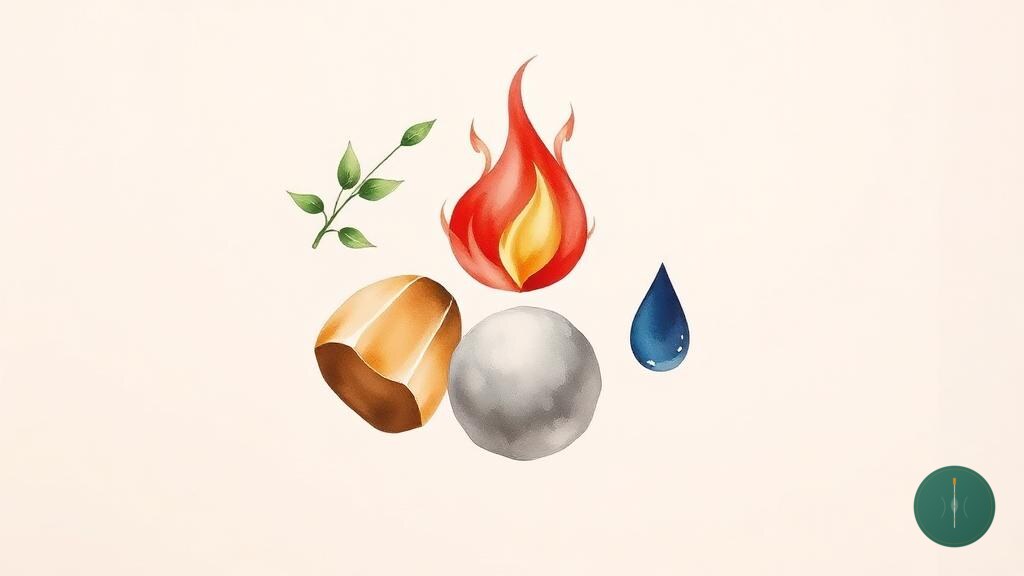
2. The Five-Element Sheng (generating) cycle — Wood → Fire → Earth → Metal → Water → Wood.
3. The Five-Element Ke (controlling) cycle — Wood ☐ Earth, Earth ☐ Water, Water ☐ Fire, Fire ☐ Metal, Metal ☐ Wood.
Every meridian is itself classified by element (e.g. Liver = Wood, Heart = Fire, Spleen = Earth). Within each meridian, every Five-Shu point is also classified by element. This produces a 12 × 5 matrix in which every needle has a precise elemental address.
Sa-am exploits this matrix to do one thing supremely well: restore balance to a deficient or excess meridian by simultaneously adding the right element from the mother and restraining pathology from the controller.
The Tonification & Sedation Formula
For any meridian, the Sa-am rule is built on two paired needles:
To tonify a deficient meridian:
- Tonify its own mother-element point — the Five-Shu point on its own meridian that matches the element preceding it on the Sheng cycle.
- Tonify the same-element point on its mother meridian — drawing energy in from the upstream organ.
- Sedate its own controller-element point — the Five-Shu point that matches the element which controls it.
- Sedate the same-element point on its controller meridian — restraining pressure from the controlling organ.
To sedate an excess meridian: the rule is the mirror image — sedate the child element pair, tonify the controller pair.
The result, in either direction, is exactly four needles: two tonified, two sedated. Hence the name Four-Needle Technique (사침법, sa-chim-beop).
Worked Example: Liver Deficiency Prescription
Liver belongs to Wood. Its mother on the Sheng cycle is Water (Kidney); its controller on the Ke cycle is Metal (Lung).
- Tonify LV8 (Qūquán) — the Water (mother) point on the Liver channel.
- Tonify KI10 (Yīngǔ) — the Water point on the Kidney channel (the mother organ).
- Sedate LV4 (Zhōngfēng) — the Metal (controller) point on the Liver channel.
- Sedate LU8 (Jīngqú) — the Metal point on the Lung channel (the controller organ).
Four needles. No local points. No ashi. The entire prescription lives below the elbows and knees, and addresses the Liver imbalance by generating it through Water and releasing the brake applied by Metal.
The 12 Standard Prescriptions at a Glance
Every Yin and Yang organ has its own tonification and sedation formula. The classical 12 are summarised below — a one-page reference any practitioner can keep at the desk.
| Meridian | Element | Tonification (보법) | Sedation (사법) |
|---|---|---|---|
| Lung | Metal | LU9 + SP3 / Tonify; LU10 + HT8 / Sedate | LU5 + KI10 / Tonify; LU10 + HT8 / Sedate |
| Large Intestine | Metal | LI11 + ST36 / Tonify; LI5 + SI5 / Sedate | LI2 + BL66 / Tonify; LI5 + SI5 / Sedate |
| Stomach | Earth | ST41 + SI5 / Tonify; ST43 + GB41 / Sedate | ST45 + LI1 / Tonify; ST43 + GB41 / Sedate |
| Spleen | Earth | SP2 + HT8 / Tonify; SP1 + LV1 / Sedate | SP5 + LU8 / Tonify; SP1 + LV1 / Sedate |
| Heart | Fire | HT9 + LV1 / Tonify; HT3 + KI10 / Sedate | HT7 + SP3 / Tonify; HT3 + KI10 / Sedate |
| Small Intestine | Fire | SI3 + GB41 / Tonify; SI2 + BL66 / Sedate | SI8 + ST36 / Tonify; SI2 + BL66 / Sedate |
| Bladder | Water | BL67 + LI1 / Tonify; BL54 + ST36 / Sedate | BL65 + GB41 / Tonify; BL54 + ST36 / Sedate |
| Kidney | Water | KI7 + LU8 / Tonify; KI3 + SP3 / Sedate | KI1 + LV1 / Tonify; KI3 + SP3 / Sedate |
| Pericardium | Fire | PC9 + LV1 / Tonify; PC3 + KI10 / Sedate | PC7 + SP3 / Tonify; PC3 + KI10 / Sedate |
| Triple Burner | Fire | TB3 + GB41 / Tonify; TB2 + BL66 / Sedate | TB10 + ST36 / Tonify; TB2 + BL66 / Sedate |
| Gallbladder | Wood | GB43 + BL66 / Tonify; GB38 + SI5 / Sedate | GB44 + LI1 / Tonify; GB38 + SI5 / Sedate |
| Liver | Wood | LV8 + KI10 / Tonify; LV4 + LU8 / Sedate | LV2 + HT8 / Tonify; LV4 + LU8 / Sedate |
Each row is a complete clinical session. Once the diagnosis is made, the prescription is fixed.
Diagnosis: How a Sa-am Prescription Is Chosen
Sa-am does not freelance. The needles are chosen by the diagnosis, and the diagnosis is reached classically — through the Four Pillars (inspection, listening/smelling, inquiry, and palpation, especially pulse), often layered with Korean Sasang constitutional medicine when the practitioner is trained in it.
Turn This Knowledge Into a Treatment Plan
Enter any Western diagnosis and get a complete TCM treatment protocol — acupuncture points, herbal formulas, moxibustion, cupping, and gua sha recommendations.
The clinical decision tree is essentially:
1. Identify the imbalanced organ — which Zang-Fu is deficient or excess?
2. Confirm the direction — is the pattern primarily one of vacuity (needs tonification) or repletion (needs sedation)?
3. Read off the prescription — apply the matching formula from the table above.
4. Assess after each session — Sa-am practitioners typically reassess pulse and tongue session-to-session, switching prescriptions as the picture evolves.
The discipline of fixing the prescription before needling is part of why students often find Sa-am unexpectedly demanding: there is nowhere for fuzzy thinking to hide.
What Sa-am Treats Well
Korean clinical reports and small trials suggest Sa-am performs especially well in:
- Functional digestive disorders — bloating, functional dyspepsia, IBS-like presentations. A 2022 randomised feasibility trial in Evidence-Based Complementary and Alternative Medicine tested a Sa-am protocol against sham acupuncture for functional dyspepsia and demonstrated acceptable feasibility, good adherence, and a signal of symptom benefit on the Nepean Dyspepsia Index (Lee B et al., 2022).
- Stress-driven autonomic dysregulation — palpitations, mild hypertension, sleep disturbance. A small clinical study found that the Heart-tonification Sa-am protocol (Simpo-jeongkyeok) produced measurable changes in blood pressure, pulse rate, and body temperature, suggesting genuine autonomic engagement (Choi WJ et al., 2015).
- Chronic inflammatory skin disease — case reports describe sustained remission of atopic dermatitis (Jeon YC et al., 2016) and psoriasis (Jeon YC et al., 2016) treated with Sa-am acupuncture combined with Korean herbal medicine.
- Constitutional patterns — Sa-am is a natural fit for patients whose imbalance is whole-body and pattern-based rather than locally structural.
It is generally not the first-line choice for acute structural musculoskeletal pain, where local needling, motor-point work, or trigger-point approaches usually outperform a purely distal Five-Element strategy.
Why "Fewer Needles, More Thinking" Is a Useful Discipline
A 2021 data-driven analysis of point-selection diversity across acupuncture styles in Journal of Clinical Medicine found that classical Five-Element styles like Sa-am cluster their selections far more tightly around the Five-Shu region than modern TCM, and that this constraint correlates with stronger theoretical coherence between diagnosis and prescription (Jang DY et al., 2021).
For practitioners trained in standard TCM, Sa-am offers three concrete benefits even when used as an occasional tool:
1. Diagnostic discipline — there is no point sneaking in extra needles to cover a fuzzy diagnosis.
2. Pattern thinking — every session reinforces the Sheng and Ke relationships in the practitioner's hands.
3. Patient comfort — four distal needles are dramatically less invasive than a 12-needle TCM dressing, which is invaluable for needle-sensitive patients, children, and elderly frail patients.
Practical Needling Notes
Sa-am has its own technique conventions that distinguish it from standard TCM needling:
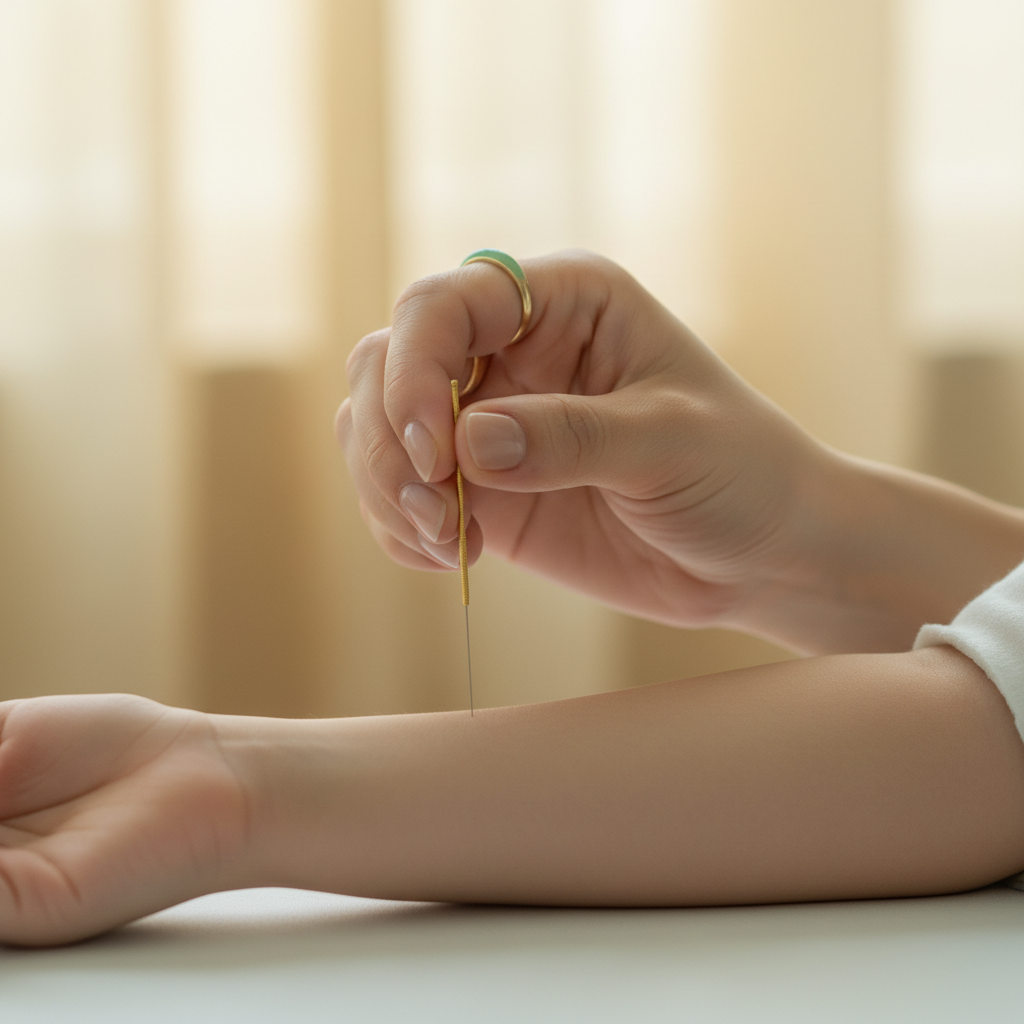
- Tonification (보법, bobeop) — needle inserted with the direction of meridian flow, gentle rotation, slow withdrawal, and the puncture site closed by pressure.
- Sedation (사법, sabeop) — needle inserted against the direction of flow, faster rotation, quick withdrawal, and the puncture site left open.
- Depth — generally shallow; Sa-am favours light, precise stimulation rather than deep needling, in keeping with the gentle Korean clinical tradition.
- Retention — typically 15–20 minutes, with reassessment of pulse mid-session.
Like the Japanese tradition, Sa-am rewards a refined needle technique. The four-needle constraint means that each needle must do its job exactly.
Where Sa-am Fits in a Modern Multi-Style Clinic
Sa-am sits naturally alongside — not against — TCM, Master Tung, scalp acupuncture, Japanese meridian therapy, and Esoteric acupuncture in a multi-style modern practice. Pragmatic patterns of integration include:
- Sa-am as the constitutional layer, with a few local TCM points added afterwards for symptomatic musculoskeletal pain.
- Sa-am alone for paediatric, geriatric, and needle-sensitive patients.
- Sa-am for stress-related visceral patterns (functional dyspepsia, palpitations, sleep) where systemic correction outperforms local needling.
- Sa-am as a "diagnostic test" — if a single Sa-am session shifts the pulse markedly, the practitioner has confirmed the working pattern.
A Closing Reflection
Sa-am asks the practitioner to commit — to a diagnosis, to a pattern, and to four very specific needles. There is no room to hedge. For practitioners willing to embrace that discipline, the reward is a system of remarkable elegance: an entire treatment, distilled to four points below the knees and elbows, expressing the full Five-Element correction in a single act.
Three hundred years after a monk in a Korean cave first formalised it, Sa-am still teaches us the same lesson: less needling, more thinking, always wins.
Explore More on Medi-Chi
- Korean Sa-am Acupuncture Reference — Interactive Five-Element diagram and the full 12 prescriptions
- Sa-am Point Selection Guide — All 12 prescriptions with indications and one-tap point links
- Koryo Hand Therapy (KHT) — Korean hand microsystem with 14 micro-meridians and self-care formulas
- Five Shu Points Explained — Foundations of Five-Element point classification
- Pulse Diagnosis Demystified — Reading the patterns Sa-am responds to
- Acupuncture Points Reference — Full point database with clinical indications
- AI Diagnosis Tool — Generate evidence-based treatment plans across 15 acupuncture styles, including Sa-am
Frequently Asked Questions
What is Sa-am acupuncture?
Why only four needles?
How is Sa-am different from TCM acupuncture?
Is Sa-am acupuncture supported by modern research?
All Citations Verified6/6
Every PubMed citation in this article has been manually verified against its source.
💡 💡 Tip: Press and hold on citation links to open them in your browser.
Derek Doran, BHSc (Acupuncture)
AHPRA Registered (CMR0002211465) · AACMA Member
Derek is the founder of MediChi and a registered acupuncturist with clinical expertise in integrating Western diagnoses with Traditional Chinese Medicine treatment protocols.
Clinically reviewed: April 23, 2026